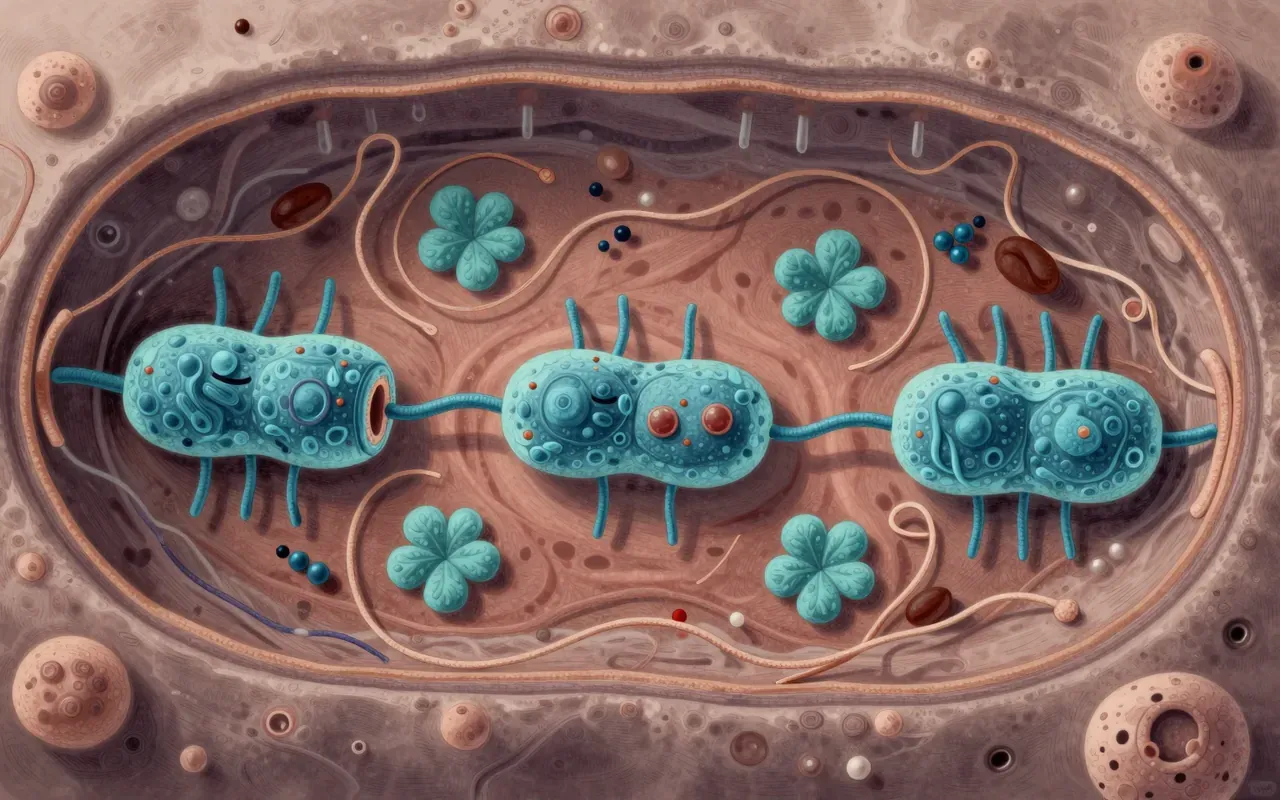
A machine made of RNA
The claim here is mechanical rather than dramatic: the ribosome is the cell’s translator, converting the sequence of a messenger RNA molecule into a chain of amino acids in a fixed and specific order. It does this by pairing each three-letter codon on the mRNA with a matching transfer RNA carrying the correct amino acid, then linking that amino acid to the growing chain. What makes the ribosome unusual among cellular machines is that its catalytic core, the site where the actual chemical bond between amino acids forms, is made of RNA rather than protein. The protein components of the ribosome are largely structural, holding the RNA scaffold in shape. This RNA-first architecture is treated as a significant clue about how translation itself may have originated.
Two subunits, one job
Every ribosome is built from two subunits, one smaller and one larger, each combining ribosomal RNA with a set of proteins. The material distinguishes prokaryotic ribosomes, which are smaller and roughly two-thirds RNA by mass, from the larger eukaryotic version, where RNA and protein sit closer to equal proportions. Mitochondria and chloroplasts carry their own ribosomes that resemble the bacterial type rather than the eukaryotic one, consistent with their proposed bacterial origins. The small subunit is responsible for reading the mRNA and checking that each incoming tRNA matches the codon correctly; the large subunit carries the site where the peptide bond actually forms. Archaeal ribosomes, despite being classed by the same size convention as bacterial ones, are described as structurally closer to the eukaryotic type.
From start codon to finished chain
Translation is described as a three-stage process bookended by defined start and stop signals. Initiation begins when the ribosome locates the start codon on the mRNA, which specifies the amino acid methionine and sets the reading frame for everything that follows. Elongation is the repetitive core of the process, with matching tRNAs delivering amino acids one at a time as the ribosome moves along the message and forms a new peptide bond at each step, a released tRNA making way for the next. Termination occurs when the ribosome reaches one of several stop codons, at which point a release factor detaches the finished chain rather than a tRNA delivering another amino acid. Multiple ribosomes commonly translate the same mRNA molecule at once, working independently along its length.
Seeing the machine
The discovery history given here runs from a first sighting to a fully resolved structure. Ribosomes were first observed under the electron microscope in the 1950s by George Palade, initially described under a more provisional name before the term ribosome was proposed to replace it. That observational work later shared recognition through a Nobel Prize awarded jointly to Palade and two colleagues for work on the cell’s internal structure. It took until the early 2000s for the atomic-level architecture of the ribosome’s two subunits to be resolved separately, using X-ray crystallography, and a Nobel Prize in Chemistry followed for the scientists who determined how the ribosome’s structure explains its mechanism. A complete structure of a eukaryotic ribosome came still later, and higher-resolution structures have continued to appear since.
One code, many outcomes
What the ribosome produces is only the first draft of a working protein, and the material is careful to keep that distinction visible. The amino acid chain that emerges from translation must fold into a specific three-dimensional shape before it can function, passing through recognised levels of structure from the raw sequence up to assemblies of multiple folded chains. On top of folding, proteins are commonly altered afterward through chemical modifications such as phosphorylation, methylation or the addition of sugar groups, changes that can switch a protein on, off, or into an entirely different role. This layering, from a linear code through translation, folding and modification, is presented as the reason a relatively small set of genes can produce a much larger range of functional proteins.
The idea still being argued
This is worth the time for anyone who wants the machinery behind a word used constantly and explained rarely. The translation sequence is laid out clearly enough to actually picture, and the discovery history gives a concrete sense of how something this small was first seen and then mapped atom by atom, which took the better part of half a century and two separate Nobel Prizes to complete. Where it earns extra credit is in flagging live uncertainty rather than pretending the field is finished: the specialised-ribosome hypothesis, the idea that not all ribosomes are functionally identical, is presented as a genuine open question rather than settled science. It is a dense read in places, but not a padded one.