Forty per cent of a 3.2-million-year-old skeleton
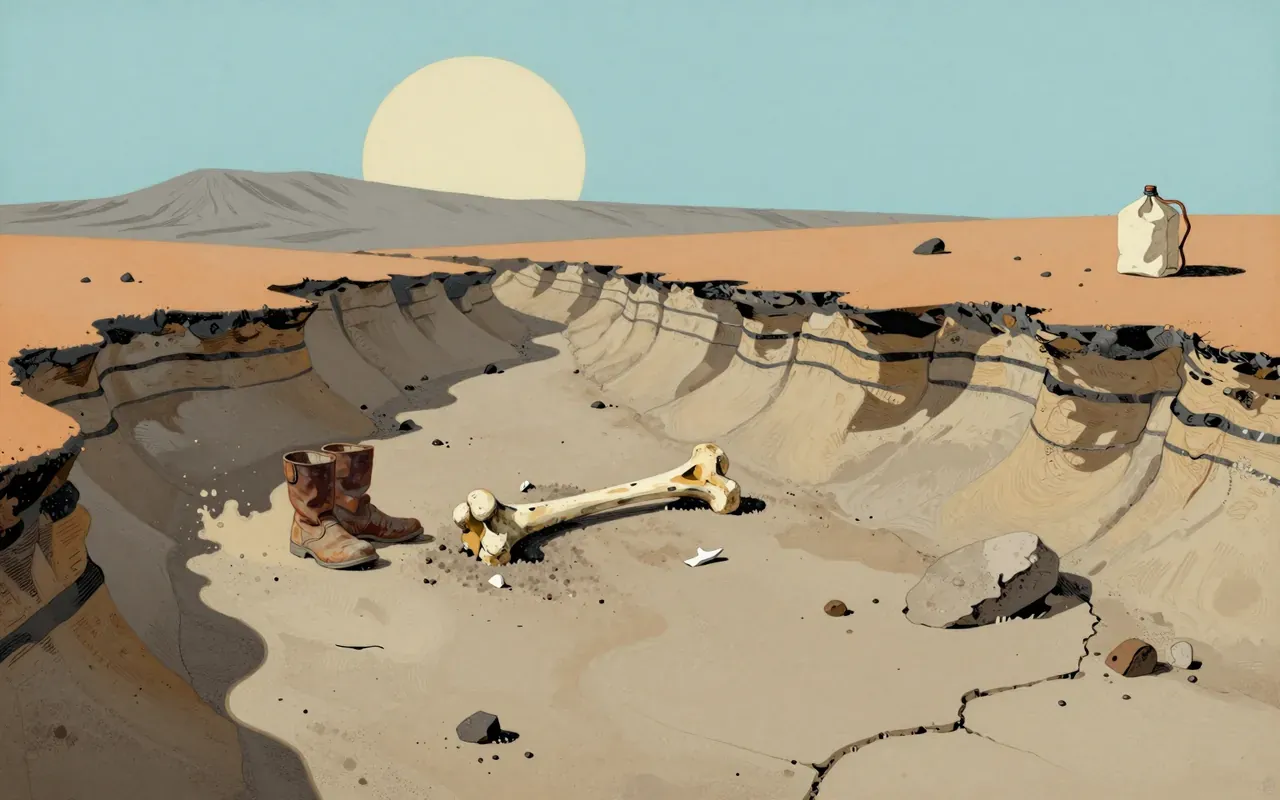
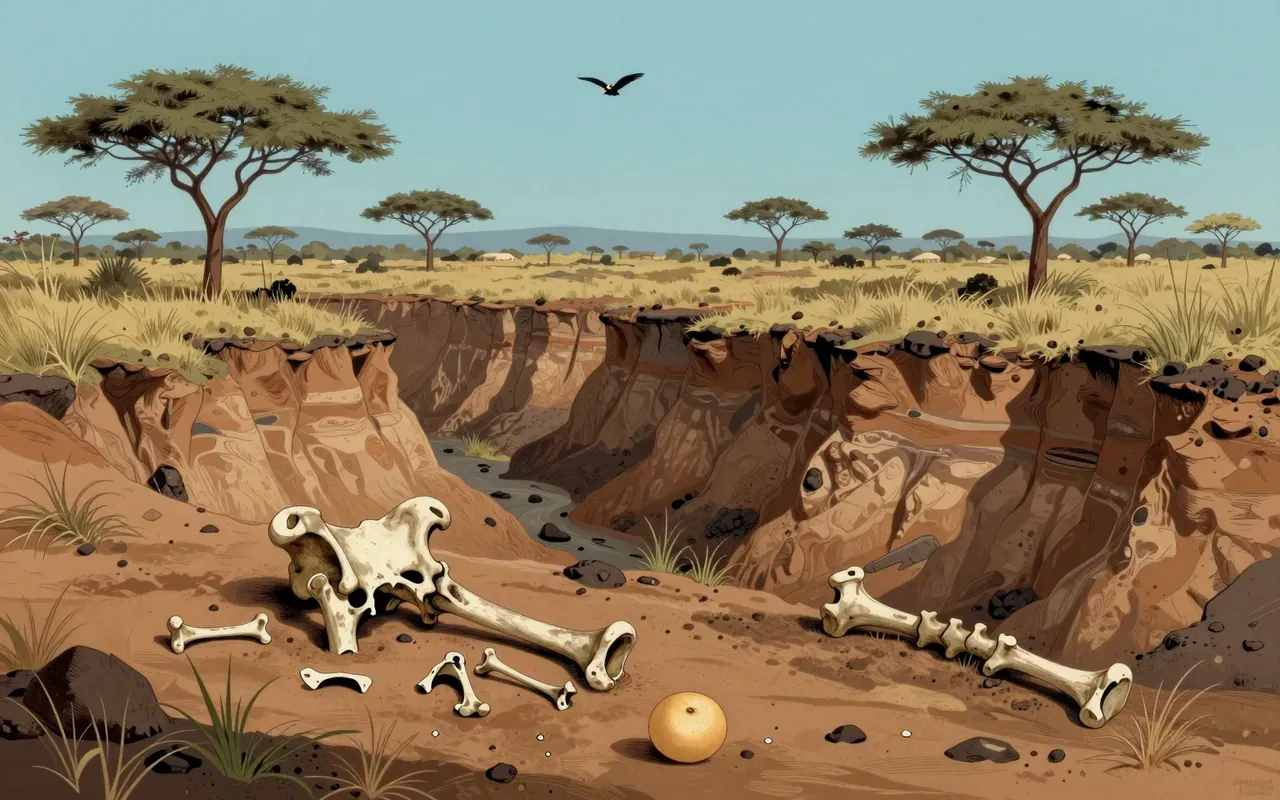
On 24 November 1974, Donald Johanson and graduate student Tom Gray found bone fragments on a gully slope near the Awash River in Hadar, Ethiopia, that turned out to be roughly forty per cent of a single skeleton, an unusually complete find for a hominin fossil that old. The skeleton, catalogued as AL 288-1 and nicknamed Lucy, was dated to about 3.2 million years old and assigned to Australopithecus afarensis, a species that lived across East Africa from roughly 3.9 to 2.9 million years ago. The claim her skeleton supported was specific: that upright, two-legged walking had evolved well before the large brains associated with later human ancestors, since Lucy’s leg and pelvis bones show clear adaptations for bipedalism while her brain, at somewhere between 375 and 500 cubic centimetres, was still comparable in size to a modern ape’s.
A knee, a pelvis, and footprints in ash
The case for Lucy walking upright rests on several specific anatomical details rather than a single feature: a valgus knee, in which the femur angles inward toward the body’s centreline the way it does in habitual bipeds rather than knuckle-walkers, a pelvis and sacrum shaped to support an upright torso, and a lumbar curve in the spine consistent with standing rather than a permanently bent posture. Two years after Lucy’s discovery, in 1976, Mary Leakey’s team found direct, physical confirmation of the same conclusion at Laetoli in Tanzania: footprints preserved in volcanic ash, left by afarensis individuals walking across wet ash roughly the same age as Lucy. One trackway extended thirty-two metres and showed a walking speed slower than a modern human’s, with a more bent-limbed gait, evidence for a real but less efficient form of bipedal walking than humans use today.
Walking before a big brain
The core finding, that afarensis walked upright on two legs while retaining a small, ape-sized brain, has held up over five decades of subsequent research and further fossil discoveries across Hadar, Laetoli and other East African sites. It decisively separated bipedalism from brain expansion in the timeline of human evolution: whichever pressures favoured walking upright, they operated long before anything resembling a large human brain existed, contradicting an older assumption that intelligence and upright posture evolved together. Later specimens, including a 2.8-million-year-old jaw fragment found decades after Lucy, have extended the picture of afarensis and its possible descendants without overturning the basic sequence her skeleton first demonstrated.
Long arms, open questions
What Lucy’s skeleton does not settle is how afarensis actually lived day to day, or how directly it connects to modern humans. Her arm-to-leg proportions, with arms notably long relative to her legs compared with modern humans, have kept alive a genuine debate over whether the species retained real tree-climbing ability as part of its normal behaviour or simply inherited long arms from an earlier ancestor without using them arboreally. Whether afarensis is a direct ancestor of the genus Homo, rather than a side branch, also remains contested, since some researchers argue its jaw anatomy is too specialised, too similar to later robust australopithecines, to fit comfortably as a direct human ancestor. Even the question of what environment afarensis mainly occupied has shifted over time, with more recent analysis favouring wooded grassland over open savanna.
A body that reframed the question
Lucy mattered immediately beyond palaeontology because she gave the abstract idea of a bipedal ape-like ancestor a physical, nearly complete body to point to, which reshaped both scientific and public understanding of human origins. The finding that walking evolved before large brains reframed a central question in the study of human evolution, away from asking what made our ancestors smart enough to stand upright and toward asking what advantage upright walking itself offered a small-brained hominin navigating a mixed woodland and grassland environment. Her skeleton has also remained a live subject of scientific inquiry rather than a settled museum piece: a 2016 study proposed she died falling from a tree, an interpretation her original discoverer disputed, and as recently as 2024 researchers were still refining what her specific habitat and the coexisting hominin species around her actually looked like.
Still argued over, fifty years on
This is worth the time both for the science and for how unusually well the story is documented from the moment of discovery onward: a specific date, a specific gully, a specific percentage of skeleton recovered, and two years later a set of footprints that confirmed the same conclusion by an entirely different method. It rewards attention to the anatomical detail, the valgus knee, the pelvis shape, the arm-to-leg ratio, since those specifics are what actually carry the argument rather than the more general claim that Lucy “proves” bipedalism came first. Readers should expect genuine, still-open debates rather than a fully closed case, particularly around her species’ place in the human lineage and how much time it spent in trees. Fifty years on, she remains argued over rather than merely displayed.