What the work claims
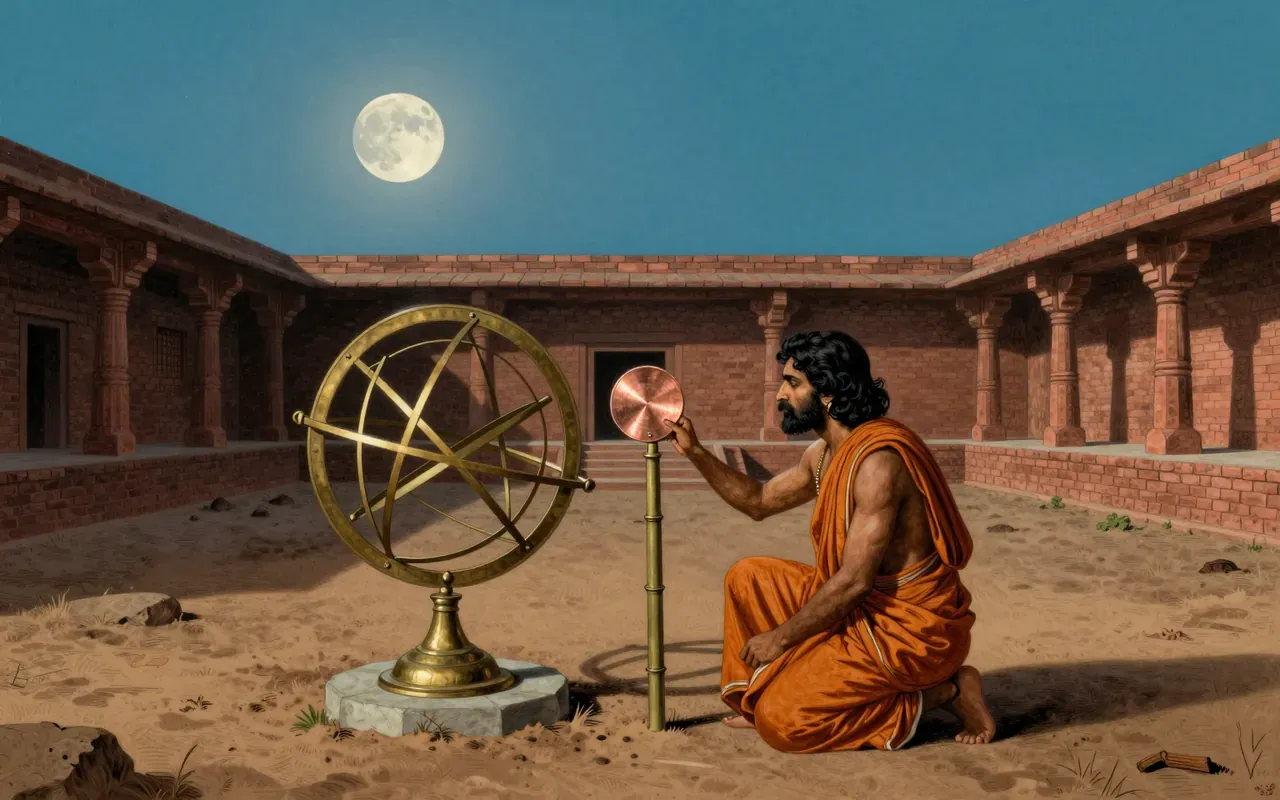
Earth rotates daily on its axis. The Moon and planets shine by reflected sunlight. Lunar eclipses occur when the Moon enters Earth’s shadow. π ≈ 3.1416, and may be irrational. Sine is defined as half-chord. First-order Diophantine equations can be solved via kuṭṭaka. The sidereal day is 23h 56m 4.1s. The sidereal year is 365d 6h 12m 30s.
How it was done
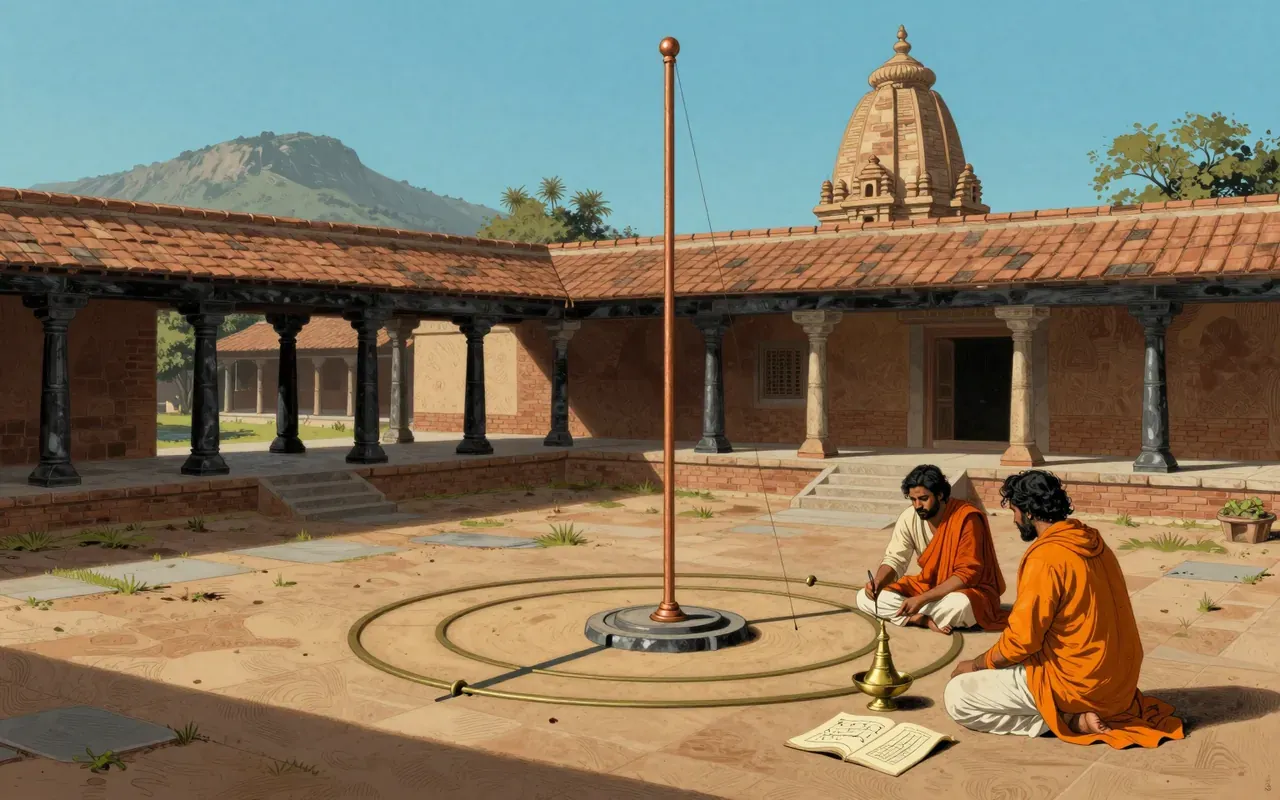
Aryabhata used geometric reasoning, shadow observations, and chord-based trigonometry to model celestial motion. He derived Earth’s sidereal rotation and year from observational astronomy. He defined sine as ardha-jya (half-chord) and solved Diophantine equations using the kuṭṭaka algorithm.
What holds up
His sidereal day (23h 56m 4.1s) matches the modern value to within 0.009 seconds. His eclipse theory correctly identifies Earth’s shadow as the cause of lunar eclipses. His reflected-light model for Moon and planets aligns with observation. His definition of sine as ardha-jya is a documented conceptual origin.
What does not
The material does not support claims that Aryabhata proved Earth’s rotation, measured π experimentally, or established irrationality formally. It says only that he ‘may have come to the conclusion’ about π’s irrationality — no mechanism, proof, or argument is given.
Why it matters beyond the lab
Aryabhata’s work shows that non-Western mathematical astronomy achieved high empirical precision and conceptual abstraction centuries before similar developments elsewhere — without implying priority, influence, or continuity, only that it happened.
Is it worth your time
Yes. Aryabhata’s methods and results remain pedagogically central to histories of astronomy and mathematics — not because they are still used, but because they show how precise quantitative models emerged without telescopes, calculus, or modern algebra.