Perception without a middleman
The claim at the centre of Gibson’s ecological approach is that perception does not require an intermediate step of internal mental construction to make sense of raw sensory input. Rather than treating the eye as delivering ambiguous shapes and colours that the brain must then interpret and represent, Gibson argued that an animal perceives its environment directly in terms of what it offers for action, given that animal’s particular body and capabilities. This put him at odds with both major psychological traditions of his time: behaviourism, which treated perception as stimulus and response without reference to meaning, and cognitivism, which held that perception depended on internal representations built up by the brain. Gibson’s alternative, that environment and animal are not separable items but form perception together, became the foundation of what he called ecological psychology.
A word for what a thing offers
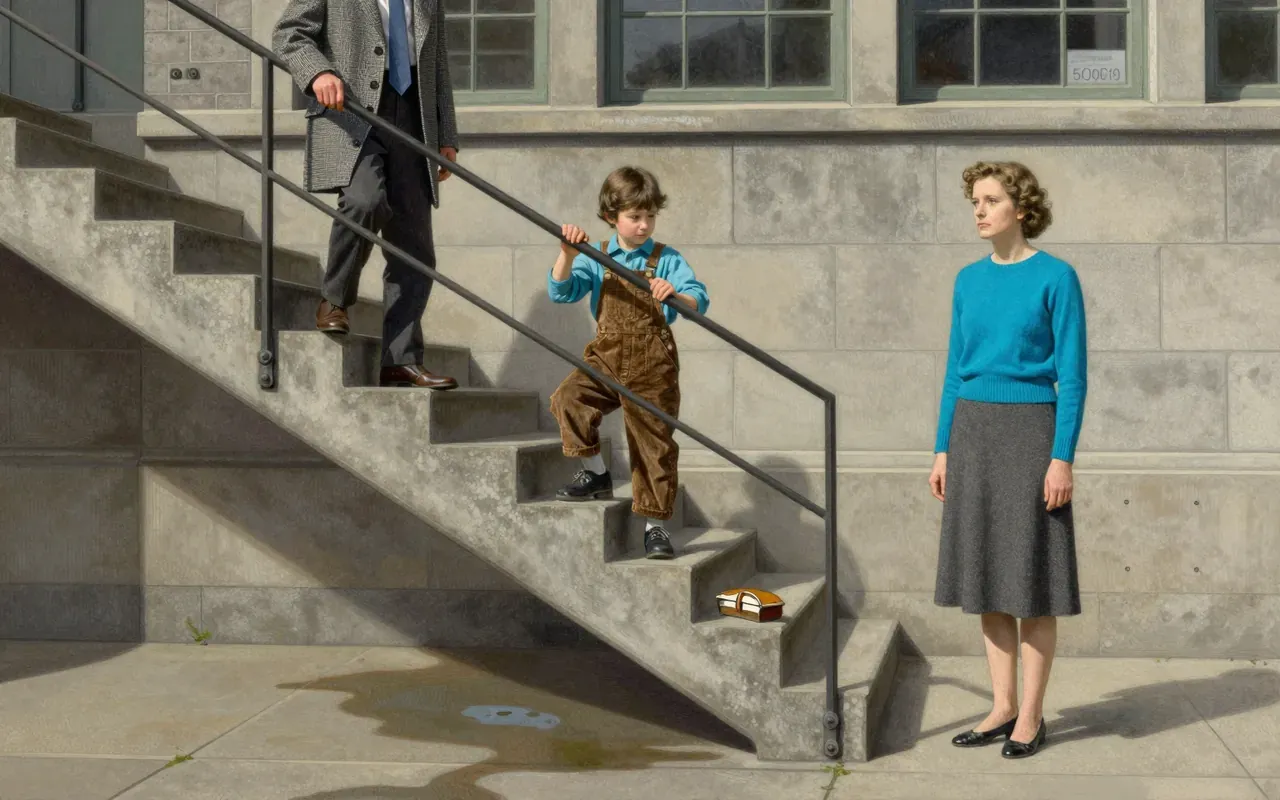
Gibson developed this framework over a long career, most of it spent at Cornell University from 1950 onward. Some of his earliest applied research came from studying how flight affected pilots’ visual perception during the Second World War, work that fed directly into visual aptitude tests used to screen pilot candidates. He introduced the term affordance in his 1966 book, The Senses Considered as Perceptual Systems, to describe what a given feature of the environment offers a particular animal, such as a set of stairs affording climbing to an adult of the right proportions, and developed the concept fully in his 1979 book, The Ecological Approach to Visual Perception. His wife, Eleanor Jack Gibson, whom he married in 1932, contributed closely related research, including the well-known visual cliff experiment demonstrating that crawling infants perceive depth and avoid an apparent drop.
Wartime cockpits and crawling infants
What has held up, and spread far beyond academic psychology, is the basic usefulness of thinking about objects and environments in terms of the action possibilities they present. Affordance theory is now applied across industrial design, human-computer interaction, robotics, fire-safety planning, language education, and even criminology, a breadth of adoption that suggests the underlying idea is doing real explanatory work rather than functioning as a purely academic label. In robotics specifically, teaching a machine to recognise an object’s affordances, such as where a hammer can be gripped effectively among its many theoretically possible contact points, remains an active and genuinely difficult research problem. There is also direct neurological support for something like automatic affordance perception: a 2002 study found that simply viewing an object primes the brain to perform the action it affords, even without any intention to act.
A concept that escaped psychology
What has not held up cleanly is a single, agreed meaning for the term itself. Gibson’s original definition covered any theoretically possible action a feature of the environment supports for a given animal, including uses that are unlikely or unconventional, such as sitting on a ball or throwing a chair. Donald Norman’s influential 1988 book for designers narrowed this considerably, defining affordances as only the action possibilities a person can readily perceive, a version of the concept Gibson himself never actually used, since he never referred to action possibilities in his own writing. Norman later acknowledged, in 2013, that this narrowing had been unintentional, and introduced a separate term, signifiers, specifically to describe how a design communicates which actions are actually available, particularly on digital interfaces that lack the physical cues Gibson’s original examples relied on. The two definitions of affordance now coexist in the literature, a source of ongoing confusion rather than a settled resolution.
One word, two meanings
The practical stakes of getting this right show up directly in design and safety work. A well-designed evacuation route, using clear signage and unobstructed pathways, is meant to afford rapid escape during an emergency in exactly the sense Gibson intended, and researchers have tested affordance-based evacuation designs using both physical mock-ups and virtual reality to see whether people actually perceive and use the intended paths under pressure. In digital interface design, the split between Gibson’s and Norman’s definitions has real consequences: a button that looks pressable but is not, what William Gaver termed a false affordance, misleads users in a way that plain visual design without this theoretical framing might not catch as reliably. Robotics researchers building machines that must judge, from vision alone, whether and how an unfamiliar object can be grasped or used are applying the same underlying idea to a domain Gibson himself never anticipated.
Patching the gap with signifiers
Yes, and the value here is partly in watching a single, well-defined idea escape its original discipline and get reshaped by new users along the way. Gibson’s core claim about direct perception is a genuinely different way of thinking about how seeing works, worth encountering on its own terms rather than through the diluted version most people absorb secondhand through design jargon. The more unexpected reward is the story of the term’s own drift, from Gibson’s broad, philosophically grounded original sense through Norman’s narrower, practically useful revision, to Norman’s later admission that something had gone missing along the way. That is a genuinely instructive case study in how a scientific concept changes meaning as it moves into applied fields, and it is worth an hour for that alone.