What the work claims
That rough, chaotic-seeming natural forms are not formless — they exhibit statistical self-similarity and can be assigned fractional dimensions. That such structures are describable, nameable (‘fractal’), and generatable from iteration. That order resides in scaling relationships, not smoothness or symmetry.
How it was done
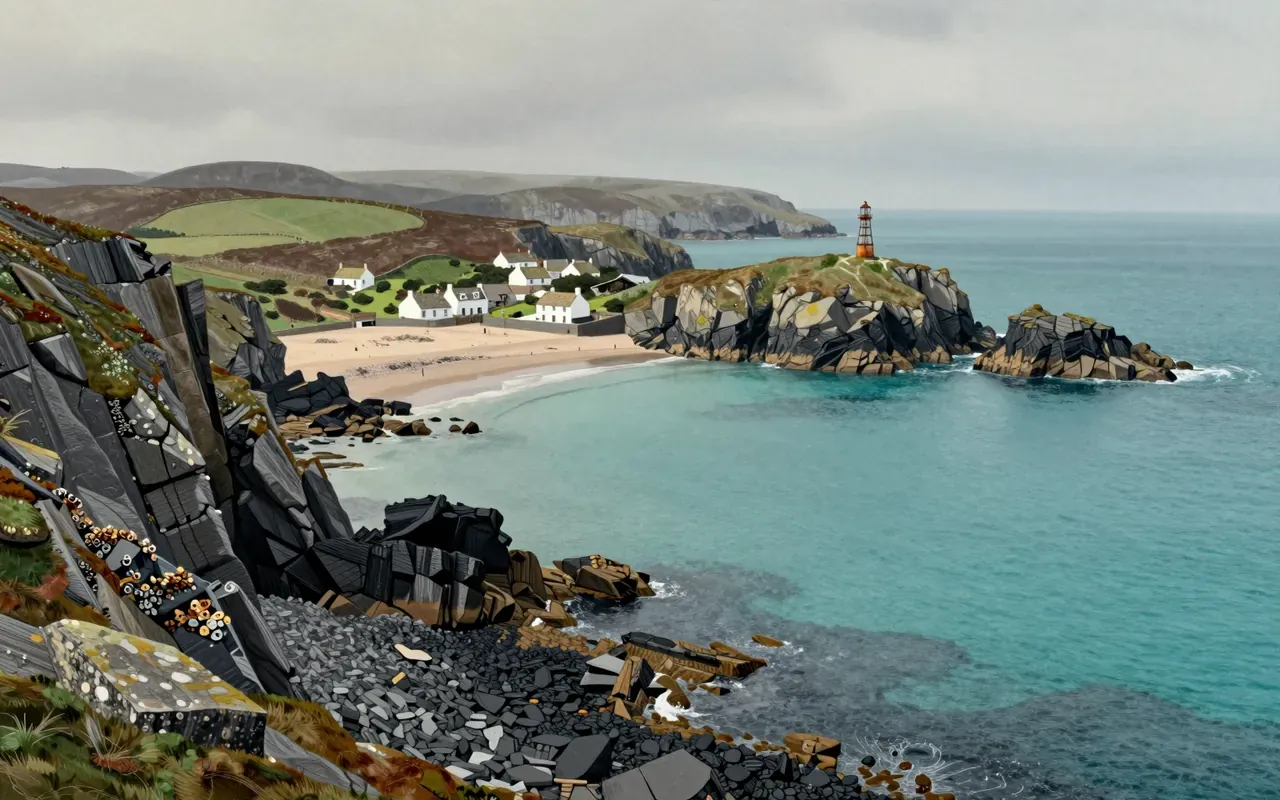
Mandelbrot used IBM’s computers to generate fractal images via computer graphics between 1979 and 1980. He plotted Julia sets while at Harvard, visualising the Mandelbrot set from late 1979 and publishing on it in 1980. He analysed self-similar curves using Hausdorff dimension in his 1967 Science paper on the coastline of Britain. He coined ‘fractal’ in 1975 and first published the concept in Les Objets Fractals.
What holds up
The demonstration that visual complexity arises from simple mathematical rules holds up. The assertion that rough natural phenomena — like clouds or shorelines — possess a degree of order holds up. The use of Hausdorff dimension to analyse self-similar curves in the 1967 coastline paper holds up. The discovery of the Mandelbrot set via computer visualisation in 1979–1980 holds up.
What does not
The work does not establish causality, predictive power, or universality. It does not quantify uncertainty, validate models against physical measurements, or resolve disputes about dimensionality in real-world systems. It does not claim fractals explain dynamics, only that they describe certain static geometries.
Why it matters beyond the lab
It changed how scientists, designers, and artists approach irregularity — shifting focus from smoothing noise to measuring scale-invariant structure. It enabled new ways to classify coastlines, terrain, and textures. But it did not replace classical geometry; it supplemented it where Euclidean assumptions fail.
Is it worth your time
Yes — if you need to understand how simple rules generate measurable complexity in natural forms. No — if you expect formal proof, predictive models, or engineering applications. The work is foundational for visual reasoning about roughness, not a toolkit.