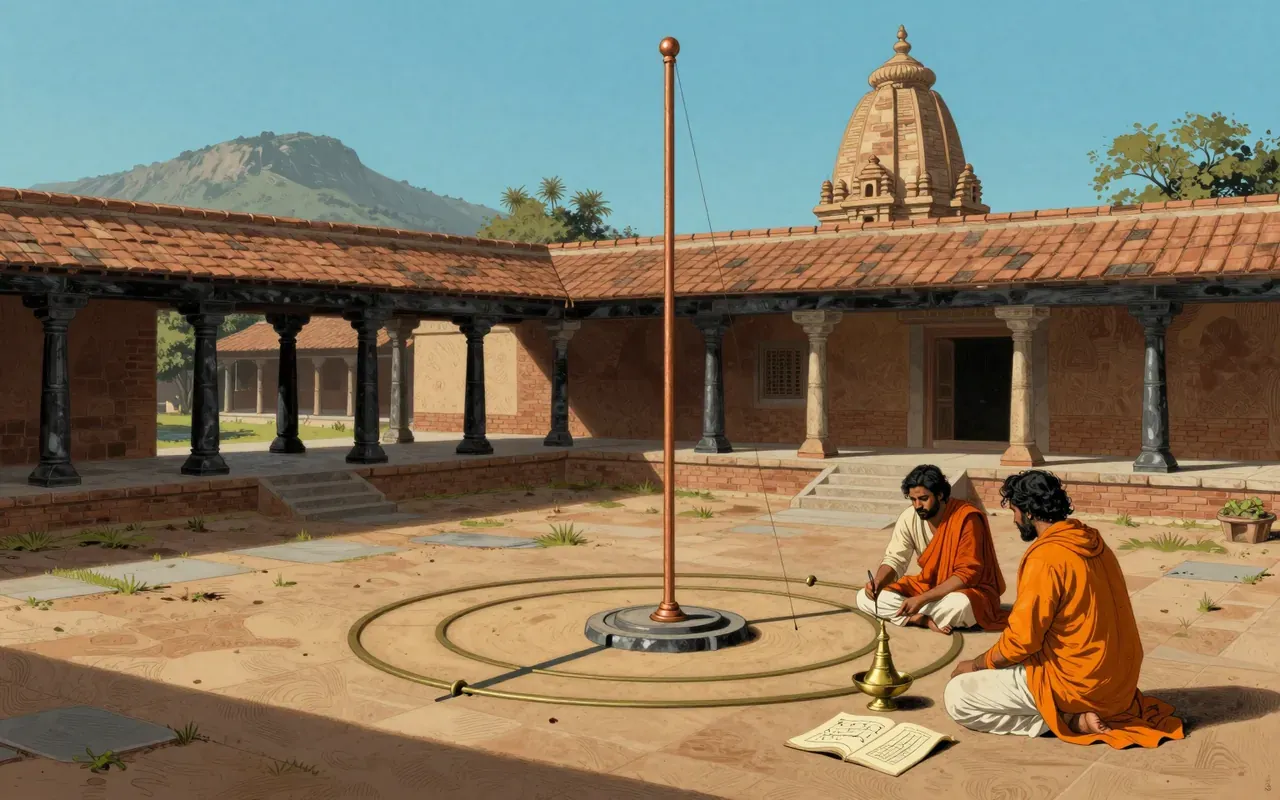
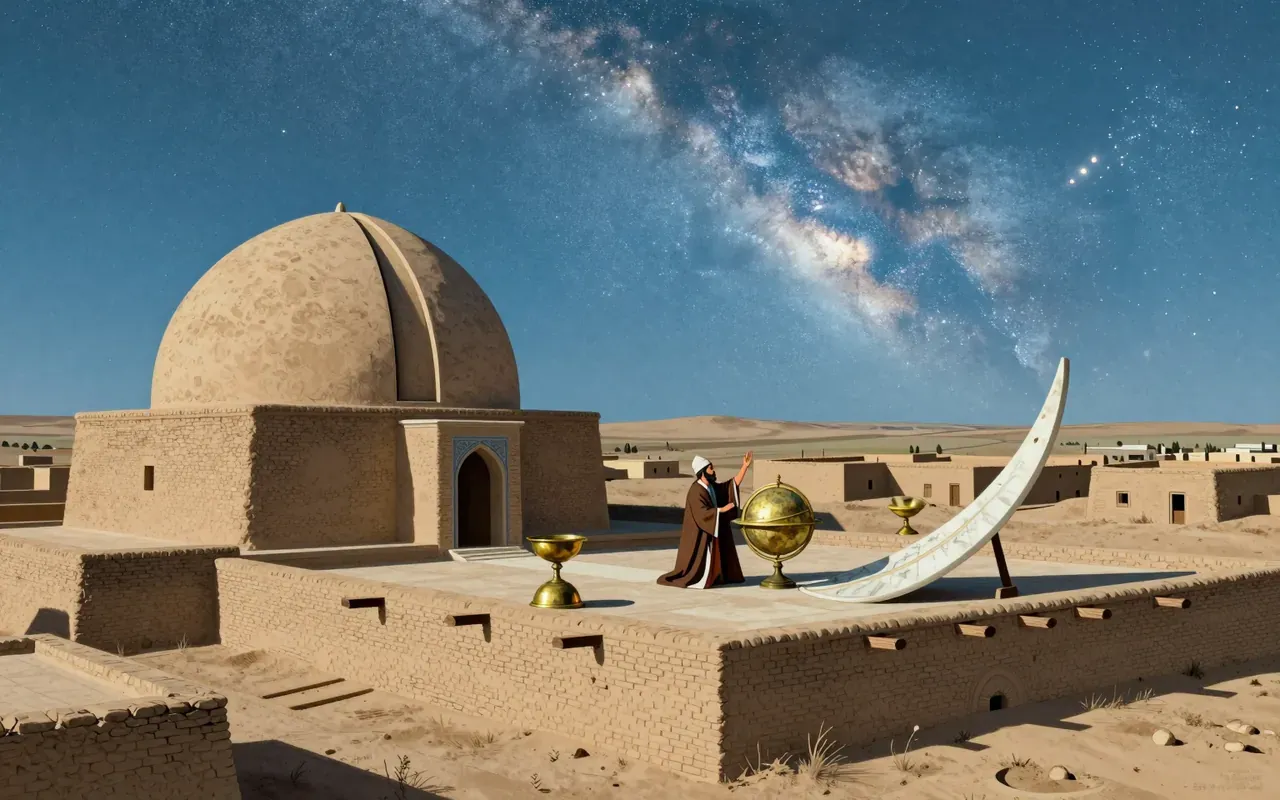
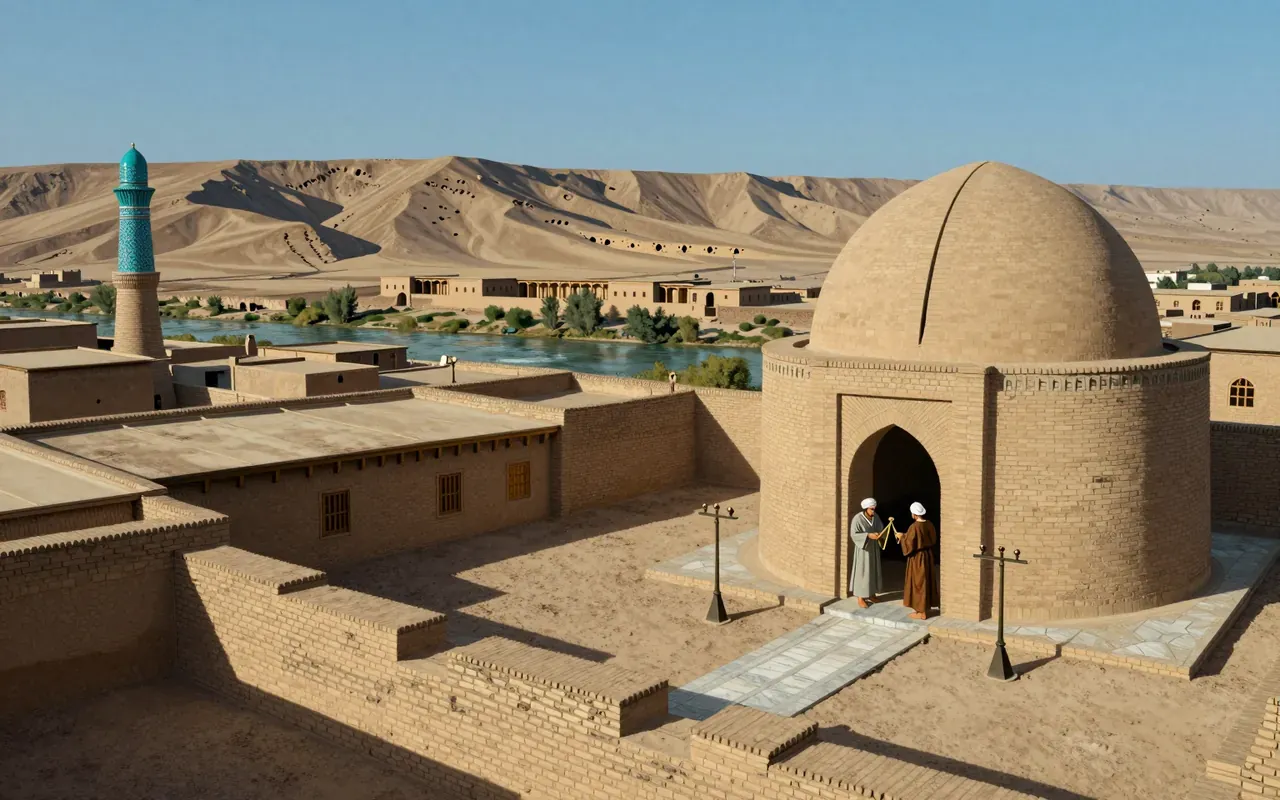
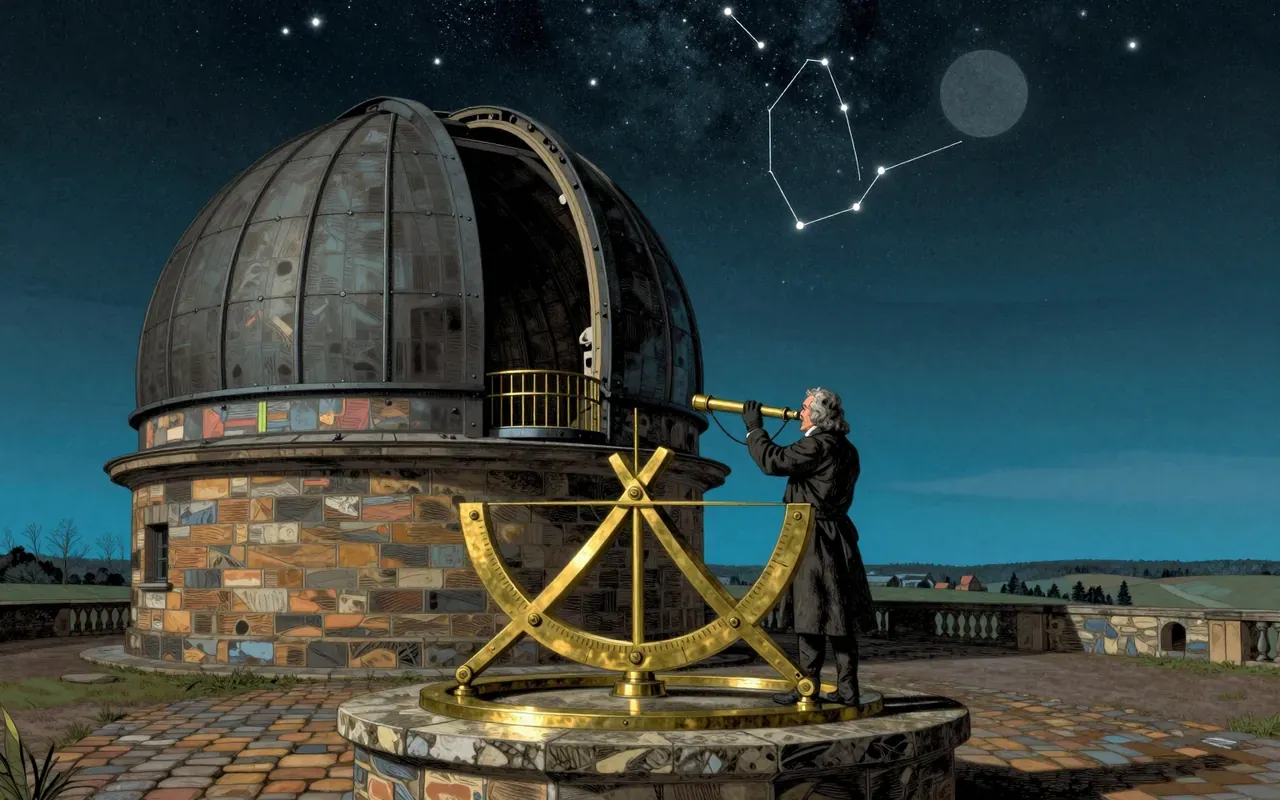
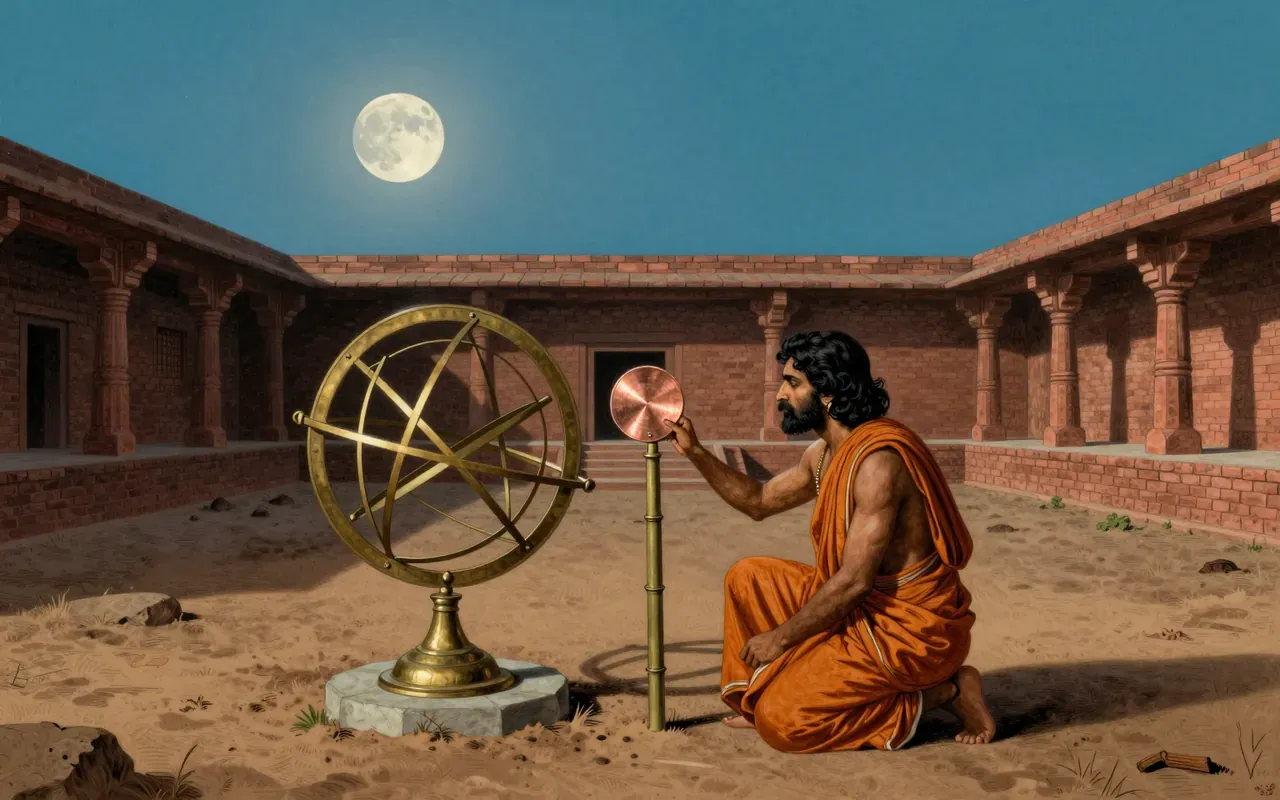
Bhāskara II didn’t invent calculus — but he derived its central insight while calculating planetary motion in Ujjain.
Bhāskara II’s work demonstrates that core analytical insights — linear approximation of trigonometric functions, algorithmic solution of quadratic Diophantine equations, and geometric-algebraic proof of Pythagoras — were achieved in 12th-century India through astronomical practice and treatise-based mathematics. His results hold up under verification. But he did not formalise derivatives, limits, or calculus as a discipline. The significance lies not in anticipation, but in independent, context-driven discovery — rooted in observation, instrumentation, and problem-solving at Ujjain.
He approximated sine differences with cosine — a functional precursor to the derivative — while tracking planets.
3:02
The First General Solution
He solved Pell’s equation x² − ny² = 1 generally using Chakravala — centuries before Europe.
4:38
Proofs Without Euclid
His two methods in Bijaganita are algebraic and geometric proofs of the Pythagorean theorem.
6:11
Motion at the Turning Point
He identified zero instantaneous variation at planetary extrema — an operational grasp of stationarity.
Worth your time?
Yes. Study the whole thing.
4.5/ 5
What works
The sine approximation holds for x ≈ y.
The Chakravala method solves x² − ny² = 1 generally.
His solution to 61x² + 1 = y² is verified.
His two methods in Bijaganita are equivalent to proofs of the Pythagorean theorem.
What does not
He did not develop the notion of a derivative.
He did not formulate a general theory of limits, rates of change, or infinitesimals.
His work does not constitute calculus as a system.
Study it if
Historians of science
Mathematicians interested in non-Western traditions
Astronomers studying pre-telescopic calculation
Skip it if
Students seeking introductory calculus
Researchers looking for algorithmic improvements to modern Diophantine solvers
The written brief1 min read
What the work claims
Bhāskara II’s work claims that trigonometric variation can be linearly approximated by cosine, that planetary motion has stationary points where variation vanishes, that Pell’s equation admits a general algorithmic solution, and that the Pythagorean relationship follows from algebraic and geometric constructions.
How it was done
Bhāskara II used geometric-algebraic reasoning in Bijaganita and Līlāvatī to derive relationships between triangle sides. He applied the cyclic Chakravala method to solve indeterminate quadratic equations, including Pell’s equation x² − ny² = 1. In astronomical calculations, he approximated sine differences using cosine and observed zero instantaneous variation at planetary extrema.
What holds up
The approximation sin(y) − sin(x) ≈ (y − x) cos(y) holds for x ≈ y. The Chakravala method solves x² − ny² = 1 generally. His solution to 61x² + 1 = y² is verified. His two methods in Bijaganita are equivalent to proofs of the Pythagorean theorem.
What does not
He did not develop the notion of a derivative. He did not formulate a general theory of limits, rates of change, or infinitesimals. His work does not constitute calculus as a system.
Why it matters beyond the lab
It repositions the history of mathematical analysis: key insights emerged from astronomical practice in 12th-century Ujjain, not only from 17th-century European mechanics. This challenges assumptions about where and how foundational ideas take root.
Is it worth your time
Yes — it reveals how rigorous, non-Western mathematical reasoning anticipated core ideas of calculus and number theory centuries before their formalisation in Europe, without relying on later conceptual frameworks.
Norman Myers set a strict numerical bar for calling a region a biodiversity hotspot, and the resulting list of places, covering a small slice of land but a huge share of species, has since directed hundreds of millions of dollars in conservation funding.