Two predictions, one testable difference
Einstein’s general theory of relativity, published in 1915, predicted that starlight passing close to the Sun would bend through an angle of about 1.75 arcseconds for a star seen right at the Sun’s edge, almost exactly double the roughly 0.83 arcseconds a straightforward Newtonian calculation of gravity’s pull on light would give. That factor-of-two gap gave astronomers an unusually clean test: rather than hunting for a subtle statistical trend across many observations, a single well-measured number, the apparent shift in a star’s position near the eclipsed Sun, could distinguish decisively between the two theories.
Two expeditions, one eclipse
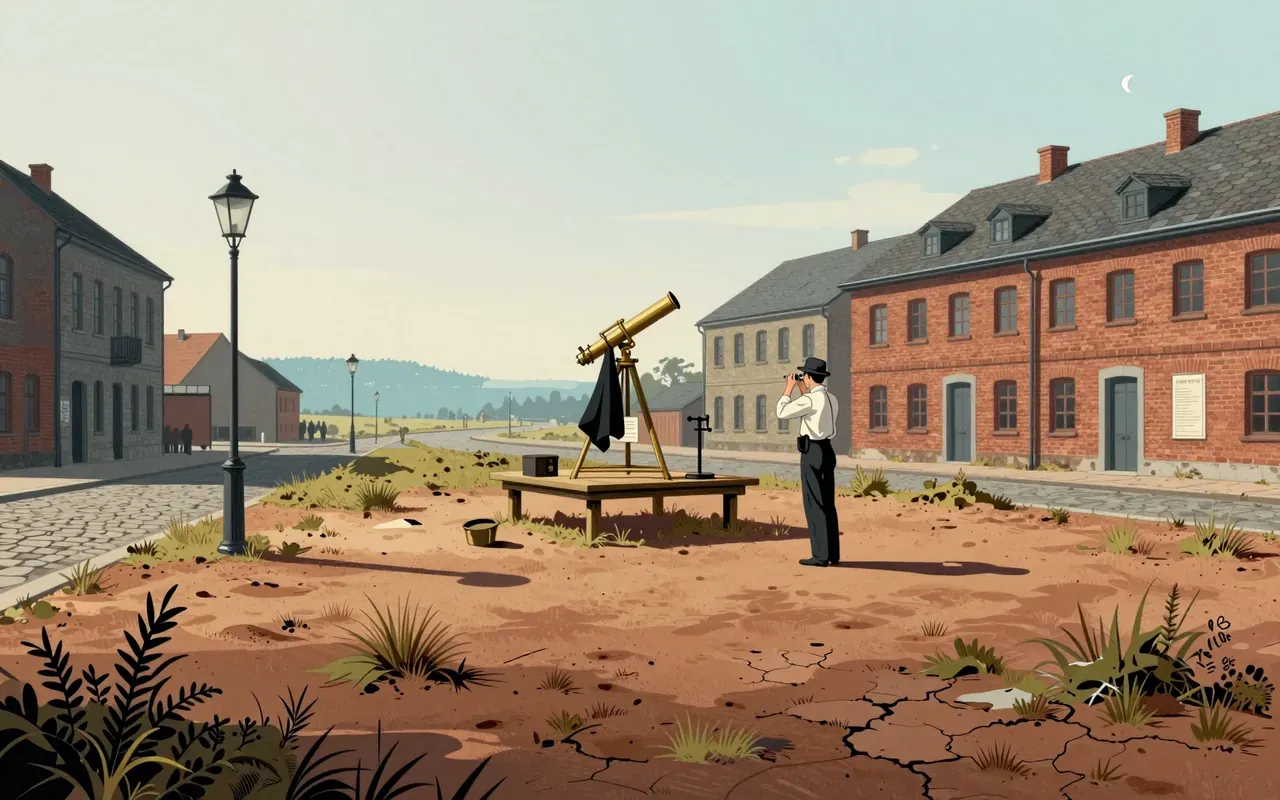
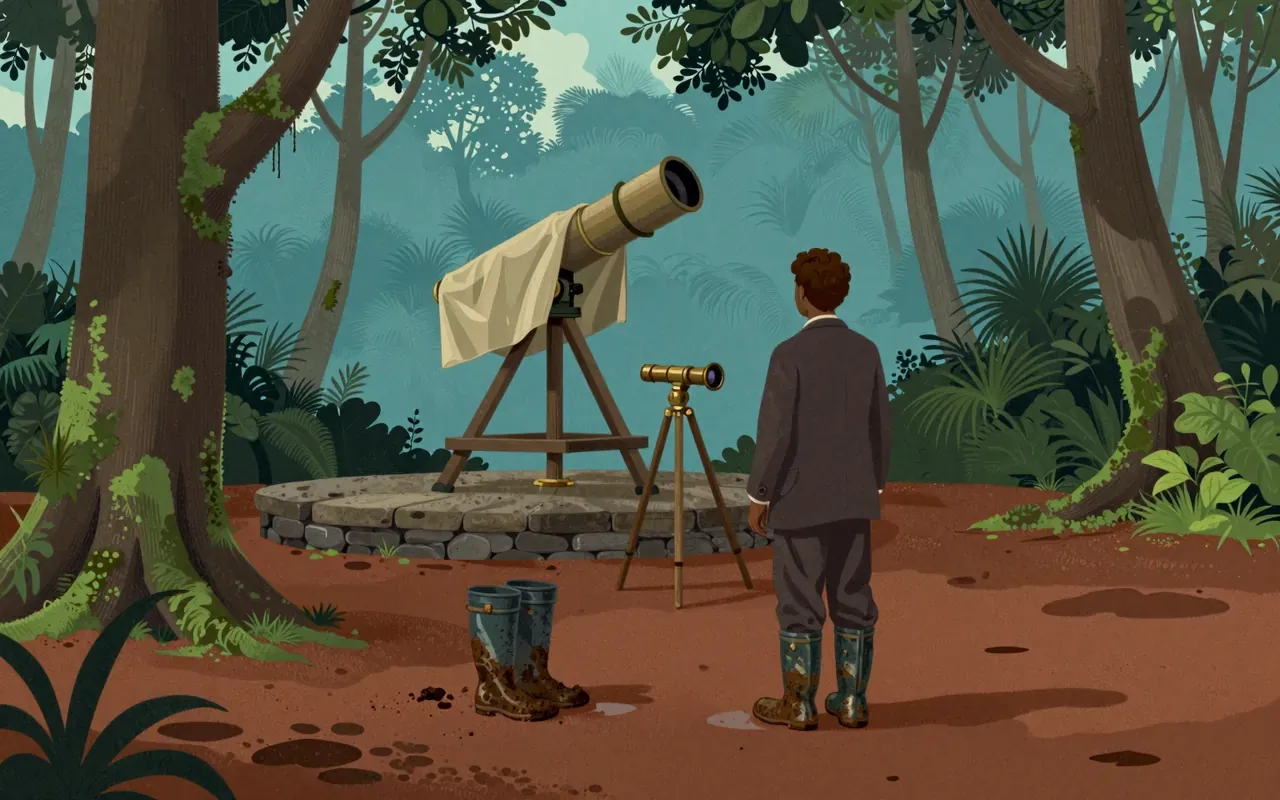
Arthur Eddington, secretary of the Royal Astronomical Society and one of the few British astronomers who fully understood Einstein’s mathematics, worked with the Astronomer Royal, Frank Dyson, to organise two expeditions to observe the total solar eclipse of 29 May 1919, when stars near the Sun would briefly become visible against a darkened sky. Eddington and Edwin Cottingham travelled to the island of Príncipe off West Africa, while Andrew Crommelin and Charles Davidson of the Greenwich Observatory travelled to Sobral in Brazil, arriving in March 1919. Both teams aimed to photograph stars, including some in the Hyades cluster, appearing close to the eclipsed Sun, then compare their positions against earlier night photographs of the same stars taken with the Sun nowhere nearby.
Clouds, blur, and a backup telescope
Conditions were difficult at both sites. Heavy morning rain and cloud at Príncipe compromised the sixteen photographs Eddington managed to take there, leaving fewer usable star images than the team had hoped for going into the observation. At Sobral, the expedition’s main 13-inch telescope produced blurred images, apparently because of unexpected heating effects on the instrument during the exposures, and only a smaller 4-inch backup telescope at the same site produced results clear enough to measure with real confidence. That backup telescope’s readings, together with the usable Príncipe plates, pointed toward Einstein’s predicted value of light deflection rather than toward the smaller Newtonian figure.
A result announced to the world
The results were announced at a joint meeting of the Royal Society and Royal Astronomical Society on 6 November 1919 and formally published the following year, presented as confirming Einstein’s prediction over the Newtonian figure. J.J. Thomson, president of the Royal Society, endorsed the conclusion at that meeting, and the story became major international news within days, an unusually fast transition for what was, on its face, a fairly technical astronomical measurement. That announcement is generally credited with turning Einstein from a respected physicist known mainly within his field into an international public figure almost overnight.
Whose data counted
The tidy public account leaves out a genuine complication: Eddington gave little weight to the blurred images from Sobral’s main 13-inch telescope, which on their own suggested a value closer to the Newtonian prediction, and relied instead on the Príncipe plates and Sobral’s smaller backup instrument, both of which favoured Einstein’s figure. By the 1970s, some historians and scientists had raised the concern that this selective weighting amounted to confirmation bias rather than a purely technical judgment, since setting aside the larger telescope’s readings, whatever the justification involving its known heating problem, meant the celebrated result rested partly on a discretionary choice rather than a single unambiguous measurement.
Vindicated, mostly
A 1979 re-examination of the original Sobral photographic plates, using measuring equipment far more advanced than what was available in 1919, largely supported Eddington’s original handling of the data and found his analysis less affected by bias than some of the later criticism suggested, though the episode remains a genuinely debated case rather than a fully closed one. Independent confirmation eventually came from an entirely different method: radio-astronomical measurements in the late 1960s directly confirmed the full relativistic deflection value with far greater precision than eclipse photography ever could. The story is worth an hour both for the elegance of the original test and for how much more complicated the real process behind its famous conclusion turns out to have been.