sciencebriefs
all subjects →
8:44in productionCh. 1 · The first inoculation/ 8:44 · ceiling 15 min
Medicine · Evolution

Edward Jenner

Jenner didn’t invent vaccination — he invented the human challenge trial.

Jenner’s 1796 experiment introduced the human challenge trial — not vaccination itself. He used cowpox material from Sarah Nelmes to inoculate James Phipps, then deliberately exposed him to smallpox material twice. Phipps remained disease-free. Jenner repeated this across 23 people and showed the protective material could be passed person-to-person. The work holds up as a controlled demonstration of acquired immunity via challenge. It does not establish population-level safety, statistical significance, or mechanism. Its enduring value lies in method: it treated immunity as a testable claim, not an assumption.

Chapters & takeaways5
  1. 0:57
    The first inoculation

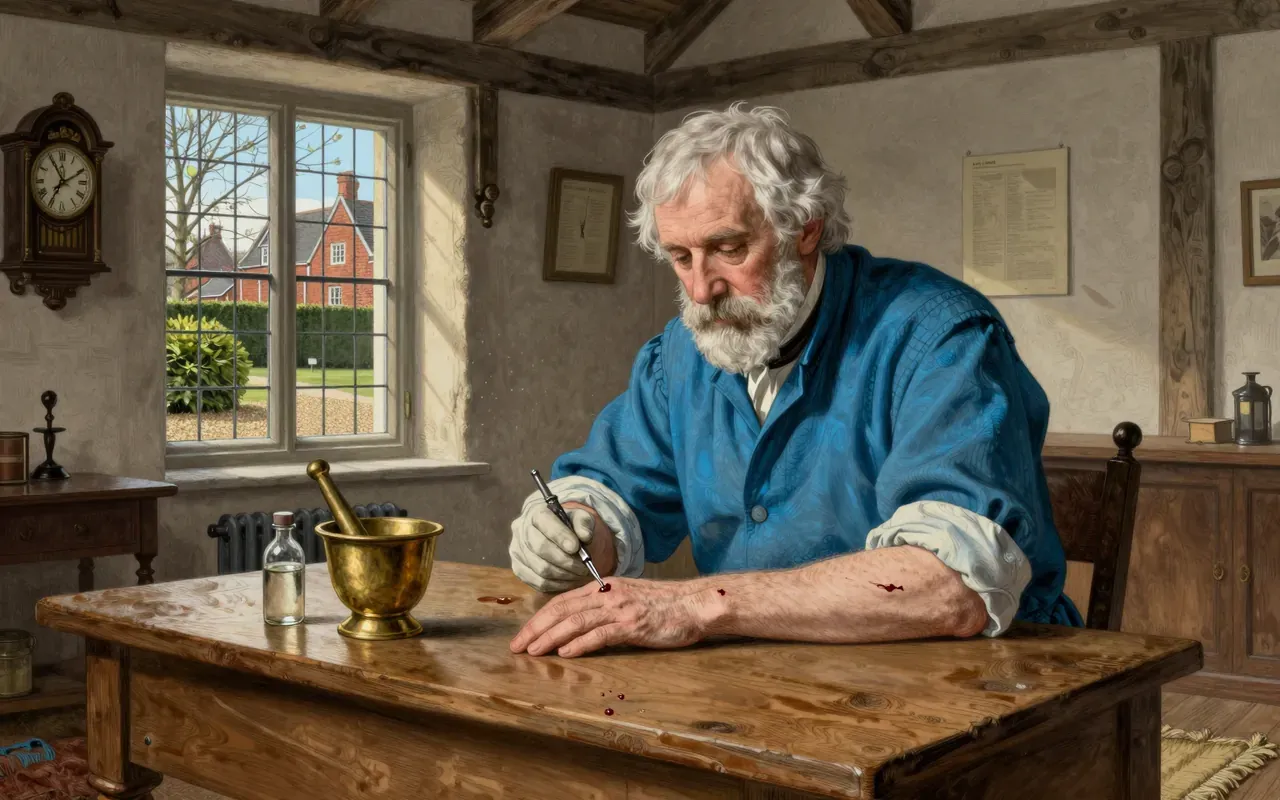
    Jenner took pus from Sarah Nelmes’s cowpox blisters and inoculated James Phipps on 14 May 1796.

  2. 2:09
    The challenge

    Phipps was challenged twice with variolous material — and showed no disease either time.

  3. 3:02
    What made it new

    Jenner’s contribution was not using cowpox — it was proving immunity by deliberate challenge.

  4. 4:08
    Person-to-person transmission

    Cowpox material retained protective effect when passed from person to person.

  5. 5:31
    Safety observed

    No full-blown infection followed cowpox inoculation. No breakthrough smallpox occurred in any recipient.

Worth your time?

Yes. Study the whole thing.

4/ 5
What works
  • established challenge as proof of immunity
  • demonstrated person-to-person transmission of protective material
  • showed cowpox inoculation produced no breakthrough smallpox in 23 subjects
What does not
  • invented vaccination
  • proved population-level safety
  • used controls or statistics
  • identified viral mechanism
Study it if
  • historians of science
  • vaccine developers
  • students of experimental design
Skip it if
  • general readers seeking origin stories
  • clinicians assessing modern vaccine protocols
The written brief1 min read

What the work claims

That inoculation with cowpox material confers immunity to smallpox — verified by direct challenge with variolous material.

How it was done

Jenner inoculated James Phipps with cowpox pus from Sarah Nelmes’s hands on 14 May 1796. He then challenged Phipps with variolous material on 1 July 1796 and again later. He repeated this across 23 subjects, including his infant son. He showed cowpox material could be passed person-to-person.

What holds up

Phipps developed only mild symptoms after cowpox inoculation. He showed no disease after two separate challenges with variolous material. No unexpected side effects occurred. No breakthrough smallpox occurred in any recipient. Jenner demonstrated person-to-person transmission of protective cowpox material.

What does not

The sources do not establish that Jenner discovered cowpox inoculation, invented vaccination, or proved its safety for populations. They do not report sample size beyond 23, error rates, statistical analysis, or long-term follow-up beyond absence of breakthrough smallpox.

Why it matters beyond the lab

It established challenge as evidence of immunity — a conceptual pivot from empirical observation to experimental proof. That logic underpins modern vaccine regulation, though the trial design lacked controls, blinding, or quantification.

Is it worth your time

Yes. It is the first documented use of controlled challenge to verify immunity in humans — a method still foundational to vaccine evaluation.

Same field · Medicine4 of 23
Up next in Science

Edward B. Lewis

· 11:02

Lewis didn’t just find new genes — he broke the gene open, then used the pieces to rebuild how we think about risk, development, and inheritance.

11:02