A key, a kite, and a storm
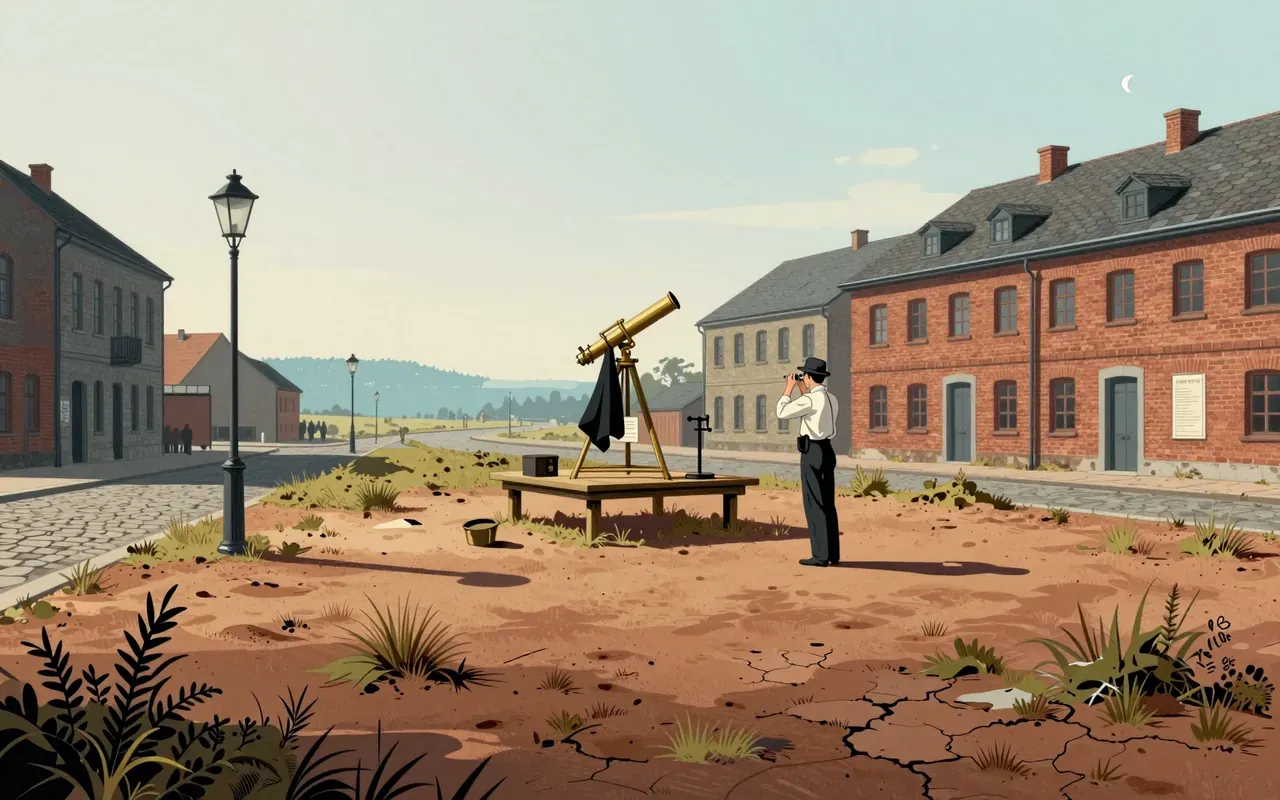
In June 1752, according to the account historian Joseph Priestley later published in 1767 based on Franklin’s own recollections, Benjamin Franklin flew a kite into a thunderstorm with his son William to test whether lightning and the electricity already being studied in laboratories were the same phenomenon. A metal key was tied to the end of the kite’s hemp string, with a dry silk cord between the key and Franklin’s hand acting as an insulator while he sheltered in an open shed to keep himself and the silk dry. The kite was not struck directly; instead, its proximity to a charged storm cloud induced a charge along the wet string, and Franklin noticed loose threads on the string standing apart, repelling one another the way objects carrying the same electrical charge do. He then touched the key and transferred the induced charge into a Leyden jar, an early capacitor used to store and study electrical charge.
Not the only test of the idea
The experiment’s core method was straightforward given what was already understood about electricity in the 1750s: if lightning behaved like the static electricity researchers could already generate and store, then a charge drawn from a storm cloud through a kite string should behave identically to charge from any ordinary electrical source, repelling similar threads and charging a Leyden jar the same way. Franklin was not working in isolation on this question. Thomas-François Dalibard had already conducted a related experiment using a tall iron rod at Marly-la-Ville, France, in May 1752, drawing sparks from a storm cloud without a kite at all, a demonstration that in some respects preceded Franklin’s own and tested a closely related version of the same underlying idea using different apparatus.
A conclusion that never wavered
The underlying claim, that lightning and laboratory electricity are the same phenomenon, has held up completely and is no longer in any scientific doubt. Franklin turned the finding into a genuinely practical invention almost immediately: the lightning rod, a grounded metal conductor mounted on a building to safely channel a lightning strike into the earth rather than through the structure itself, applying the same principle the kite experiment illustrated to a concrete engineering problem. The lightning rod worked as intended and spread into wide practical use, making Franklin’s electrical work stand out among eighteenth-century natural philosophy for how quickly a theoretical demonstration turned into a piece of everyday protective technology, still built on the same basic principle centuries later.
From demonstration to lightning rod
What remains genuinely uncertain is not the physics but the precise history of the event itself. Franklin’s own account, published as a letter in the Pennsylvania Gazette in October 1752, did not clearly state whether he personally carried out the experiment exactly as later popularly described, and the widely repeated version of events rests substantially on Priestley’s 1767 retelling, based on what Franklin told him years after the fact, rather than on a contemporaneous, independently witnessed record. This gap between the celebrated story and the available documentation is precisely why some historians treat the kite experiment’s exact details with caution, distinct from questioning whether Franklin’s broader conclusion about lightning and electricity was correct, which is not in dispute.
A fatal replication
The stakes of testing this idea directly turned out to be real rather than merely theoretical: Georg Wilhelm Richmann, attempting to replicate a similar lightning-drawing experiment in Saint Petersburg in August 1753, was killed when he was struck by an unexpected discharge, a stark demonstration that the phenomenon Franklin and Dalibard had investigated was genuinely dangerous and not merely a curious laboratory effect scaled up. That single, fatal outcome underscores why the kite experiment’s core claim mattered practically as well as scientifically: understanding lightning as electricity meant it could, in principle, be redirected and controlled, which is exactly what the lightning rod that followed set out to do, protecting buildings from an already well-documented hazard rather than an unexplained natural terror.
A famous scene, thinly documented
This is worth the time as a compact example of how a famous scientific story can be simultaneously true in its conclusion and uncertain in its specific retelling, a distinction worth holding onto rather than collapsing into either full belief or dismissal. The physics Franklin was testing, that lightning and ordinary electricity share the same nature, checks out entirely and led directly to a still-used piece of protective technology. The historical record around the kite itself, resting on a secondhand account published fifteen years after the fact, is thinner than the popular image of Franklin in a thunderstorm suggests, and readers should treat the vivid details, the key, the silk string, the shed, as a plausible reconstruction rather than a firmly documented eyewitness record. Both the caution and the underlying science are worth taking seriously here.