Pollen grains that wouldn’t sit still
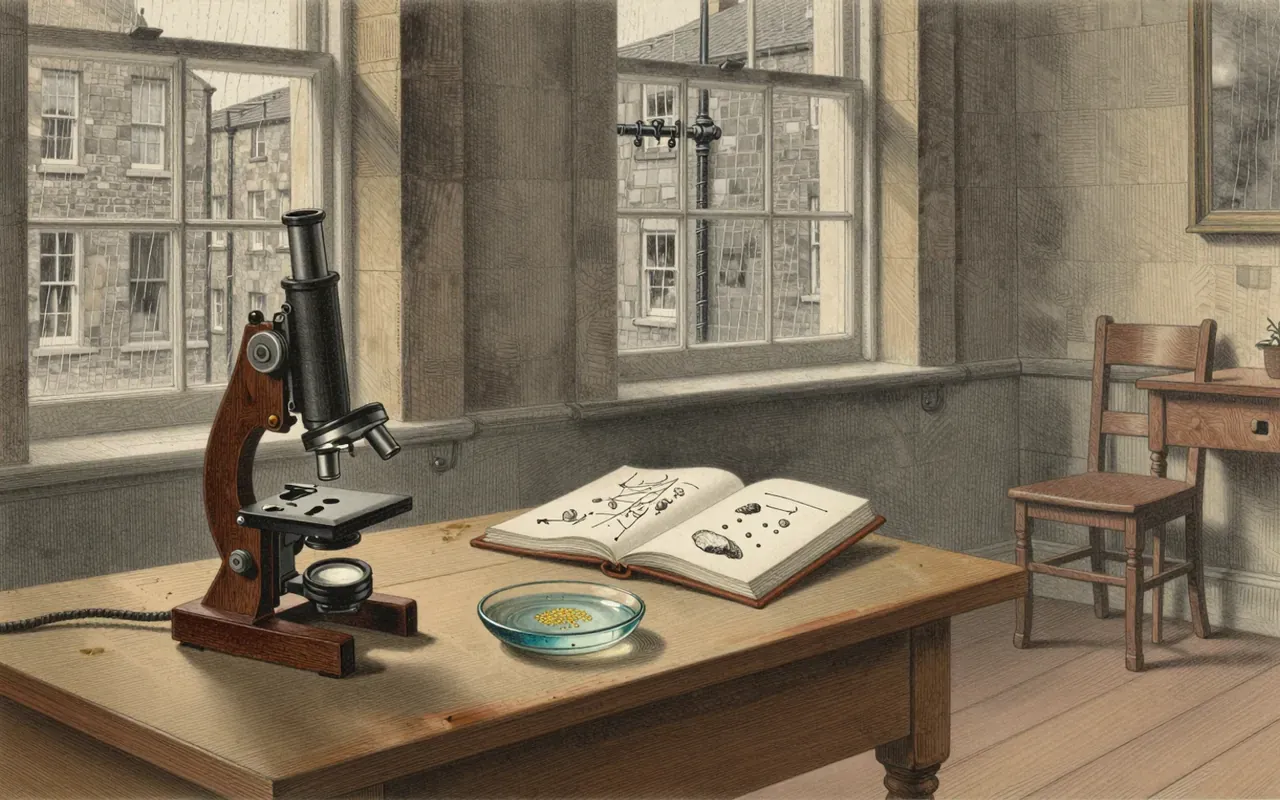
In 1827, the Scottish botanist Robert Brown was examining pollen grains from the plant Clarkia pulchella suspended in water under a microscope, watching individual particles roughly 6.4 microns across, when he noticed they moved with a continuous, jittery, apparently random motion rather than sitting still or drifting smoothly in one direction. The movement was easy to see and easy to reproduce, which made it a genuine puzzle rather than a fleeting or ambiguous observation: anyone with a microscope and a suspension of small particles in water could watch the same restless jitter for themselves.
Ruling out life as the cause
Brown’s first instinct was to ask whether he was watching some sign of life in the pollen itself, since a living process seemed a plausible explanation for spontaneous movement. He tested that possibility directly by repeating the observation with clearly non-living materials, glass dust and rock dust suspended in water, and found the same restless, jittery motion appeared regardless of what kind of particle was used. That simple control ruled out any biological cause and established the phenomenon as a genuine physical effect rather than a quirk specific to living pollen.
Decades without an explanation
What actually caused that motion remained unexplained for decades after Brown’s original observation. The phenomenon was well documented and easily reproduced but had no accepted physical mechanism behind it, leaving it as a genuine, unresolved puzzle sitting in plain view under any microscope for the better part of a century, a rare case of an easily repeatable observation persisting without a working explanation for so long. Scientists could describe the motion and watch it happen on demand, yet had no settled account of what was physically driving it from one moment to the next.
Random hits from invisible molecules
In 1905, Albert Einstein proposed a specific theoretical explanation: the jittery movement of a visible particle suspended in a liquid results from the particle being struck, from random directions and at random moments, by the far smaller, invisible molecules of the surrounding fluid itself, individual collisions too small to see but numerous and uneven enough, moment to moment, to push a larger particle around in the erratic way Brown had observed. The proposal mattered well beyond explaining one microscope observation, since it offered convincing evidence that atoms and molecules genuinely exist as physical objects, at a time when their reality was still a live and seriously contested scientific question rather than settled fact.
A prediction anyone could test
Einstein’s theory produced a specific, checkable quantitative prediction, relating the average of the squared distance a particle travels to the diffusion coefficient and the amount of time elapsed, a relationship that could be tested directly against careful measurement rather than simply argued about in the abstract. Jean Perrin carried out exactly that test through meticulous experiments in 1908, tracking the actual displacement of suspended particles over time and finding results that matched Einstein’s predicted relationship closely, turning Einstein’s theoretical argument into an experimentally confirmed one rather than a plausible but untested hypothesis about invisible molecules.
Settling a century-long argument about atoms
Perrin’s confirmation effectively settled the long-running scientific argument over whether atoms and molecules were real physical entities or merely a useful mathematical convenience for describing chemistry, work recognised with the 1926 Nobel Prize in Physics for his research into the discontinuous structure of matter. This is worth an hour for how directly a simple, easily repeated observation, watching pollen grains jitter under a microscope, sat unexplained for the better part of a century before becoming the decisive experimental proof that matter is made of discrete, countable particles rather than a smooth continuum.