sciencebriefs
all subjects →
9:23in productionCh. 1 · One pipe, one problem/ 9:23 · ceiling 15 min
Engineering · Energy

George Westinghouse

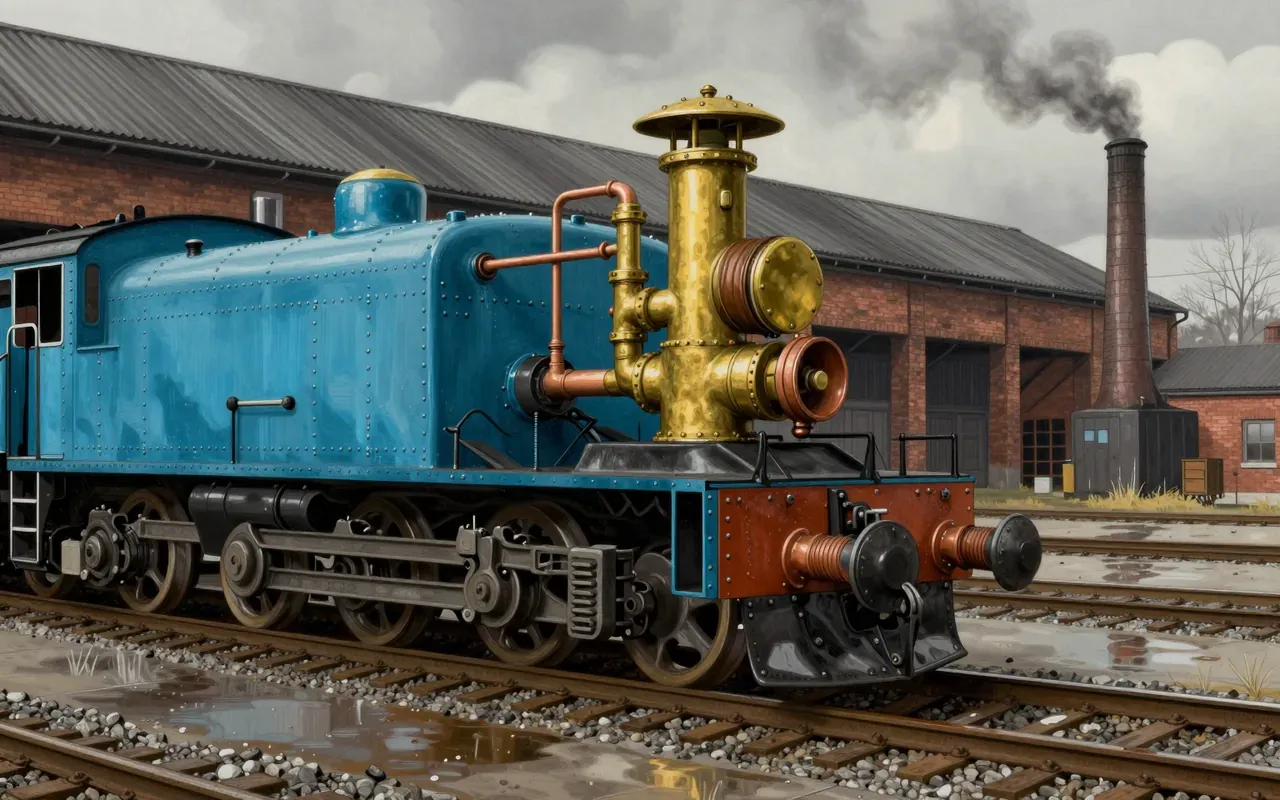
Fail-safe engineering began not in labs, but on broken railway lines — where a ruptured pipe had to stop a train, not kill its passengers.

Westinghouse solved two infrastructure problems: train braking and AC power distribution. His 1869 air brake was revolutionary but flawed — it failed catastrophically on pipe rupture. His 1871 redesign made failure safe. In 1885, he imported foreign AC components to test distribution — not as theory, but as deployable hardware. Neither effort was about invention from scratch. Both were about rigorous, evidence-led adaptation under constraint.

Chapters & takeaways4
  1. 0:57
    One pipe, one problem

    The 1869 air brake enabled simultaneous control across all cars — but relied on a single point of failure.

  2. 2:52
    Fail-safe by design

    By reversing valve logic and adding reservoirs, Westinghouse turned failure into automatic safety.

  3. 4:19
    Adopt, not invent

    He did not invent AC distribution — he imported, tested, and scaled foreign components in Pittsburgh.

  4. 5:56
    The physics of default

    Safety was engineered, not assumed: constant pressure disengaged brakes; loss of pressure engaged them.

Worth your time?

Yes. Study the whole thing.

4.5/ 5
What works
  • fail-safe-braking
  • ac-distribution-deployment
  • iterative-engineering
What does not
  • invention-of-transformer
  • invention-of-ac-generation
  • theoretical-physics
  • proof-of-concept-only
Study it if
  • engineers
  • infrastructure-designers
  • safety-system-developers
Skip it if
  • physicists
  • theoreticians
  • historians-of-science
The written brief1 min read

What the work claims

Westinghouse claimed a practical, scalable solution to train braking failure — first via compressed air, then via AC power distribution — both grounded in physical apparatus, not theory alone.

How it was done

Westinghouse demonstrated a compressed-air braking system in Pittsburgh in 1869 using an air compressor and reservoir on the locomotive, with a single pipe running the length of the train. In 1885, he imported Gaulard–Gibbs transformers and a Siemens AC generator to experiment with AC power distribution in Pittsburgh.

What holds up

The improved braking system automatically applied brakes upon air line interruption. It used car-mounted reservoirs and inverted valves so constant line pressure kept brakes disengaged. This design was demonstrably fail-safe in practice.

What does not

The 1869 braking system was not fail-safe: any rupture or disconnection left the train without brakes. The material does not claim Westinghouse invented the transformer, AC generation, or the concept of AC distribution — only that he adopted and deployed them experimentally.

Why it matters beyond the lab

It established infrastructure-level safety logic: systems must default to safe states on failure. That principle now underpins aviation, nuclear controls, and industrial automation — but Westinghouse proved it first on rails.

Is it worth your time

Yes — it shows how iterative engineering solves real-world failure modes, and how adopting foreign inventions can pivot entire industries.
Same field · Engineering4 of 36
Up next in Science

Georges Cuvier

· 9:58

Cuvier didn’t just name extinct beasts — he proved life could vanish, and made Earth’s history a story of catastrophe, not continuity.

9:58