sciencebriefs
all subjects →
9:58in productionCh. 1 · The Fact of Extinction/ 9:58 · ceiling 15 min
Evolution · Earth & climate

Georges Cuvier

Cuvier didn’t just name extinct beasts — he proved life could vanish, and made Earth’s history a story of catastrophe, not continuity.

Cuvier established extinction as fact, founded vertebrate paleontology and comparative anatomy, co-established biostratigraphy via the Paris Basin, and named Pterodactylus — all by comparing fossils to living animals. He attributed extinction to catastrophic floods. His taxonomy included fossils. His flood hypothesis does not hold. His methods and core conclusions do.

Chapters & takeaways5
  1. 1:01
    The Fact of Extinction

    Extinction was not speculation — it was proven fact.

  2. 2:18
    Anatomy as Time Machine

    Comparing fossils to living animals built vertebrate paleontology and redefined biological classification.

  3. 3:39
    Rocks That Record Life

    Strata in the Paris Basin revealed patterns of life through time — the birth of biostratigraphy.

  4. 5:14
    Catastrophe, Not Gradualism

    He blamed floods — not slow change — for extinction, anchoring his theory in catastrophe, not continuity.

  5. 6:41
    Naming the Unseen

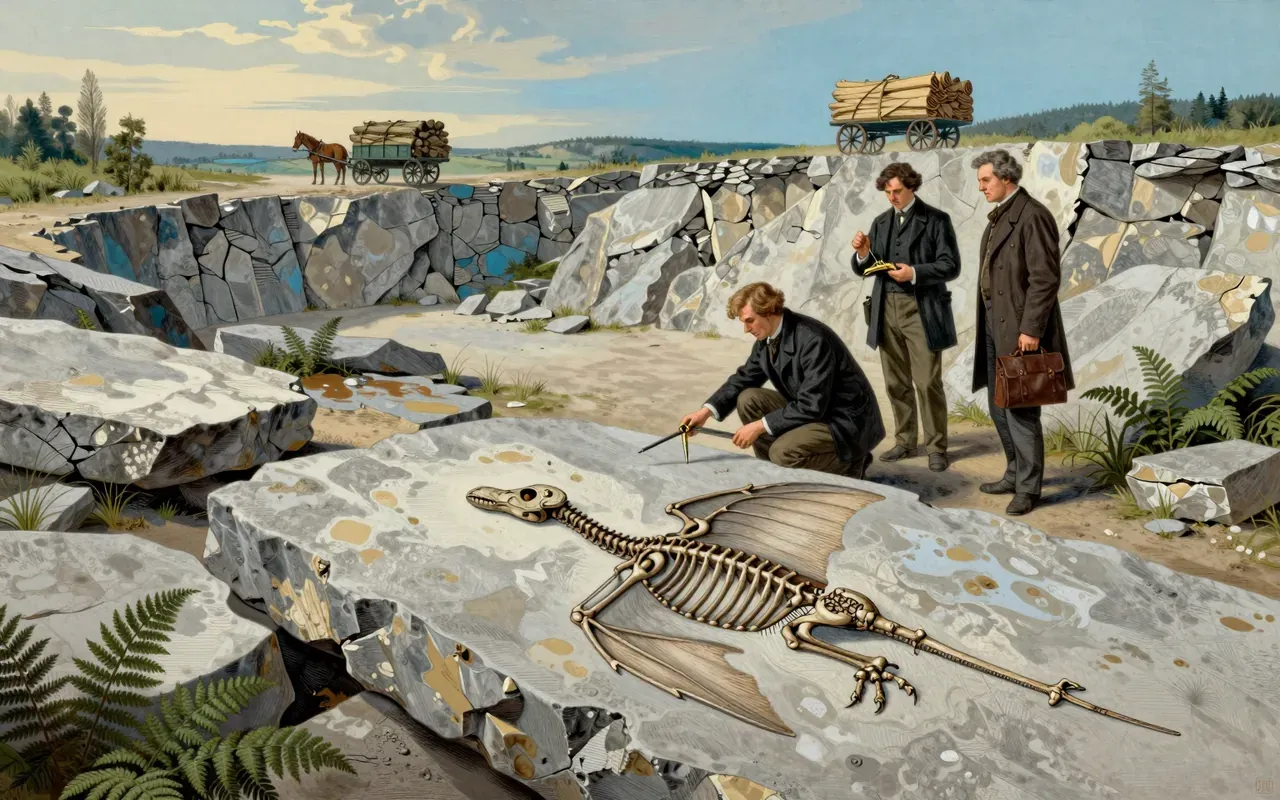
    Naming Pterodactylus marked the first formal recognition of flying reptiles as distinct, extinct animals.

Worth your time?

Yes. Study the whole thing.

4.5/ 5
What works
  • establishment of extinction as scientific fact
  • foundation of vertebrate paleontology
  • co-founding of biostratigraphy
  • expansion of Linnaean taxonomy to include fossils
What does not
  • Implicitly claims evolutionary descent
  • Proposes uniformitarianism
  • Establishes geological timescale numerically
  • Describes Mosasaurus as a new genus
Study it if
  • geologists
  • paleontologists
  • historians of science
Skip it if
  • biologists studying molecular evolution
  • climate modellers
  • geneticists
The written brief1 min read

What the work claims

Extinct species were wiped out by periodic catastrophic flooding events. Fossils represent real, formerly living organisms now gone. Fossil and living forms can be rigorously compared to reconstruct anatomy and relationships.

How it was done

Cuvier compared living animals with fossils to establish comparative anatomy and paleontology.

What holds up

Extinction as a scientific fact. Vertebrate paleontology as a discipline founded on comparative anatomy. Biostratigraphy’s basic principles from the Paris basin study with Brongniart. Classification expanded to include fossils alongside living species.

What does not

His catastrophic flood hypothesis for extinction has been superseded. The material does not support claims that he proposed evolution, gradual change, or any mechanism beyond periodic flooding.

Why it matters beyond the lab

Cuvier forced science to confront deep time and irreversible loss — reframing Earth history as dynamic, violent, and non-linear. This underpins modern conservation, climate science, and geology’s temporal framework.

Is it worth your time

Yes. His methods and conclusions shaped how scientists interpret fossil evidence, classify life, and reason about deep time — all still central to vertebrate paleontology and biostratigraphy.
Same field · Evolution4 of 45
Up next in Science

Gerty Cori

· 11:14

Enzyme defects cause genetic disease — and this was proven, not hypothesised.

11:14