A machine for firing tables
In August 1942, John Mauchly, then an instructor at the University of Pennsylvania’s Moore School of Electrical Engineering, wrote a memo proposing a general-purpose electronic computer, an idea that, with encouragement from Herman Goldstine, became a formal proposal and then an Army contract in April 1943. The stated purpose was narrow and practical: the Ballistics Research Laboratory needed artillery firing tables calculated faster than existing electro-mechanical methods allowed, and the promised machine, ENIAC, was to do this electronically rather than mechanically, using vacuum tubes instead of moving relay switches. Mauchly led the conceptual design while J. Presper Eckert directed the hardware engineering, an arrangement that would later matter a great deal when the resulting invention’s ownership was disputed in court.
Eighteen thousand tubes in one room
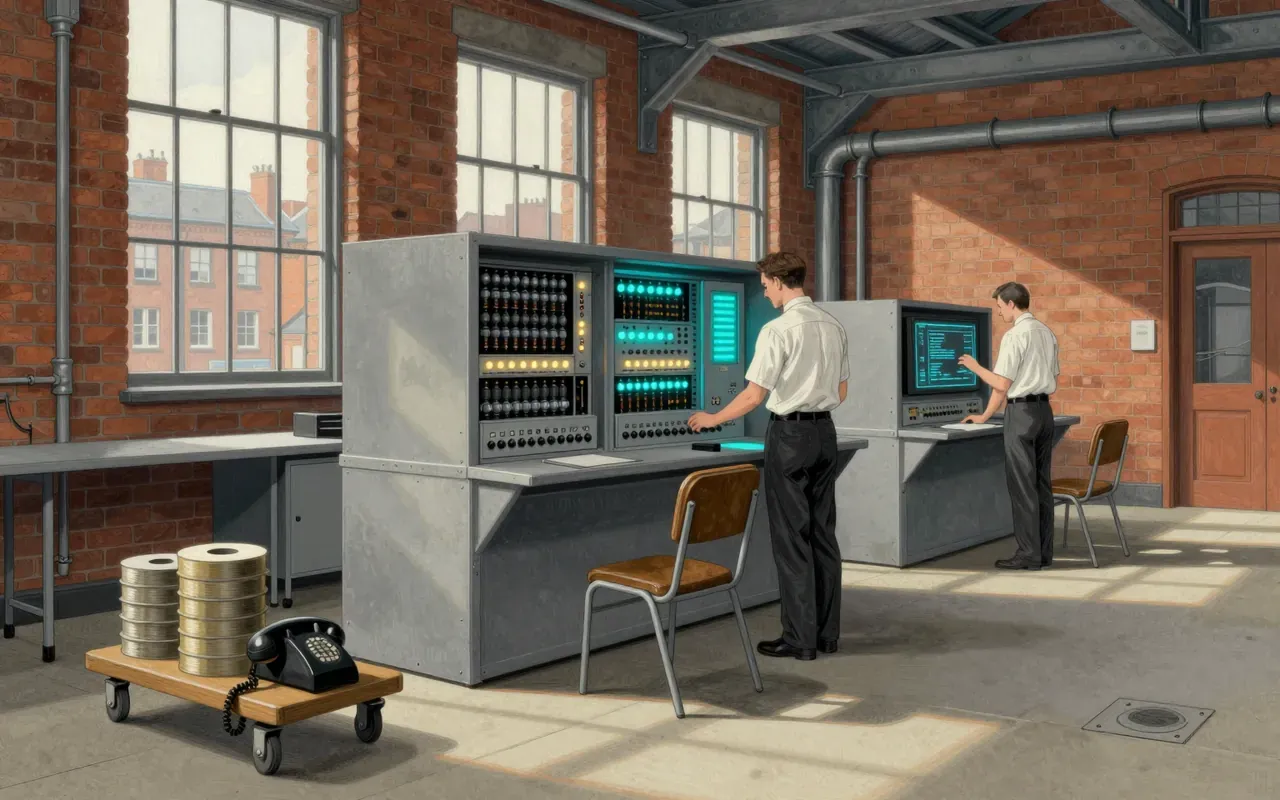
Construction began in July 1943 and the finished machine, completed by 1945, was physically enormous: roughly ten feet tall, three feet deep and a hundred feet long, weighing more than thirty short tons and occupying about 300 square feet of floor space. It contained around 18,000 vacuum tubes, 7,200 crystal diodes, 6,000 relays, 70,000 resistors and 10,000 capacitors, connected by an estimated five million hand-soldered joints, and drew 150 kilowatts of electricity to run. Despite the scale, its actual computing speed by later standards was modest, performing about 5,000 addition or subtraction operations per second, roughly a thousand times faster than the electro-mechanical machines it replaced, but its twenty ten-digit accumulators had, at first, no way to store a program internally.
Reprogrammed by hand, one plugboard at a time
Because ENIAC had no internal memory for instructions, it was programmed by physically wiring plugboards and setting three portable function tables, each containing 1,200 ten-way switches, a process specialists describe as complex enough that mapping a new problem onto the machine typically took weeks. This meant that switching ENIAC from one calculation to an entirely different one was a matter of manual rewiring, not of loading new software as later computers would allow. That changed in April 1948, when the machine was modified to operate closer to a stored-program design, cutting reprogramming time down from days to hours, a change that made ENIAC noticeably more flexible than it had been at completion, though it never became a true stored-program machine in the modern sense.
A weapons calculation before a firing table
ENIAC’s first actual use, once assembled, was not the artillery calculations it had been built for but a study, run in December 1945, of the feasibility of a thermonuclear weapon, work that supported hydrogen bomb research being carried out at Los Alamos. The machine was publicly dedicated in February 1946 and later transferred to Aberdeen Proving Ground in Maryland in 1947, where it continued operating for several more years before being retired in October 1955. Reliability was a persistent early problem: tubes burned out often enough in the first years that the machine was reportedly nonfunctional roughly half the time, though engineers steadily improved this, reducing failures to about one tube every two days by 1947 and eventually achieving a continuous run of 116 hours without a failure by 1954.
Six women, largely uncredited at the time
The day-to-day work of programming ENIAC, in the plugboard-and-switch sense described above, was carried out by six women recruited and trained for the task: Jean Jennings, Marlyn Wescoff, Ruth Lichterman, Betty Snyder, Frances Bilas and Kay McNulty. Their contribution went largely uncredited in contemporary accounts of the machine, an omission only substantially corrected decades later, when the group was inducted into the Women in Technology International Hall of Fame in 1997 and became the subject of later documentaries and books. This gap between who did the technical work and who received credit for it at the time is as much a documented part of ENIAC’s history as its vacuum tubes, and later recognition has not fully closed it.
The 1973 ruling that undid its own patent
ENIAC’s status as ‘the first general-purpose electronic computer’ is worth examining rather than accepting at face value, because a 1973 federal court decision in Honeywell v. Sperry Rand complicated it directly: the ruling invalidated the ENIAC patent, which had been applied for in 1947 and granted only in 1964, finding that its core concept had been derived from the earlier Atanasoff-Berry Computer, prototyped in 1939 by John Atanasoff and Clifford Berry but never completed as a working machine. The court’s decision placed ENIAC’s underlying invention in the public domain and gave legal recognition to Atanasoff as inventor of the first electronic digital computer, a title distinct from ENIAC’s own, better-supported claim to being the first general-purpose and programmable one. That legal nuance, rather than a simple firstness claim, is the more interesting and more accurate story.