Salt tolerance measured in degrees
Halophiles are organisms whose defining trait is tolerance for salt concentrations that would be destructive to most other life, and the material sorts them into three tiers based on how much salt they actually favour: slight halophiles growing best in roughly a third to four-fifths of a mole of salt per litre, moderate halophiles tolerating considerably more, and extreme halophiles surviving in concentrations that reach up to about five and a bit moles per litre. For comparison, ordinary seawater sits at a much lower concentration, meaning even the mildest classification of halophile already tolerates conditions saltier than the ocean, while extreme halophiles inhabit water roughly five times as concentrated. Environments named as home to these organisms include the Dead Sea, Utah’s Great Salt Lake, and various salt evaporation ponds, all places where water has concentrated far beyond typical marine salinity through evaporation or geological isolation.
Two solutions to the same osmotic problem
Two genuinely different biochemical strategies are described for handling this salt load, and the material treats them as distinct solutions to the same underlying osmotic problem rather than variations on one theme. Most halophilic bacteria, yeasts, algae and fungi rely on accumulating organic compatible solutes, molecules including certain amino acids, sugars and specific betaine and ectoine compounds, inside the cell to balance the osmotic pressure created by the surrounding salt without disrupting the cell’s internal machinery. A smaller group takes a more radical route instead, allowing potassium ions to accumulate directly inside the cytoplasm at high concentration, a strategy that requires the organism’s entire internal protein chemistry to be built around functioning in a highly charged, ion-saturated environment rather than a more conventional cellular interior.
An adaptation that may have evolved twice
This second, potassium-based strategy is restricted to a specific and somewhat scattered set of organisms: the archaeal family Halobacteriaceae, the moderately halophilic order Halanaerobiales, and the bacterium Salinibacter ruber. Because these groups are not closely related to one another, the material treats this shared strategy as likely representing convergent evolution, meaning the same solution to extreme salt tolerance arose independently more than once across distinct evolutionary lineages, rather than being inherited from a single common ancestor that happened to already possess it. This detail matters because it suggests the potassium-flooding approach, while unusual, is not an evolutionary fluke restricted to one lineage but a genuinely viable solution that different organisms arrived at separately when facing the same extreme environmental pressure.
Proteins built differently for a salty interior
The proteins inside these salt-tolerant organisms are structurally distinct from ordinary proteins in ways the material describes specifically: lower overall hydrophobicity, an overrepresentation of acidic amino acid residues, reduced presence of the amino acid cysteine, and a greater tendency toward flexible coil structures rather than more rigid folded shapes. These features are presented as adaptations that let proteins remain properly folded and functional inside a cytoplasm either packed with organic solutes or saturated with potassium ions, conditions that would destabilise an ordinary protein’s structure. The organism’s DNA also shows distinct patterns in how genetic code is used, a further sign that adapting to extreme salt reaches down to the molecular level rather than being a surface-level tolerance.
Salt-cured food’s uninvited microbial residents
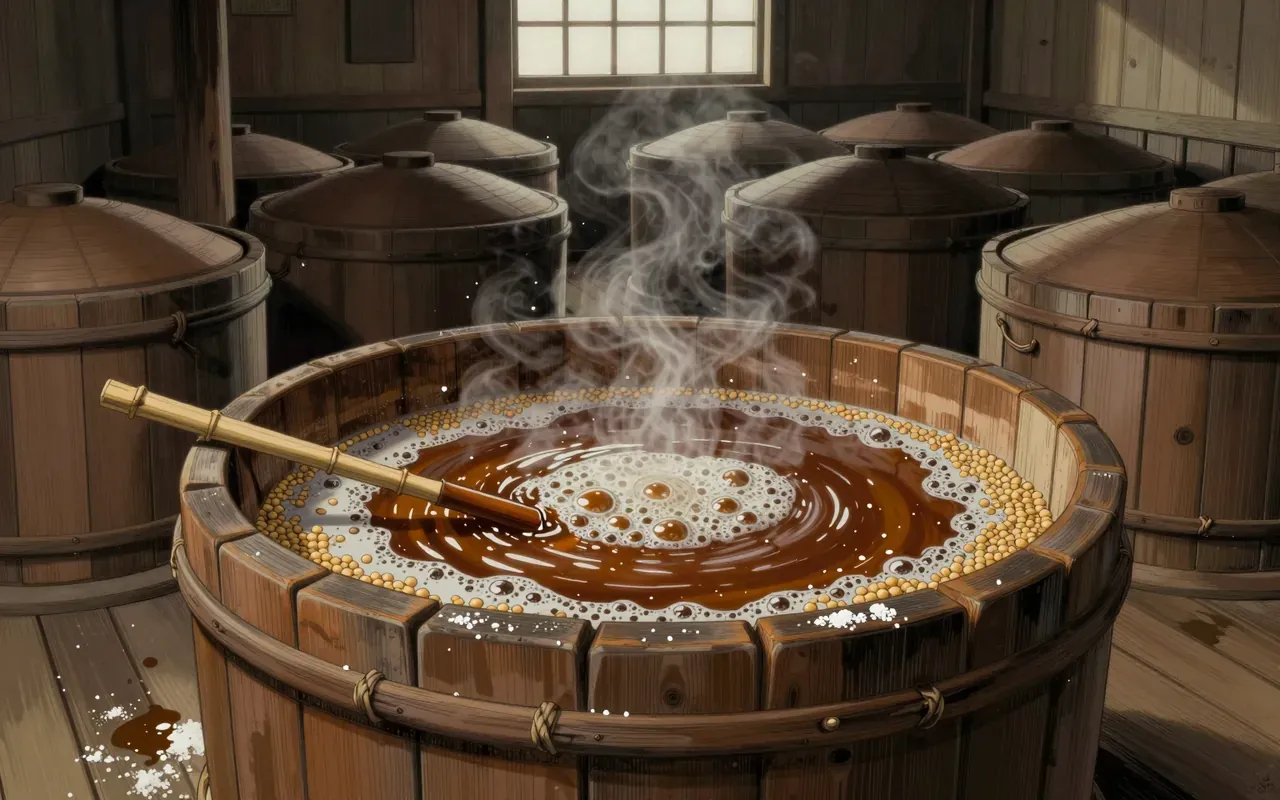
Halophiles turn up, sometimes usefully and sometimes as unwanted contaminants, throughout salt-based food preservation and fermentation. The material names Chromohalobacter beijerinckii as found in salted preserved foods, and Tetragenococcus halophilus as present in salted anchovies and in soy sauce production specifically, tying a genuinely obscure area of microbiology directly to recognisable foods most readers have eaten. This connection matters because it demonstrates that halophile biology is not confined to remote hypersaline lakes; the same organisms, or close relatives, are actively involved in fermentation processes that shape flavour in foods that rely on heavy salting as a preservation method, meaning this extremophile category has a genuinely everyday footprint most people never notice.
A model for salt water on other worlds
The material’s closing point is about vulnerability rather than tolerance: because halophiles are so specifically adapted to a high-salt environment, most of them cannot survive being placed in fresh water at all, undergoing immediate cell rupture through osmotic stress as water rushes into cells built to be in equilibrium with a much saltier surrounding environment. This fragility outside their niche is presented alongside halophiles’ relevance to astrobiology, where their biology serves as a working model for how life might function in the subsurface saline ocean believed to exist beneath the icy crust of Jupiter’s moon Europa. This is a strong hour precisely because it moves between concrete Earth biochemistry and a genuinely speculative but carefully framed astrobiological application without ever losing its grounding in the underlying mechanism.