Planck didn’t discover quanta — he invented them to save classical physics, then accidentally broke it forever.
Planck’s 1900 derivation solved the black-body problem by introducing quantised emission — a move he treated as formal, not physical. It established h and E = hν, declared radiant heat discontinuous, and broke classical continuity. It did not propose light quanta as particles. Its legacy is not what Planck believed, but what his mathematics forced physics to accept.
Planck’s black-body law was first proposed at a DPG meeting on 19 October 1900.
2:43
The assumption no one believed
He assumed energy is emitted only in quantized form — a postulate he called 'purely formal'.
4:39
The units that changed everything
He introduced h and E = hν, and declared radiant heat a discontinuous mass of identical units — 'pennies of the atomic world'.
6:36
The break classical physics never recovered from
His assumption was incompatible with classical physics — and is now regarded as the birth of quantum physics.
Worth your time?
Yes. Study the whole thing.
4.5/ 5
What works
The Planck constant h holds.
The relation E = hν holds.
The black-body law matches experiment where classical theory fails.
The conclusion that radiant heat is discontinuous and composed of discrete units holds.
What does not
Planck did not propose photons.
He did not claim quantisation applied to radiation in free space.
He did not interpret quanta as physical particles.
He did not intend to found a new physics.
Study it if
Physicists who need to trace quantum theory to its first unambiguous break with continuity.
Historians of science tracking how formal assumptions become ontological commitments.
Students confronting the gap between textbook simplifications and original reasoning.
Skip it if
Anyone seeking confirmation that Planck 'discovered the quantum' as a physical entity.
Readers expecting a narrative of intentional revolution rather than reluctant formalism.
The written brief1 min read
What the work claims
Electromagnetic energy is emitted only in discrete, indivisible units. Radiant heat is not a continuous flow but a discontinuous mass of identical units. This quantisation is incompatible with classical physics.
How it was done
Planck derived a new black-body radiation law by assuming electromagnetic energy is emitted only in quantized form. He presented this derivation at a Deutsche Physikalische Gesellschaft (DPG) meeting on 14 December 1900. He had proposed an earlier version of the law at a DPG meeting on 19 October 1900.
What holds up
The Planck constant h and the relation E = hν hold. His black-body radiation law matched experimental data where classical theory failed. The conclusion that radiant heat is discontinuous and composed of discrete units — ‘pennies of the atomic world’ — remains foundational.
What does not
Planck did not claim quantisation applied to light itself, nor did he propose photons. He treated quantisation as a property of emission and absorption by resonators — not of radiation in transit. He called it a ‘purely formal assumption’ and did not interpret quanta as physical particles.
Why it matters beyond the lab
It established the first empirical necessity for discreteness in nature — not as a calculational trick, but as a condition for physical consistency. Every quantum technology, from lasers to semiconductors, rests on this break — not on Planck’s interpretation, but on the irreversibility of the step he took.
Is it worth your time
Yes — it redefined physical reality. Planck’s quantisation assumption was not a refinement but a rupture: it replaced continuity with discreteness at the foundation of energy exchange. If you care how physics justifies what counts as real, this is where the argument begins.
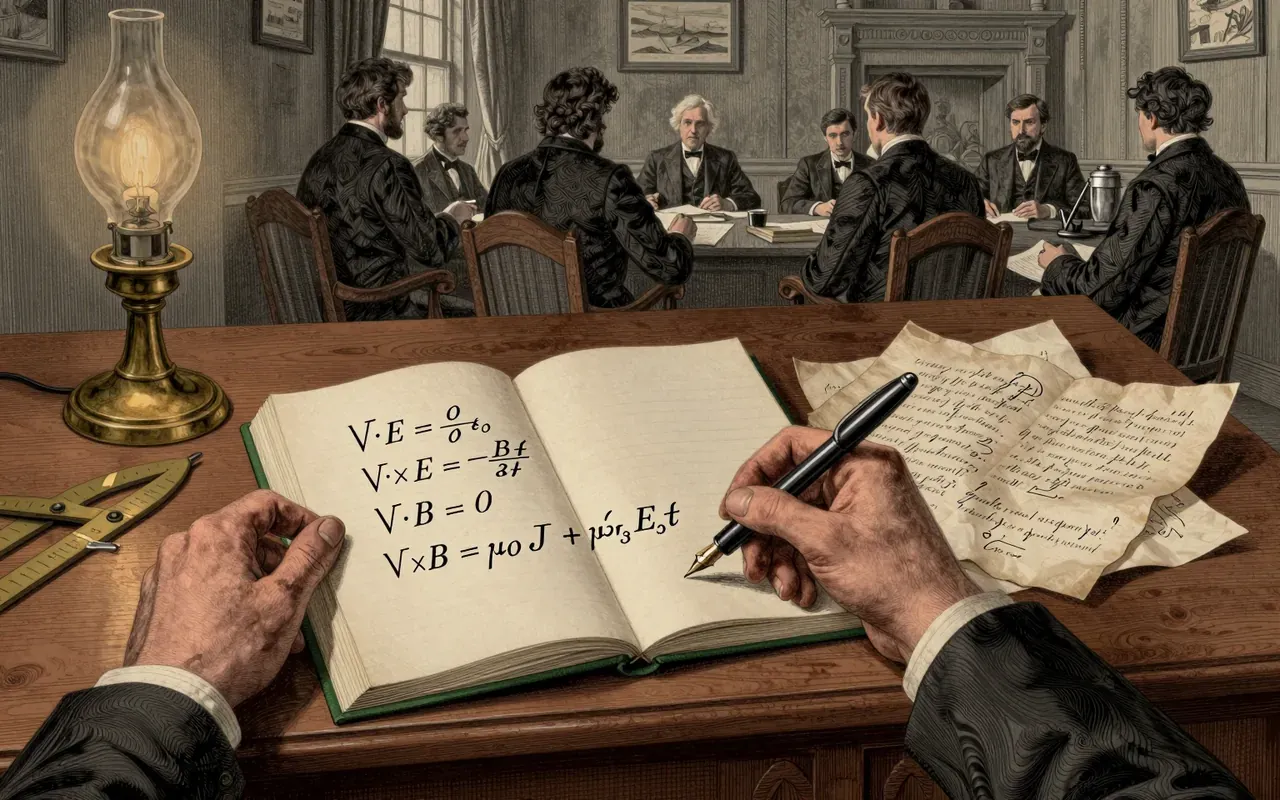
When James Clerk Maxwell added one missing term to the equations linking electricity and magnetism, the mathematics predicted a wave travelling at a speed that matched light almost exactly, revealing light itself as an electromagnetic phenomenon.