9:53in productionCh. 1 · The apparatus/ 9:53 · ceiling 15 min
Physics
Franck–Hertz experiment
Quantisation isn’t abstract — it’s a 4.9 eV voltage drop you can watch on an oscilloscope.
The Franck–Hertz experiment demonstrated discrete 4.9 eV energy loss by electrons colliding with mercury atoms — the first electrical evidence for quantised atomic energy levels. It confirmed Bohr’s model was compatible with observation, but did not prove it. Its strength lies in measurability, reproducibility, and clarity: no statistics, no fitting, no ambiguity — just a voltage threshold and a current dip.
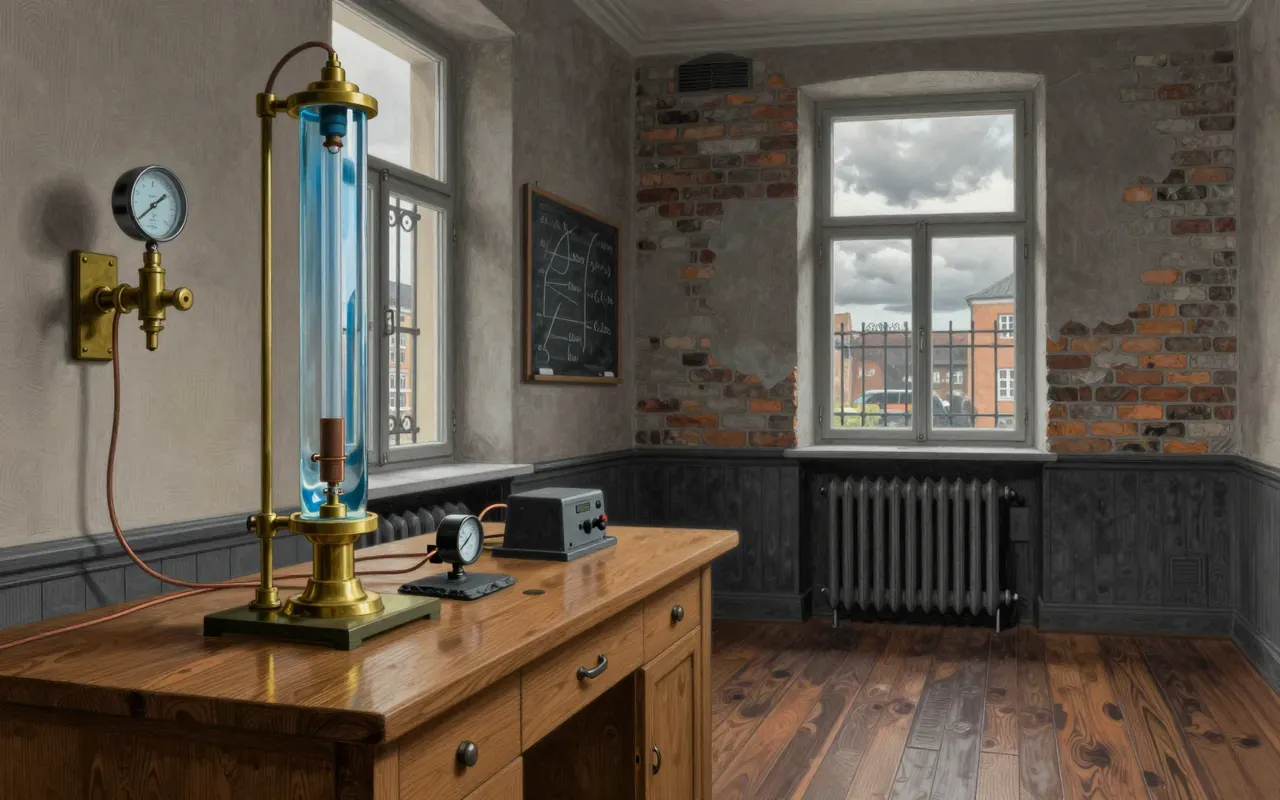
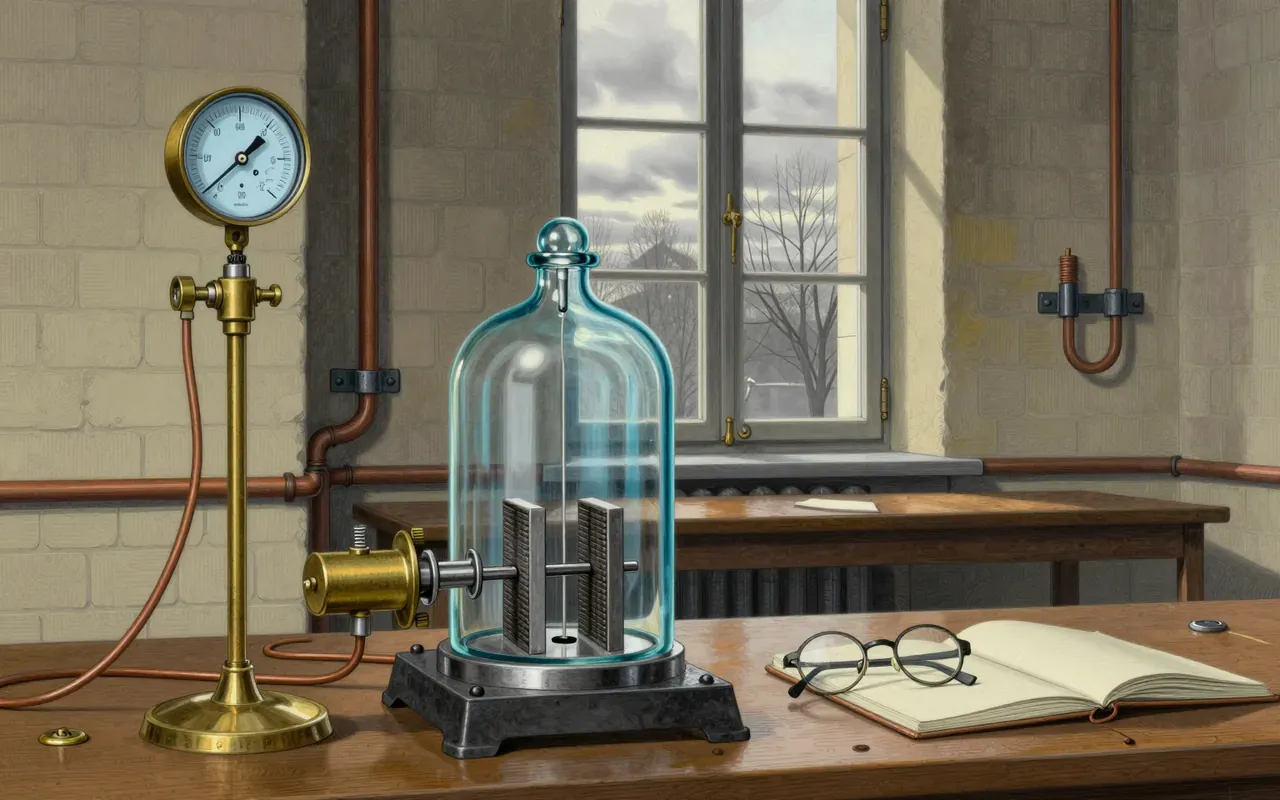
They built a vacuum tube to fire electrons through mercury vapour — simple, scalable, and entirely electrical.
2:21
The quantum step
Electrons lost either exactly 4.9 eV or none — no fractions, no gradients, no partial deceleration.
3:43
The atomic explanation
The 4.9 eV matched the gap between two specific quantum levels — and Bohr’s model allowed no states between them.
5:05
The historical pivot
It was the first electrical proof of quantisation — and it aligned with Bohr’s model within a year of its publication.
Worth your time?
Yes. Study the whole thing.
4.5/ 5
What works
as a foundational demonstration of quantisation
as a self-contained electrical experiment
as a counterpoint to classical expectations
What does not
prove Bohr's model
show spectral emission
measure orbital structure
require quantum field theory
Study it if
undergraduate physics students
teachers of modern physics
historians of experimental science
Skip it if
researchers seeking new quantum phenomena
engineers building quantum devices
policy makers assessing emerging tech
The written brief1 min read
What the work claims
That atomic energy levels are quantised: mercury atoms absorb kinetic energy from electrons only in discrete 4.9 eV packets, corresponding to excitation of an internal electron from its lowest to a higher quantum level.
How it was done
Franck and Hertz designed a vacuum tube to study electrons flying through mercury vapour. They measured how much kinetic energy electrons lost in collisions with mercury atoms.
What holds up
Electrons colliding with mercury atoms lose precisely 4.9 eV — no more, no less. Slower electrons scatter elastically. Faster ones retain residual kinetic energy after losing exactly 4.9 eV. This discrete loss matches Bohr’s requirement of no intermediate energy levels.
What does not
It does not prove Bohr’s model. It is consistent with it, but says nothing about electron orbits, angular momentum, or spectral lines beyond the 4.9 eV transition.
Why it matters beyond the lab
It severed classical mechanics from atomic-scale interactions. Not as a theoretical insight, but as a reproducible electrical signal — a threshold voltage you can measure with a voltmeter and see as a current dip.
Is it worth your time
Yes. It is the first electrical measurement to clearly show the quantum nature of atoms — a direct, low-tech test of quantisation that remains teachable and unambiguous.