sciencebriefs
all subjects →
8:37in productionCh. 1 · How it was done/ 8:37 · ceiling 15 min
Physics · Chemistry

Stern–Gerlach experiment

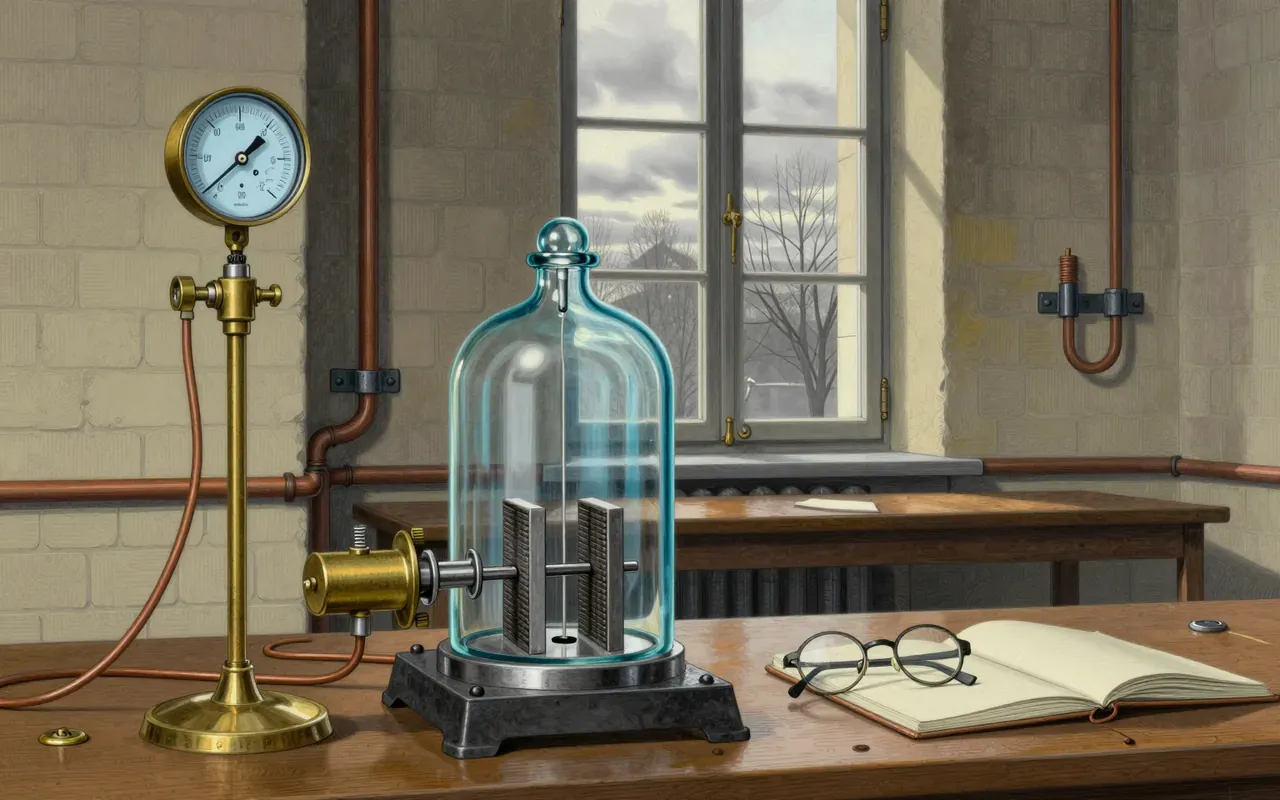
Quantization wasn’t predicted — it was photographed on a glass slide.

The Stern–Gerlach experiment demonstrated quantization of angular momentum orientation using silver atoms deflected by an inhomogeneous magnetic field, revealing discrete accumulation points instead of a continuous distribution — direct evidence of intrinsic quantum properties in atomic-scale systems.

Chapters & takeaways4
  1. 0:56
    How it was done

    Silver atoms passed through an inhomogeneous magnetic field in early 1922 — and their deflection revealed quantum behaviour.

  2. 2:25
    What it showed

    Discrete accumulation points — not a smear — proved angular momentum orientation is quantized.

  3. 3:44
    Why it convinced physicists

    This was the first direct evidence that atomic-scale systems obey intrinsically quantum rules — no classical explanation sufficed.

  4. 5:03
    What it did not show

    The result measured orientation quantization — not spin, not magnetic moment magnitude, not energy levels.

Worth your time?

Yes. Study the whole thing.

4.5/ 5
What works
  • angular momentum orientation quantization
  • intrinsic quantum properties in atomic-scale systems
  • discrete accumulation points vs continuous distribution
  • convincing physicists of angular-momentum quantization
What does not
  • spin
  • electron
  • magnetic moment magnitude
  • energy levels
Study it if
  • physicists
  • chemists
  • engineers
Skip it if
  • general public without science background
The written brief1 min read

What the work claims

The experiment claimed that the spatial orientation of angular momentum is quantized. It claimed this not as a theoretical prediction, but as an observable fact revealed by deflection patterns of neutral silver atoms.

How it was done

Otto Stern and Walther Gerlach sent silver atoms through an inhomogeneous magnetic field in early 1922. The field gradient deflected particles with non-zero magnetic moment. Deflection was recorded on a detector screen, such as a glass slide.

What holds up

The discrete accumulation points on the detector screen are robust. They contradicted classical expectations of a continuous smear. They confirmed quantization of spatial orientation for angular momentum in silver atoms — and, by extension, all atomic-scale systems, as physicists concluded at the time.

What does not

The experiment did not measure spin directly. Spin was not yet theorised in 1922. The discrete spots were later interpreted as evidence of electron spin, but the original result only established quantization of angular momentum orientation — nothing more.

Why it matters beyond the lab

It forced physics to abandon classical continuity at the atomic scale. Every quantum sensor, every MRI machine, every atomic clock rests on the reality of quantized angular momentum orientation — a reality first made visible in that 1922 glass slide.

Is it worth your time

Yes. It is the first direct experimental demonstration that angular momentum orientation is quantized — not inferred, not model-dependent, but measured as discrete accumulation points on a screen.

Same field · Physics4 of 114
Up next in Science

Turing test

Alan Turing · 9:04

The Turing test doesn’t ask whether machines think—it asks whether we’ve stopped noticing the difference.

9:04