Six hundred dark lines in sunlight
In 1815, the physicist Joseph von Fraunhofer examined the spectrum of sunlight in unusually fine detail and counted roughly six hundred dark lines running across the coloured band, gaps where specific wavelengths of light were simply missing from what would otherwise have been a smooth, continuous spread of colour. These gaps, since named Fraunhofer lines in his honour, were the first clear evidence that sunlight carries a highly specific, structured signature rather than a featureless spread, though nobody at the time yet understood what produced them or what they might eventually be used to find out about the source of the light itself.
A prism, a slit, a telescope
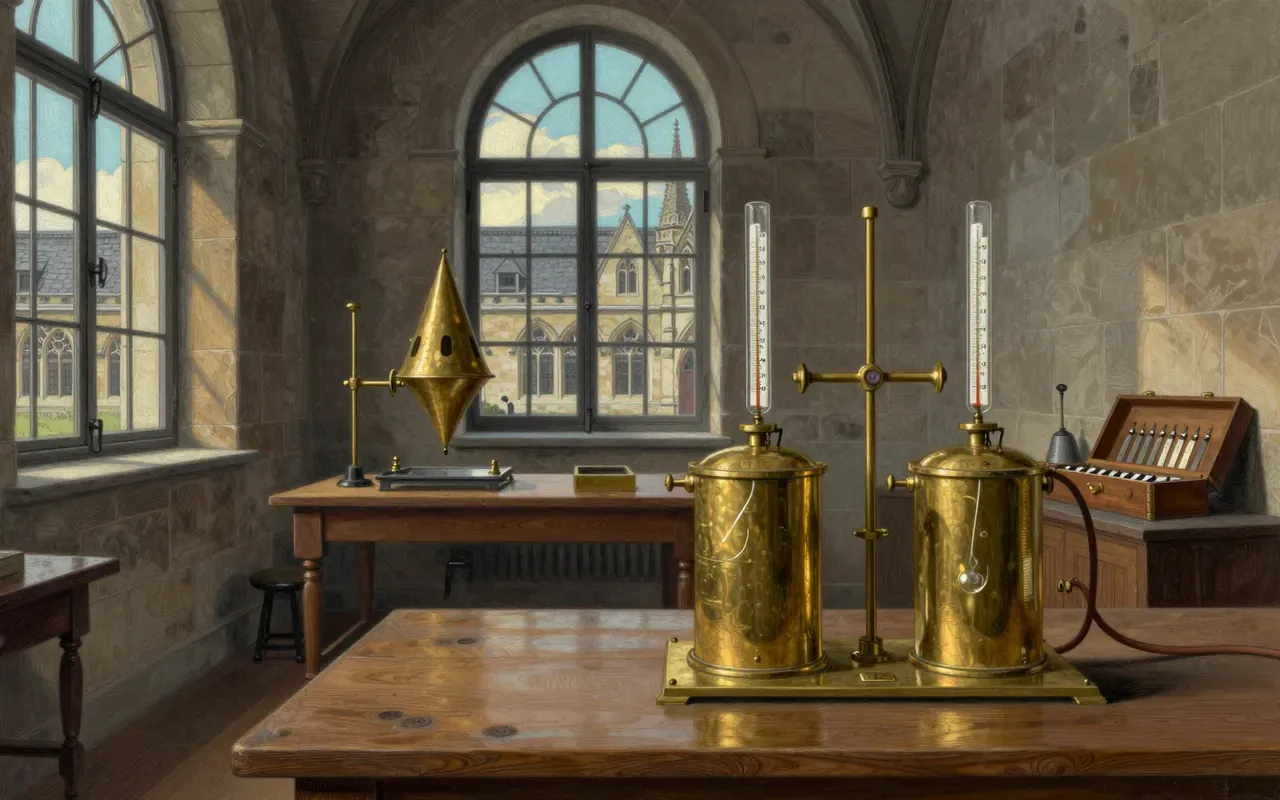
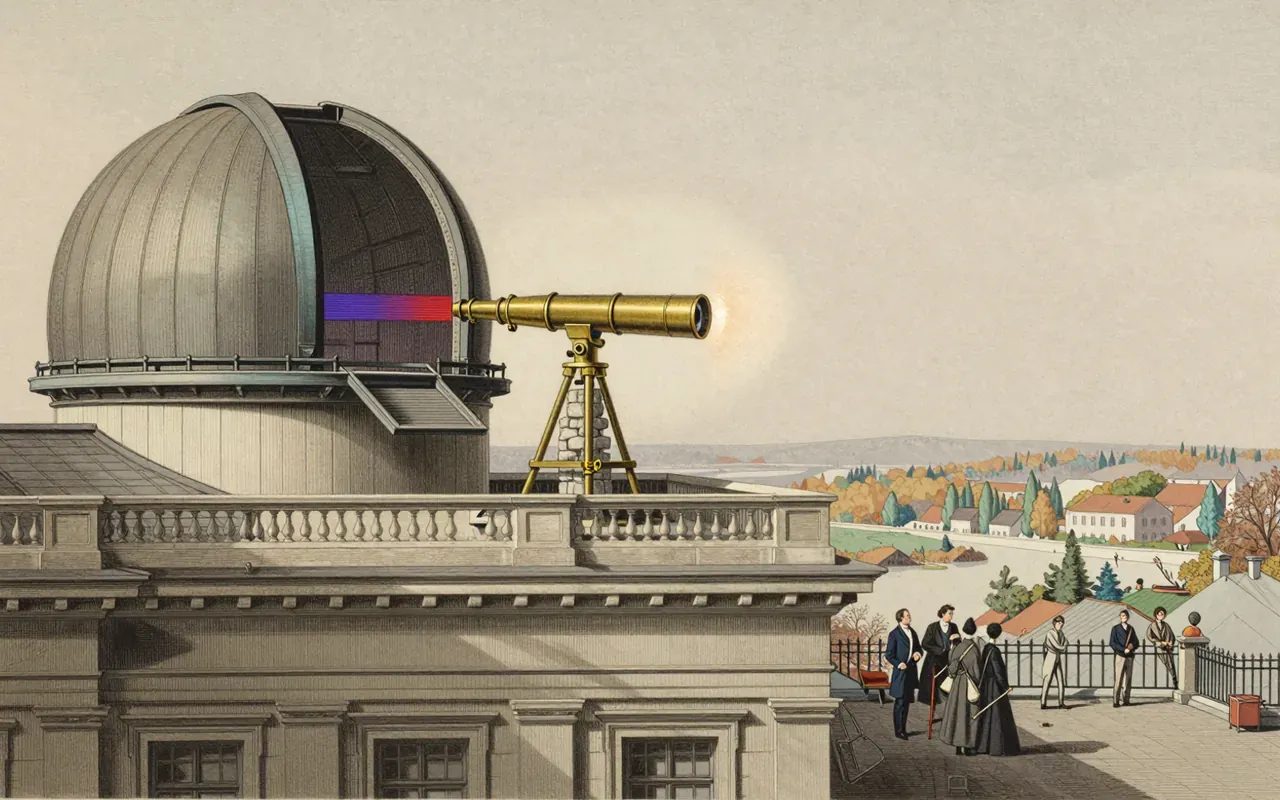
Fraunhofer built the instrument needed to see this structure clearly by combining a prism, which spreads light into its component wavelengths through dispersion, with a narrow slit to sharpen the incoming beam and a telescope to examine the resulting spectrum closely, a design that markedly increased both the resolution and the reproducibility of spectral observation compared to earlier, cruder attempts at splitting light with a prism alone. He later refined the approach further with a diffraction-based spectroscope, an instrument using a grating rather than a prism to separate wavelengths, extending the same basic principle to a different physical method of dispersing light.
Reading light like a fingerprint
Decades later, Robert Bunsen and Gustav Kirchhoff turned Fraunhofer’s instrument into a tool for chemical identification rather than pure observation. Heating different substances in a flame and examining the resulting light through a spectroscope, they found that each element produced its own distinctive, sharply defined pattern of bright lines, an optical fingerprint specific enough to identify a substance from its light alone. Using this method, Bunsen discovered the elements caesium and rubidium purely by recognising spectral lines that matched no known element, demonstrating that spectroscopy could find entirely new elements, not just confirm the presence of ones already known.
Two lines, one element
The precision achievable with this technique is illustrated well by sodium, whose characteristic emission appears as two closely spaced bright lines, at wavelengths of 588.9950 and 589.5924 nanometres, a signature distinct enough that even a small amount of sodium in a flame can be identified confidently against every other element’s spectrum. That degree of specificity, a pattern of lines at exact, repeatable wavelengths unique to each element, is what made spectroscopy reliable enough to use as a genuine identification method rather than a rough visual comparison between glowing samples, and it is why the technique still underpins fields as different as gemology and stellar classification today.
Pointed at the stars
The same principle that let Bunsen and Kirchhoff identify elements from a laboratory flame applies equally well to light arriving from enormously distant sources, since a star’s own light carries the spectral fingerprints of whatever elements it contains. Henry Draper first used the term spectrograph in 1876, when he photographed the spectrum of the star Vega, an early step in a practice that has since let astronomers work out the chemical composition of stars and other astronomical objects from Earth, without ever collecting a physical sample, a capability that became fundamental to stellar classification and to much of what astronomers know about the composition of the universe.
From prism to computer
The instrument itself has changed considerably since Fraunhofer’s original prism-and-telescope design; modern spectrometers typically use diffraction gratings, movable slits and computer-controlled photodetectors rather than a human eye at an eyepiece, but the underlying principle, spreading light into its component wavelengths and reading the pattern of lines that results, is unchanged from 1815. This is worth an hour for how directly a careful observation of dark lines in sunlight led, within a few decades, to a general method for identifying what any glowing object anywhere is actually made of, whether it sits on a laboratory bench or burns many light years away.