Cold enough to stop most life, not this life
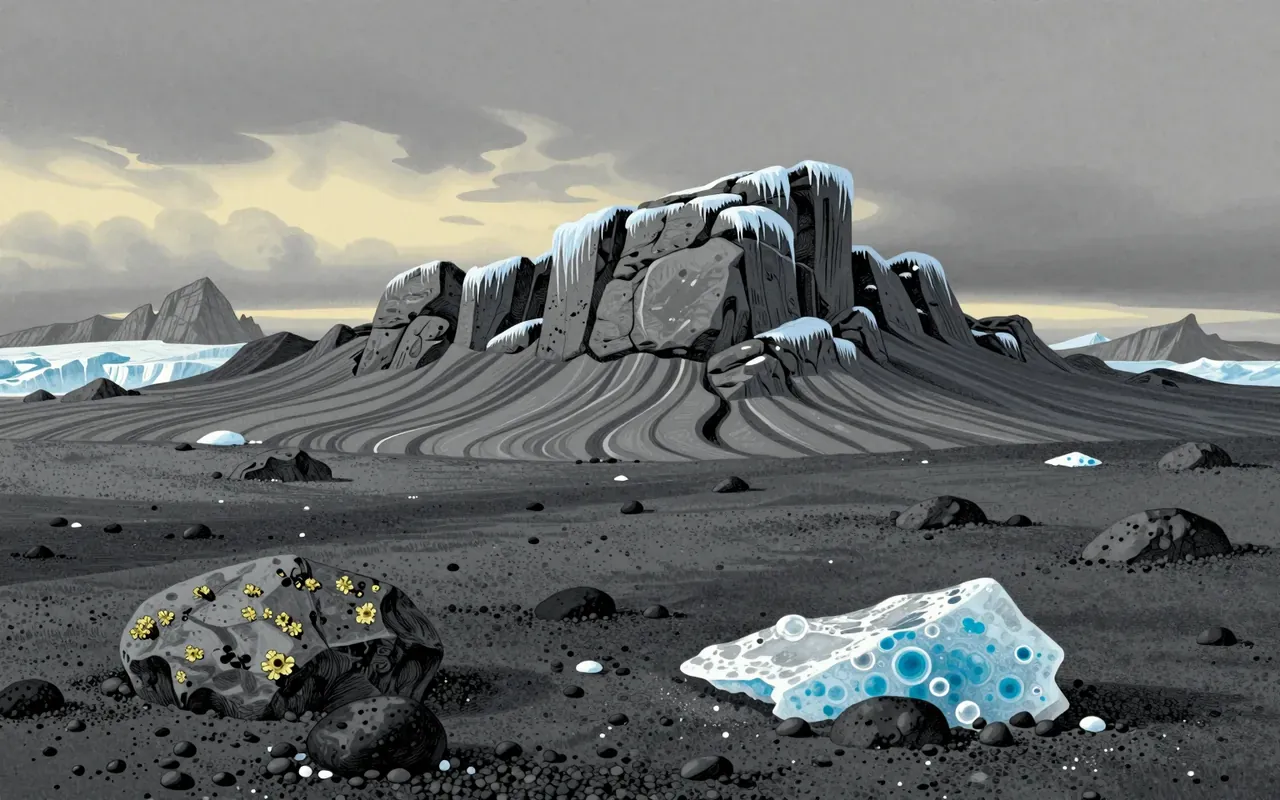
Psychrophiles are described here as organisms that do not merely tolerate cold but actually grow and reproduce within it, spanning a temperature range from roughly minus twenty degrees Celsius up to about twenty degrees. Their habitats include polar ice, permafrost, deep ocean water, glaciers, snowfields and highly saline sea ice, and the material notes documented microbial activity even in frozen soil below minus thirty-nine degrees, a temperature well past where liquid water ordinarily exists at all. This range matters because it distinguishes psychrophiles from organisms that simply endure cold in a dormant state; the defining claim is active biological function, including reproduction, occurring in conditions that would halt most other organisms’ cellular machinery entirely.
A lichen that keeps working below freezing
The material gives specific examples across a wider range of organisms than bacteria alone. Genera such as Arthrobacter and Psychrobacter represent the bacterial and archaeal side of the category, but eukaryotic examples are given equal weight: the lichen Xanthoria elegans is described as continuing to photosynthesise at minus twenty-four degrees Celsius, snow algae in the genera Chlamydomonas and Chlorella persist in similar conditions, and the Antarctic midge Belgica antarctica represents an insect example of the same broad cold tolerance. Including organisms this varied, a lichen, algae, an insect and assorted bacteria, under one category is meant to underline that cold tolerance has evolved independently across very different branches of life rather than being confined to a single group of specialised microbes.
A membrane built not to stiffen
Underneath this tolerance sit several distinct molecular strategies. Psychrophile cell membranes incorporate short, unsaturated fatty acids specifically because these lower the membrane’s melting point, keeping it fluid and functional at temperatures that would otherwise cause an ordinary membrane built from longer, saturated fatty acids to stiffen into a gel-like state that cellular processes cannot operate through. Carotenoids are described as playing a supporting role in further adjusting membrane properties. This adaptation targets a genuinely specific physical problem, membrane rigidity at low temperature, and the material treats it as one of several separate cold-survival mechanisms rather than folding it into a single, generalised explanation for cold tolerance.
Proteins that stop ice from forming
A second and distinct adaptation addresses the risk of ice formation directly. Psychrophiles synthesise antifreeze proteins that keep the organism’s internal fluid in a liquid state and specifically protect DNA from the physical damage ice crystal formation would otherwise cause. This is described as a separate mechanism from the membrane fluidity adaptation, targeting a different physical threat, ice itself forming inside the organism, rather than the stiffening of lipid membranes. Cold-adapted enzymes present a further wrinkle: they are described as achieving high catalytic efficiency specifically at low temperatures, but this comes at the cost of reduced thermal stability overall, meaning these enzymes tend to denature more easily if the temperature rises, a genuine trade-off rather than an unqualified advantage.
A trade-off built into cold-adapted enzymes
The terminology used to describe these organisms carries its own documented history. The material notes that researchers working as early as 1940 reported never having encountered a true psychrophile, an organism whose optimal growth temperature was itself genuinely low rather than merely tolerating cold while preferring warmth. Richard Morita later drew a specific distinction between true psychrophiles, adapted to permanently cold habitats with a correspondingly low optimal growth temperature, and psychrotrophs, organisms capable of growing below seven degrees Celsius but which actually grow best under warmer conditions. This distinction is presented as a genuine and useful sorting of what had previously been treated as one loosely defined category, with real differences in optimal and upper temperature limits between the two groups.
A name that took decades to pin down
Beyond individual organisms, the material frames psychrophiles as ecologically important for keeping nutrient cycling running in environments most other life cannot operate in at all, breaking down organic matter and recycling carbon and nitrogen through ice, snow and permafrost. Some bacteria are also described as capable of entering a viable-but-nonculturable state, remaining metabolically active without dividing, a survival mode distinct from ordinary dormancy. Industrial interest in psychrophilic enzymes for food processing, detergents and bioremediation is real but limited by production cost, according to the material, which keeps this from reading as an overhyped biotechnology pitch. Altogether this is a solid, moderate-length read for anyone curious about cold as a genuinely survivable, even workable, condition for life.