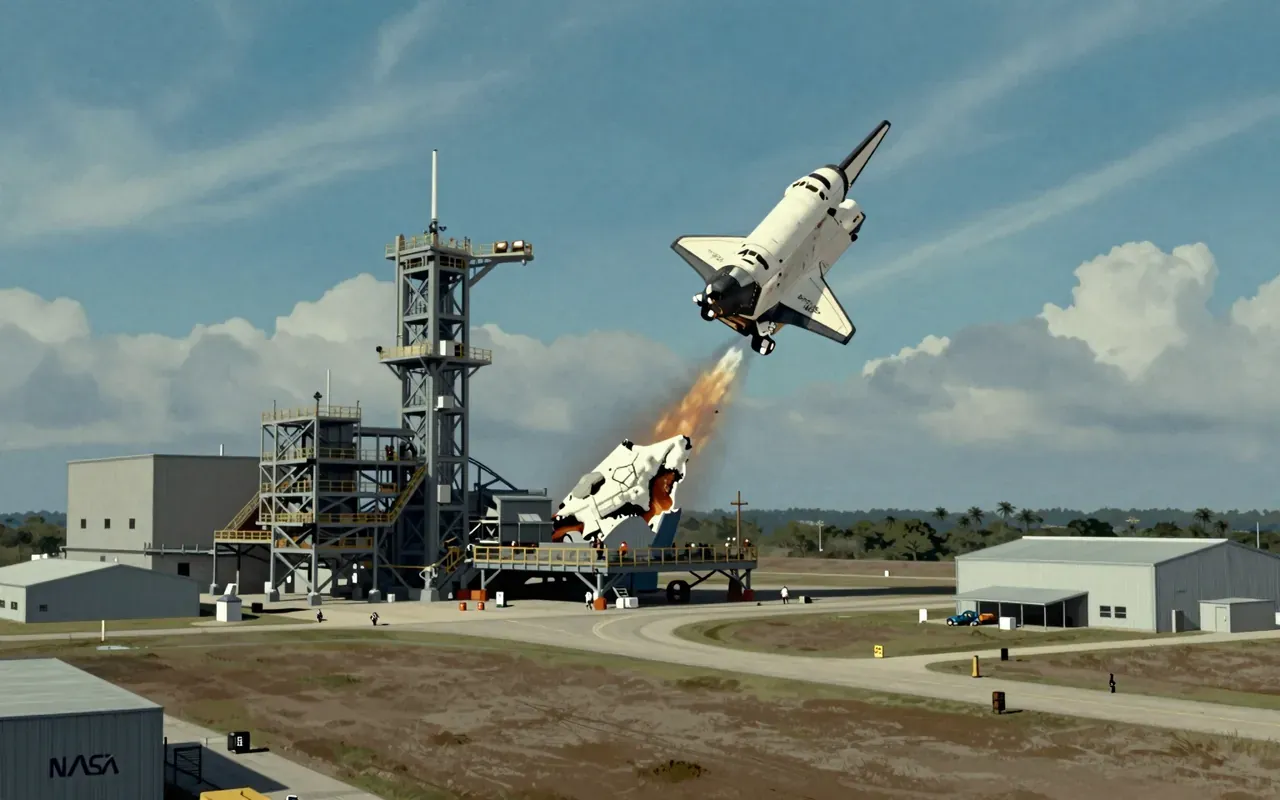
A strike 82 seconds after launch
Columbia lifted off on mission STS-107, and about 82 seconds into the launch, a piece of foam insulation roughly two feet long broke away from the external fuel tank’s left bipod attachment point and struck the reinforced carbon-carbon panels along the leading edge of the left wing at several hundred feet per second. The impact went noticed almost immediately, captured on launch footage, and it created a breach in the wing’s thermal protection system, the layer designed specifically to withstand the extreme heat generated during re-entry into the atmosphere. That breach was not visible or confirmed from inside the spacecraft, and no method existed at the time to inspect the underside or leading edge of the wing directly while the shuttle was in orbit.
Damage that went unseen during the mission
During the mission, engineers on NASA’s Debris Assessment Team and at Boeing reviewed the strike and ran damage models suggesting the breach could exceed the thermal tile thickness the wing could safely tolerate, prompting a request for imaging from the Department of Defense that could have given a clearer picture of the actual damage. Linda Ham, chair of NASA’s Mission Management Team, cancelled that request, and the crew was told by email that the foam strike posed absolutely no concern for re-entry, a judgement grounded in the fact that foam had shed from the same location on six prior occasions without ever causing structural failure to a returning orbiter, making this look, from management’s vantage point, like a known and manageable risk rather than a novel threat.
Requests for a closer look, cancelled
That judgement proved catastrophically wrong. During re-entry, as Columbia travelled at roughly Mach 23 at an altitude near 231,600 feet, superheated atmospheric gas penetrated the breach in the wing’s leading edge and began melting the aluminium structure inside the wing from within, a process invisible to the crew until sensor readings and then visible debris began indicating the vehicle was failing. The shuttle broke apart over Texas and Louisiana, killing all seven crew members aboard. The technical chain of causation held up completely under subsequent investigation: this was, as the Columbia Accident Investigation Board determined, the seventh instance of foam shedding from that specific bipod location, but the only one to cause structural damage severe enough to destroy the vehicle.
Destroyed from the inside during re-entry
What the board’s report, released in August 2003, made clear was that the technical failure sat inside a much older organisational pattern. The board found that debris shedding had affected essentially every prior shuttle flight to some degree, yet rather than treating that persistence as an unresolved danger, NASA management had progressively normalised it, one official reportedly comparing a foam strike to the functional equivalent of a foam cooler blowing off a pickup truck on the highway ahead. The board explicitly noted that this reflected the same kind of complacency that had preceded the Challenger disaster seventeen years earlier, in which acceptable risk thresholds had been lowered incrementally through a long accumulation of near-misses read as reassurance rather than as warning.
A pattern already seen once before
The consequences reached well beyond a single design fix. The board issued 29 specific recommendations, covering physical changes such as preventing foam shedding from the bipod ramp and adding on-orbit inspection capability, but also organisational changes, including the establishment of an independent Technical Engineering Authority meant to give safety concerns a channel that could not be overridden by mission management pressure in the way the imaging requests had been. NASA grounded the shuttle fleet for 29 months, added thermal imaging cameras and a robotic inspection boom to the surviving orbiters, and the board’s recommendation to retire the shuttle program by 2010 was substantially followed, with the fleet flying its final mission in 2011 after completing its remaining commitments to the International Space Station.
Twenty-nine recommendations and an end date
This is essential reading precisely because it is not a story about a single unforeseeable accident but about an organisation that had already been told, in the starkest possible terms after Challenger, what normalising known risk could cost, and that arrived at the same failure mode again through a different specific mechanism seventeen years later. The parallel between the two disasters is not incidental colour; it is the central finding of the Columbia investigation itself, and understanding how six safe foam strikes became the reasoning behind dismissing a seventh, fatal one is a genuinely instructive case study in how risk assessment degrades gradually rather than all at once. Anyone interested in organisational safety, not just space history, will find this consistently worth the time.