Looking for carbon chains from the stars
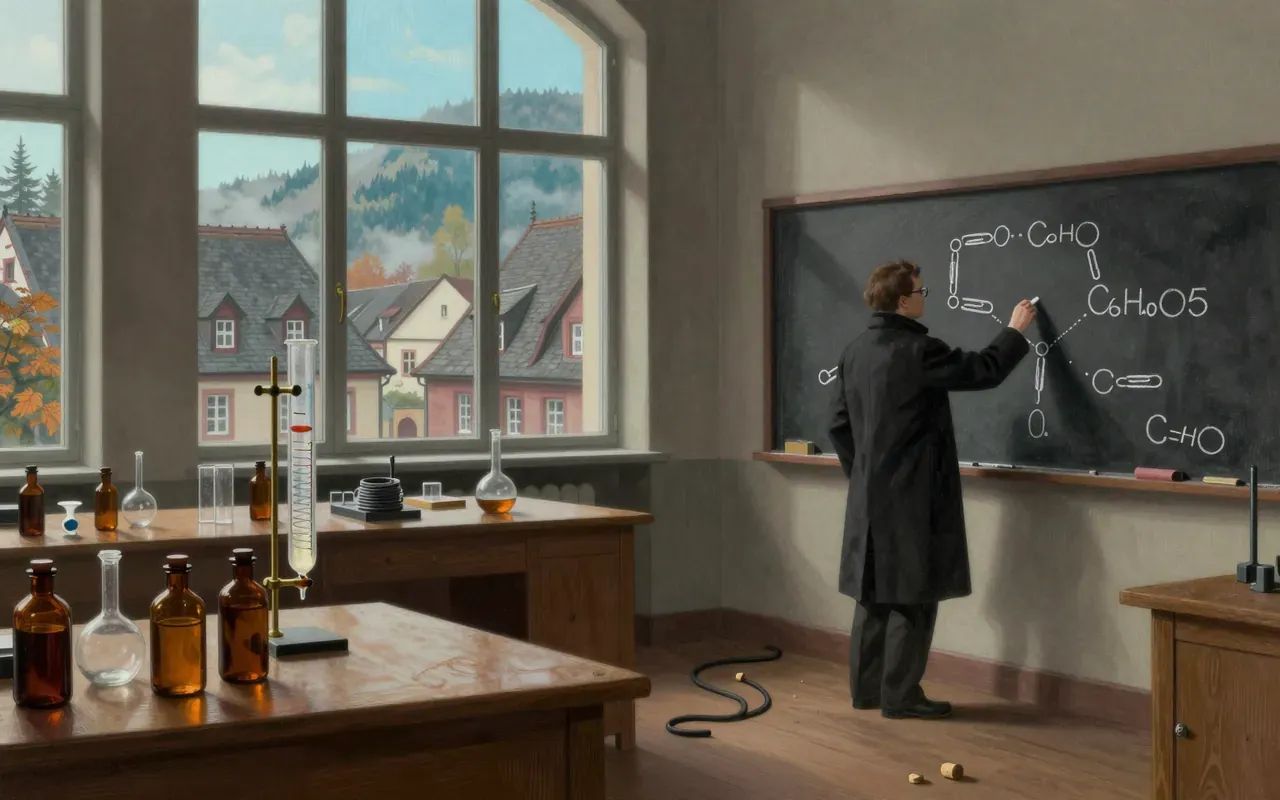
The discovery did not begin as a search for a new form of carbon. Harold Kroto had spent the years from 1967 through the mid-1980s at the University of Sussex studying unstable molecular species by spectroscopy, and laboratory measurements combined with radio astronomy observations had shown that long, linear carbon-chain molecules exist in significant abundance both in interstellar space and in the outer atmospheres of certain carbon-rich stars. The 1985 experiment with Robert Curl and Richard Smalley at Rice University was designed to recreate something like those stellar conditions in the laboratory, not to find a new structural form of an already familiar element.
A laser, some graphite, and an unexpected peak
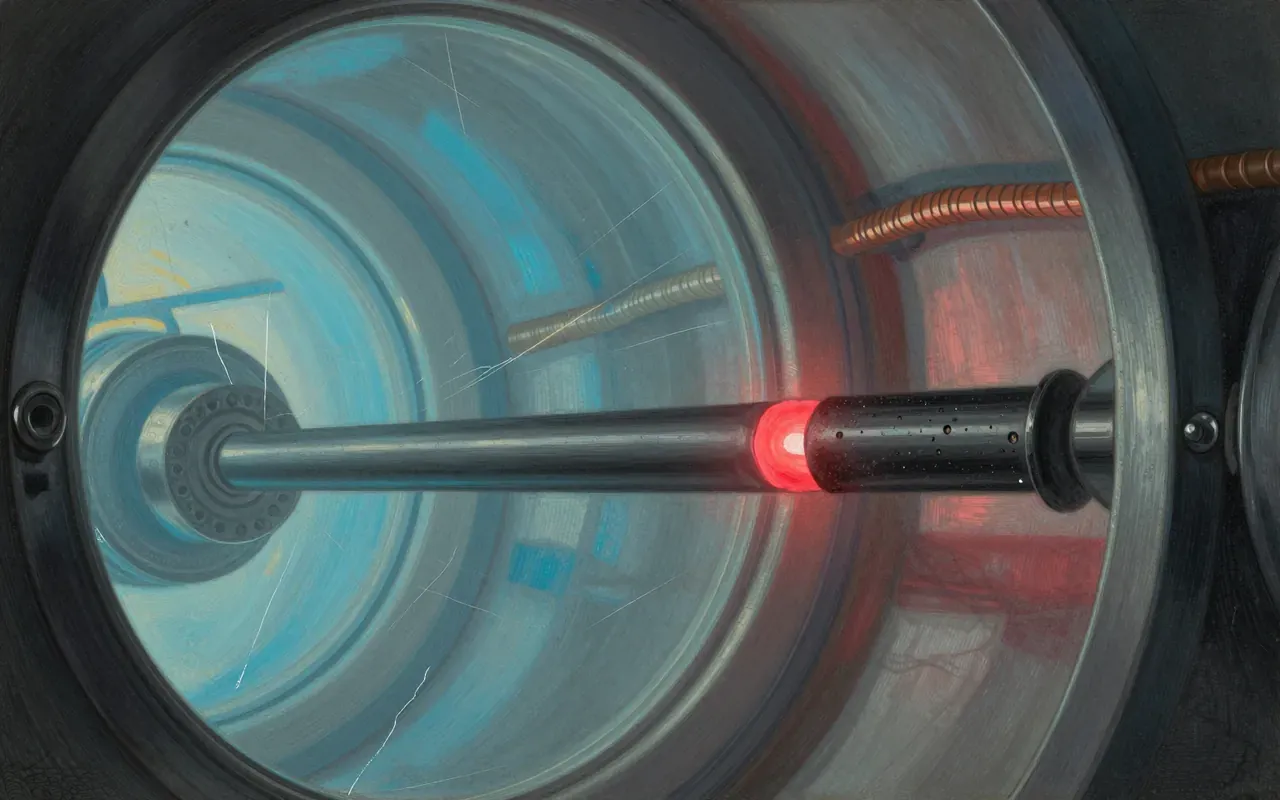
The method was to vaporise graphite with a laser inside a helium atmosphere, producing a sooty residue meant to mimic carbon condensing in a stellar outflow, working with colleagues James Heath, Sean O’Brien and Yuan Liu at Rice University’s laboratory facilities. When the resulting vapour was analysed by mass spectrometry, discrete peaks appeared corresponding to molecules containing exactly sixty or seventy carbon atoms, with the sixty-atom species standing out as unusually abundant and unusually stable compared with the general soot of scattered carbon fragments the vaporisation otherwise produced across the collection surface.
A cage shaped like a football
Working out why sixty carbon atoms should form such a stable cluster led to the molecule’s actual structure: a closed, hollow cage built from twelve five-membered rings and twenty six-membered rings of carbon, arranged in the same overall pattern as the stitched panels on a football. The team named it buckminsterfullerene, after the architect Buckminster Fuller, in recognition of the structure’s resemblance to the geodesic domes he had popularised decades earlier, and the name gave rise to fullerene as the general term for this entire family of closed carbon cages.
A third form of carbon nobody had confirmed before
What this established was that carbon had a confirmed third distinct structural arrangement beyond diamond and graphite, the two forms chemistry had long recognised as carbon’s only known solid arrangements. Where graphite’s carbon atoms sit in flat, stacked sheets and diamond’s carbon atoms form a rigid three-dimensional lattice extending outward in every direction, fullerene carbon atoms instead close entirely into a self-contained, cage-like molecule with no loose or dangling bonds left at its edges, a genuinely new structural category rather than a minor variation on either of the two previously known forms.
From a lab curiosity to nanotubes and natural deposits
The discovery opened onto further structures rather than standing alone as a single curious molecule. Carbon nanotubes, cylindrical relatives of the same closed-cage family, were identified in 1991, and fullerenes were subsequently found occurring naturally, including in a carbon-rich mineral called shungite in 1992 and, later, in cosmic dust observed by NASA’s Spitzer Space Telescope in 2010 — a fitting extension for a molecule whose original motivation had been astrophysical in the first place. Robert Curl, Harold Kroto and Richard Smalley shared the 1996 Nobel Prize in Chemistry for identifying this entire class of molecules.
A discovery worth its origin story
This is worth the time specifically because the discovery’s origin gives it a shape most chemistry stories lack: an experiment built to test an idea about carbon in dying stars turned up an entirely new terrestrial structure instead, and the connection between the two was neither forced nor incidental to the outcome. Readers interested only in fullerenes’ later applications in medicine or electronics can find that material readily elsewhere, but the 1985 discovery itself rewards attention as a case where careful spectroscopy aimed at one question produced an answer to a completely different one.