A diet that was complete and still failed
Frederick Gowland Hopkins’s 1912 claim was narrow but decisive: when animals were fed diets containing only purified protein, carbohydrate, fat, minerals and water — a diet chemically complete by every standard then in use — they failed to grow normally, and adding a small amount of milk to the same diet restored growth. The conclusion he drew was that food contains additional substances, needed only in small quantities, that are not proteins, fats or carbohydrates but are nonetheless essential — what he termed accessory food factors. This was not yet a claim about any specific vitamin, a structure, or a mechanism; it was a claim that such substances existed at all, made by demonstrating that their absence caused a measurable failure that their presence reversed.
A trial, not a discovery
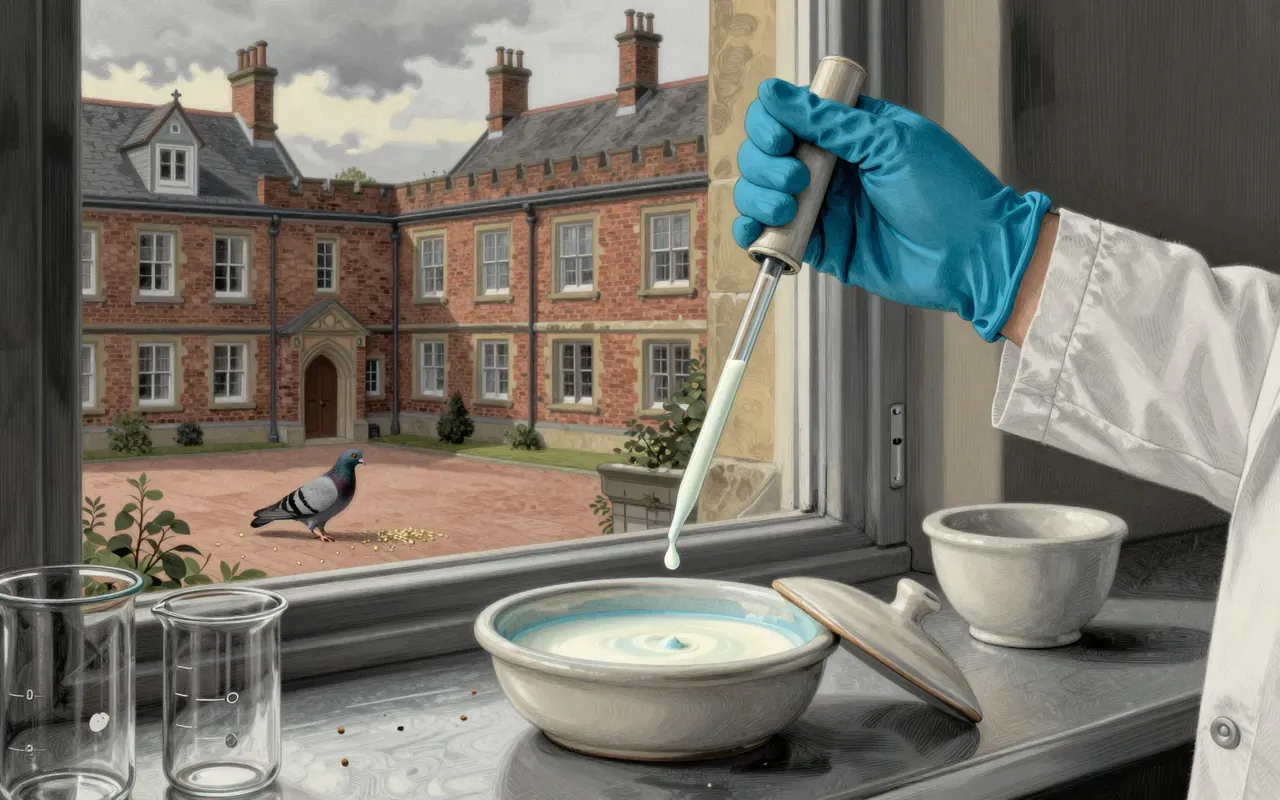
The method was a controlled feeding trial: give animals a diet that meets every known nutritional requirement as chemistry then defined it, then compare growth against animals given the identical diet plus a small addition of a natural food. Because the base diet was already complete in protein, fat, carbohydrate, minerals and water, any difference in growth caused by the addition pointed to something the analytical chemistry of the time had not identified. Hopkins was extending, and giving a systematic rationale to, observations others had already made piecemeal — Christiaan Eijkman’s finding that unpolished rice prevented polyneuritis in chickens, and earlier still, Nikolai Lunin’s demonstration that mice fed reconstituted milk components died while mice fed whole milk survived. Hopkins’s contribution was to frame these as instances of one general phenomenon rather than separate curiosities.
The catalogue that followed
The general claim has held completely: food does contain essential substances beyond protein, fat and carbohydrate, and the subsequent decades filled in exactly what those substances were. Following Hopkins’s 1912 work, thiamine was isolated in 1910 by Umetaro Suzuki and independently in 1912 by Casimir Funk, who coined the term vitamine; the naming shifted to vitamin once it was clear not all of these substances contained an amine group. Through the following decades the remaining vitamins were identified in turn — A in 1913, C, D and B2 around 1920, E in 1922, K1 in 1929, and the remaining B vitamins between 1931 and 1948 — until thirteen were recognised in total, split between four fat-soluble and nine water-soluble types. Hopkins shared the 1929 Nobel Prize in Physiology or Medicine with Eijkman for this line of work.
Centuries of clues before the explanation
What Hopkins’s 1912 experiments did not do, and could not have done with the methods available, was identify what any particular accessory factor was chemically, how many there were, or how they worked in the body — those questions were resolved separately, substance by substance, over the following thirty-six years. It would also be a distortion to credit Hopkins with the entire history of vitamin discovery: the material documents centuries of prior observation, from Egyptian recognition that liver treated night blindness to James Lind’s eighteenth-century demonstration that citrus prevented scurvy, that established the phenomena Hopkins later gave a unifying explanation for. His contribution was the general principle and the rigorous feeding-trial evidence for it, not the discovery of any single vitamin or deficiency disease.
Diseases renamed as deficiencies
Once accessory food factors were established as a real category rather than a hypothesis, deficiency diseases that had been recognised for centuries without being understood — scurvy, beriberi, pellagra, rickets — could be reclassified as consequences of a missing specific substance rather than treated as diseases in their own right with unclear causes. That reclassification is the basis of modern nutritional science and of fortified foods and dietary supplementation as public health measures, since a disease caused by the absence of an identifiable substance can be prevented by ensuring that substance is present in the diet. The distinction Hopkins established, between an adequate diet by gross composition and an adequate diet in the fuller sense, remains the working assumption behind nutrition guidance today.
A principle worth more than its details
This is a good case study in how a single well-designed feeding trial can settle a foundational question even while leaving nearly all the specifics to be worked out afterwards: Hopkins proved that something essential was missing without knowing what it was, and that distinction between establishing a phenomenon and cataloguing it is worth sitting with. It rewards attention to the decades of prior, unconnected observation — sailors, rice-fed chickens, milk-fed mice — that Hopkins’s framework retrospectively made sense of, which is a reminder that a scientific breakthrough is often less a sudden discovery than a synthesis of evidence others had already gathered. Anyone wanting the chemistry of individual vitamins will need the later, substance-specific history; this material is about the founding claim, not the full catalogue.