Earth moves, the Sun stays still
Nicolaus Copernicus’s 1543 book On the Revolutions of the Heavenly Spheres proposed that the Sun, not Earth, sits near the centre of the universe, with Earth rotating daily on its own axis and completing a yearly orbit around the Sun, an arrangement that explained the puzzling backward motion planets sometimes appear to trace across the night sky as a natural consequence of Earth’s own movement rather than a special quirk of each planet individually. The claim was specific and mathematical, not a loose philosophical suggestion: Copernicus worked out a full geometric model intended to predict planetary positions, publishing it as a serious rival to the long-established Earth-centred system associated with Ptolemy. What made the proposal genuinely radical was not any single observation, since Copernicus had no direct evidence Earth moved that his contemporaries lacked, but the reassignment of motion itself, taking movement away from the heavens and giving it instead to the ground beneath everyone’s feet.
Still circles, still epicycles
Copernicus’s model was, in important respects, less of a clean break from the old system than its later reputation suggests. He kept the assumption that planets move in perfect circles at uniform speed, an inheritance from Ptolemaic astronomy that turned out to be wrong, and to make circular orbits fit the observed data he still needed roughly thirty-four separate epicycles, small circles layered on top of the main orbits, a number not meaningfully lower than the machinery required by the geocentric system it was meant to replace. The one specific improvement most contemporary astronomers actually valued was Copernicus’s removal of Ptolemy’s equant, an off-centre reference point that had technically violated the principle of uniform circular motion; that removal was treated as an aesthetic and philosophical gain rather than a practical one, since Copernicus’s system did not, at first, produce more accurate predictions of planetary positions than the system it challenged.
Kepler’s ellipses, Galileo’s telescope
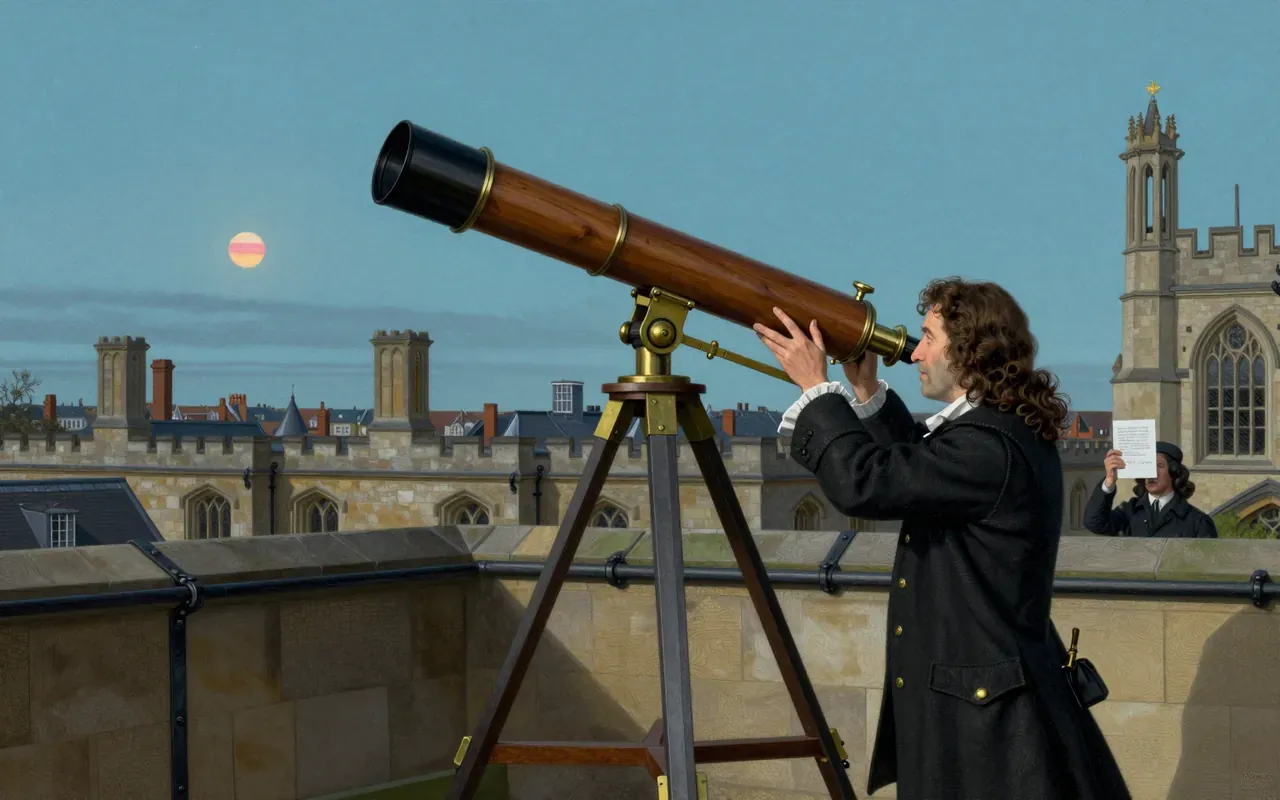
Copernicus’s central claim, that Earth orbits the Sun rather than the reverse, has of course held up completely, but it took nearly a century of further work by other people to become the accepted picture, and the philosopher Thomas Kuhn later used exactly this gap to argue that Copernicus’s book mattered less for what it itself demonstrated than for what it eventually caused others to say. Johannes Kepler supplied the first genuinely decisive practical advantage, replacing Copernicus’s circular orbits and epicycles with elliptical ones in his Rudolphine Tables, which predicted planetary positions with a level of accuracy the old geocentric system could not match, converting astronomers through demonstrated computational superiority rather than philosophical preference. Galileo’s telescopic observations from 1610 onward, particularly his discovery that Venus showed a full range of phases, a pattern the geocentric model could not explain but heliocentrism could, supplied the observational evidence that finally made the Ptolemaic alternative look untenable rather than merely less elegant.
Decades of lukewarm reception
What Copernicus’s original 1543 publication did not achieve, and could not have achieved on its own, was broad contemporary acceptance of Earth’s actual physical motion. Reception stayed lukewarm for decades: Martin Luther reportedly dismissed Copernicus as a fool, citing the Book of Joshua as evidence the Sun itself moved, and forty-five years after publication the astronomer Tycho Brahe still constructed an alternative model keeping Earth fixed at the centre while having other planets orbit the Sun, a compromise system that shows how unsettled the question remained well into the late sixteenth century. The Catholic Church stayed officially silent on the theory for roughly sixty years after Copernicus’s death, even using his mathematical tables to help reform the calendar in 1582, before declaring heliocentrism false and contrary to scripture in 1616 and later placing Galileo under house arrest in 1633 for defending it.
From silence to trial
The Copernican model’s consequences reached well past astronomy, reshaping how people understood humanity’s place in the universe more broadly. Once Earth was demoted from a fixed, central body to one ordinary planet circling an unremarkable star, the hierarchical, purpose-laden cosmos many had assumed gave way to something the historian Alexandre Koyré later described as a devalorised, purely quantitative universe, a shift in framework as significant as any specific astronomical prediction. Thomas Kuhn’s use of the episode as his central example of a scientific paradigm shift in The Structure of Scientific Revolutions turned the Copernican story into a template for understanding how scientific fields change more generally, not through a single decisive proof but through a slow accumulation of better evidence and a generational turnover in who accepts which framework as basic common sense.
A template for how paradigms actually shift
This is worth understanding closely because the popular version, Copernicus proved Earth orbits the Sun and everyone eventually agreed, badly compresses a genuinely instructive ninety-year process spanning publication in 1543 to Galileo’s trial in 1633. It rewards attention to the uncomfortable middle fact that Copernicus’s own model was not more accurate and not meaningfully simpler than the system it challenged, since that detail is exactly what makes Kepler’s and Galileo’s later, separate contributions so important rather than redundant. Readers should come away with a more accurate picture of how major scientific reframings actually happen, gradually, through multiple people’s separate work over generations, rather than through one dramatic and immediately convincing publication. As an origin story for how astronomy actually changed its mind, it is unusually well documented and worth the full ninety-year arc.