A radiation found while looking for something else
In 1903, Prosper-Rene Blondlot, a respected physicist at the University of Nancy, was attempting to polarise X-rays when he reported noticing subtle changes in the brightness of an electric spark that he attributed to a previously undiscovered form of radiation. He named the new rays after his university and described them as emanating from most substances, including, in some reports, the human body, with certain materials such as green wood and specific treated metals said to behave differently. The claim spread quickly within the French scientific community, and over the following period roughly 120 scientists published around 300 papers describing their own successful detections of N-rays, including well-regarded researchers such as Augustin Charpentier and Arsene d’Arsonval, giving the phenomenon the appearance of a broadly replicated and credible discovery.
Roughly 300 papers confirming it
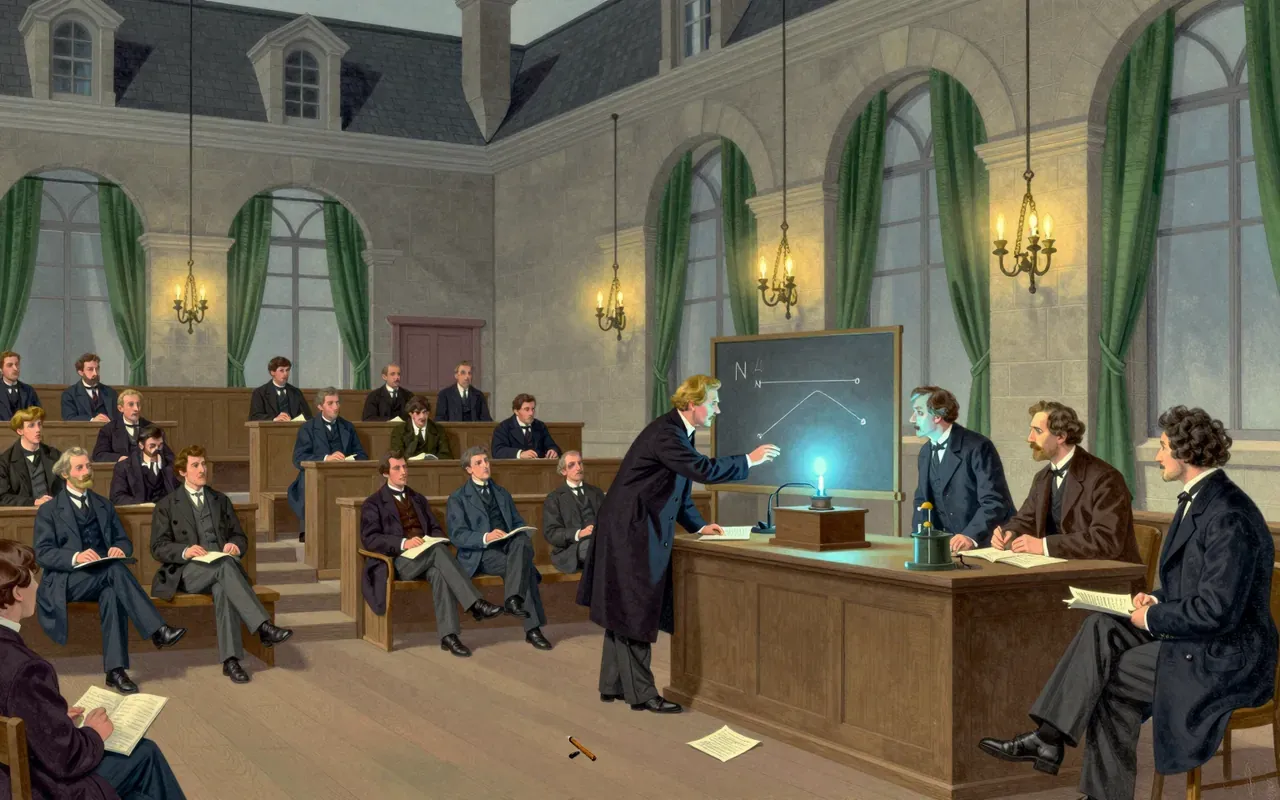
Scepticism grew outside France, particularly in Britain and the United States, where researchers had been unable to reproduce Blondlot’s results in their own laboratories. The journal Nature arranged for the American physicist Robert Wood to travel to Nancy in 1904 to observe Blondlot’s experiments firsthand under normal operating conditions. During a demonstration conducted in a darkened room, where subtle changes in spark brightness were meant to be judged by eye, Wood quietly removed the aluminium prism that was supposed to be essential to producing the N-ray effect in the apparatus. The experimenters continued to report observing the same changes in brightness they always had, entirely unaffected by the missing component that the underlying theory required.
A journal sends an outsider to look
Wood carried out a second, similarly decisive test during the same visit, secretly substituting an ordinary block of wood for a metal file that was supposed to be actively emitting N-rays as part of the demonstration. Once again, the reported observations continued without any noticeable change, even though the object supposedly responsible for the effect had been removed from the setup entirely. Taken together, the two tests held up as conclusive evidence that whatever the observers in Blondlot’s laboratory were reporting bore no relationship to any actual physical apparatus or radiation, since removing the components the theory depended on made no measurable difference to what people believed they saw.
Removing the prism in the dark
What the episode does not offer is a single, clean villain or a story of deliberate fraud on Blondlot’s part specifically; the material notes he may himself have been misled by a laboratory assistant who confirmed his observations, and there is no clear evidence he set out to deceive anyone. Nor does the material fully account for the underlying psychological or perceptual mechanism that let so many independent, trained researchers report matching results from an apparatus that was, by Wood’s demonstration, doing nothing at all. What is well established is the outcome: by 1905 the broader scientific community outside Nancy had rejected N-rays as non-existent, even though Blondlot himself reportedly maintained his belief in the phenomenon for decades afterward.
Swapping the emitting object for wood
The wider significance of the N-ray episode lies less in the specific claim, which is long forgotten as physics, than in what it revealed about how expectation and social confirmation can sustain a false result across dozens of independent researchers and hundreds of published papers, all without any of the usual markers of fraud or incompetence. It has become a standard case study in the history and philosophy of science for what is now called pathological science, situations where researchers, often in good faith, continue to report a phenomenon that turns out to have no objective basis, sustained by subtle observer bias and a research community reinforcing each other’s expectations rather than independently and rigorously testing the underlying claim.
A lesson in seeing what you expect
This is well worth the time because it is a genuinely instructive story about the limits of replication as a safeguard against error, since replication here was not scarce, roughly 120 scientists and 300 papers is a substantial evidentiary record by the standards of the time, and it still amounted to nothing once someone actually tested the apparatus’s dependence on its own supposedly essential components. Wood’s two specific interventions, pulling the prism and swapping the file, make for a satisfying and concrete demonstration of how a good sceptical test should work: simple, decisive, and aimed directly at whether the claimed mechanism, not just the reported outcome, actually held up. It rewards anyone who wants to understand scientific self-correction in its most literal, hands-on form.