Colour patterns that would not stay put
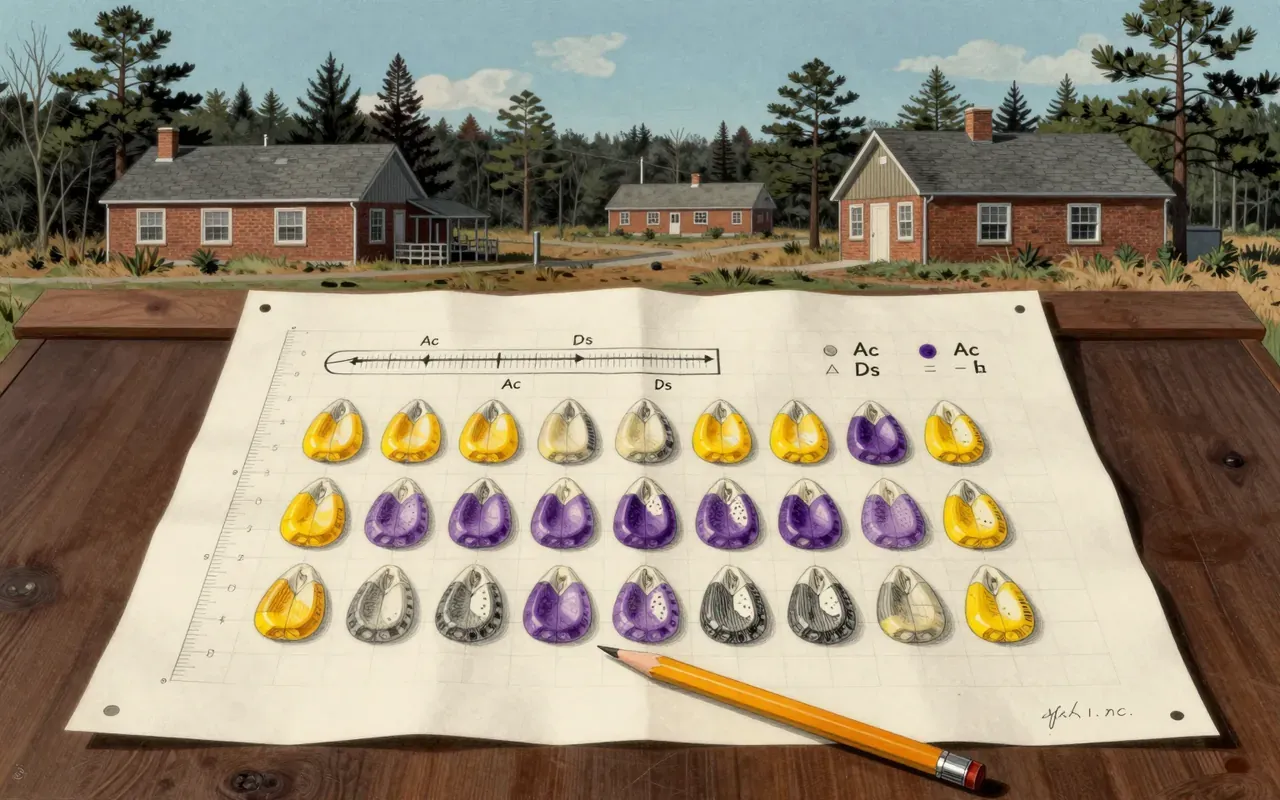
At Cold Spring Harbor Laboratory in the mid-1940s, Barbara McClintock was breeding maize and tracking an oddity: kernels and leaves sometimes showed patchy, unstable colour patterns that did not fit the standard picture of genes sitting at fixed positions on a chromosome and behaving predictably from one generation to the next. Rather than treat the instability as noise, she followed it through repeated crosses and identified two genetic elements responsible, which she named Dissociation, or Ds, and Activator, or Ac. In 1948 she reached a conclusion that broke sharply with the genetics of the time: these elements were not fixed in place but could change their position on the chromosome, and Ac controlled whether and when Ds moved and caused chromosome breakage.
Naming Dissociation and Activator
McClintock’s evidence came from painstaking genetic and microscopic work rather than any molecular technique, since the tools to examine DNA directly did not yet exist. She crossed maize plants over many generations, recorded the resulting mosaic colour patterns kernel by kernel, and used a microscope to examine the plants’ chromosomes directly, correlating visible chromosome breaks with the inheritance patterns she was tracking. By comparing how the colour instability behaved when Ac was present or absent, she worked out that Ac was needed to activate Ds and trigger its movement, and that the same controlling elements could switch other genes on or off depending on their position, a mechanism she proposed could help explain how genetically identical cells in one organism come to behave differently from one another.
A 1950 report met with silence
McClintock published her account of these mobile controlling elements in 1950 and presented it at the Cold Spring Harbor Symposium the following year, where it was met, in her own description, with puzzlement and even hostility, since it contradicted the prevailing assumption that genes occupied permanently fixed chromosomal addresses. She continued the genetic work through the early 1950s but largely stopped publishing on the subject after 1953 in the face of continued scepticism. Vindication came from an unrelated direction: when researchers found similar mobile elements in bacteria in the late 1960s and early 1970s, and subsequent molecular cloning confirmed that Ac and Ds were themselves transposons, the maize findings from two decades earlier were recognised as correct.
Bacteria catch up with maize
The original genetic and microscopic evidence, however careful, could not by itself reveal the molecular mechanism of transposition, how an element actually excises itself and reinserts elsewhere in the genome, since that required cloning the DNA sequences involved, work that followed only once molecular biology had developed the tools to do it. Nor did McClintock’s maize work establish how common or significant transposable elements would turn out to be across other species; that broader picture, and the classification of elements into cut-and-paste DNA transposons and copy-and-paste retrotransposons, came from a much wider body of research conducted by many laboratories over the following decades, including later molecular characterisation credited to Nina Fedoroff and others.
From oddity to nearly half the genome
Once transposable elements were accepted, they turned out to be far from a maize curiosity: they make up roughly half of the maize genome and nearly half of the human genome, meaning a substantial share of what had been treated as inert or purely structural DNA is, in fact, mobile genetic material with a documented history of movement. That reframing matters beyond genetics as a discipline, since transposable elements are now understood to reshape genomes over evolutionary time, contribute to processes such as antibody diversity in the immune system, and, when they land in the wrong place, cause disease by disrupting genes such as those involved in blood clotting or tumour suppression.
A vindication thirty years in coming
This is worth the time because it is one of the clearest cases in twentieth-century science of a correct, carefully argued result being set aside for reasons that had more to do with prevailing assumptions than with the quality of the evidence. McClintock kept working from the same maize field and the same microscope for years after her results stopped being taken seriously, and it took an entirely different organism, bacteria, to bring the field back around. The 1983 Nobel Prize, awarded to her alone more than thirty years after the original observations, is as much a story about how long good evidence can sit unrecognised as it is about the biology itself.