sciencebriefs
all subjects →
9:53in productionCh. 1 · The Patent Before the Picture/ 9:53 · ceiling 15 min
Engineering · Physics

Vladimir K. Zworykin

Zworykin didn’t invent television—he weaponised the cathode-ray tube and made it central to its first electronic incarnation.

Zworykin's contribution was architectural and instrumental: he defined a cathode-ray framework for electronic television and then engineered key parts—including the iconoscope—within it. His 1923 patent was conceptual; his 1931–34 work produced hardware. He did not single-handedly create television, nor did his system immediately dominate. But he fixed the cathode-ray tube at the centre of its electronic future.

Chapters & takeaways4
  1. 0:47
    The Patent Before the Picture

    Zworykin’s 1923 patent described cathode-ray tubes as both transmitter and receiver—before any working prototype existed.

  2. 2:19
    From Lab Bench to Camera Tube

    The iconoscope emerged from lab experiments starting in April 1931—not theoretical design alone, but iterative hardware work.

  3. 3:57
    A System Built on Electron Beams

    He invented a full television system architecture—not just a component—but one built entirely around cathode-ray physics.

  4. 6:04
    Beyond Broadcast: Tools for Seeing

    His influence extended beyond television: he helped develop charge storage tubes, infrared image tubes, and the electron microscope.

Worth your time?

Yes. Study the whole thing.

3.5/ 5
What works
  • 1923 patent application
  • 1931–34 iconoscope development
  • collaboration with Telefunken in 1934
  • contributions to infrared image tubes and electron microscope
What does not
  • proof
  • breakthrough
  • sole inventor
  • first working television
Study it if
  • historians of technology
  • engineers studying imaging hardware lineage
  • patent law scholars
Skip it if
  • general science audiences seeking foundational discoveries
  • those looking for consensus-defining results
The written brief1 min read

What the work claims

Zworykin claimed a complete television system using cathode-ray tubes for both transmission and reception—and later delivered a functional camera tube (the iconoscope) based on that principle.

How it was done

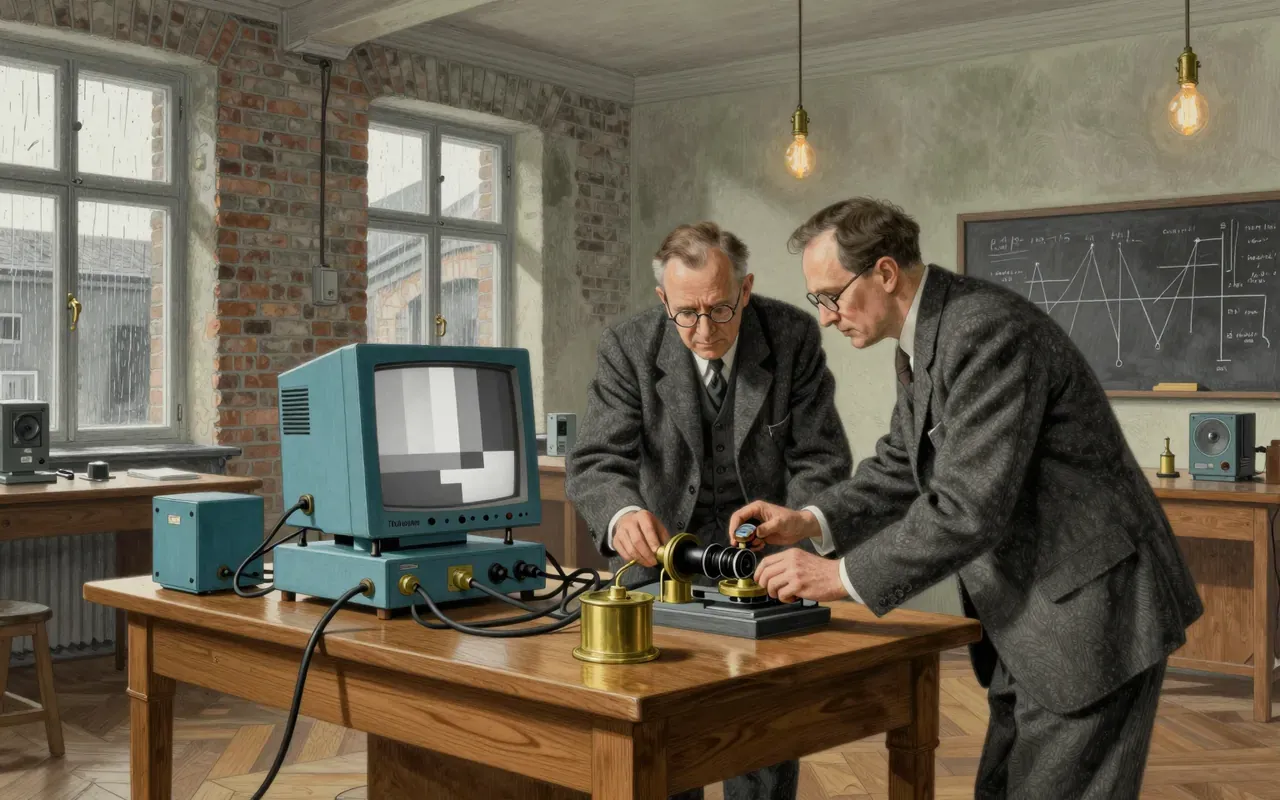
Zworykin applied for a US television patent in 1923 describing cathode-ray tubes as both transmitter and receiver. His experiments from April 1931 led to the iconoscope camera tube, named on 23 October 1931.

What holds up

Zworykin invented a cathode-ray–based television transmitting and receiving system. He played a role in practical television development from the early 1930s—including charge storage tubes, infrared image tubes, and the electron microscope. He filed the 1923 patent and developed the iconoscope through lab experiments beginning April 1931.

What does not

The sources do not establish that Zworykin’s 1923 system was built, demonstrated, or functional. They do not credit him with sole invention of television, nor do they show his system displaced competing technologies.

Why it matters beyond the lab

This work helped anchor television engineering in cathode-ray physics at a time when mechanical and hybrid systems still competed. It enabled scalable electronic imaging, but only as one strand among several parallel developments.

Is it worth your time

Yes—if you need to trace how cathode-ray television systems moved from patent claims to working hardware in the early 1930s.

Same field · Engineering4 of 36
Up next in Science

Wendy Freedman

· 9:30

She pinned down how fast the Universe expands — not with theory, but with stars as rulers.

9:30