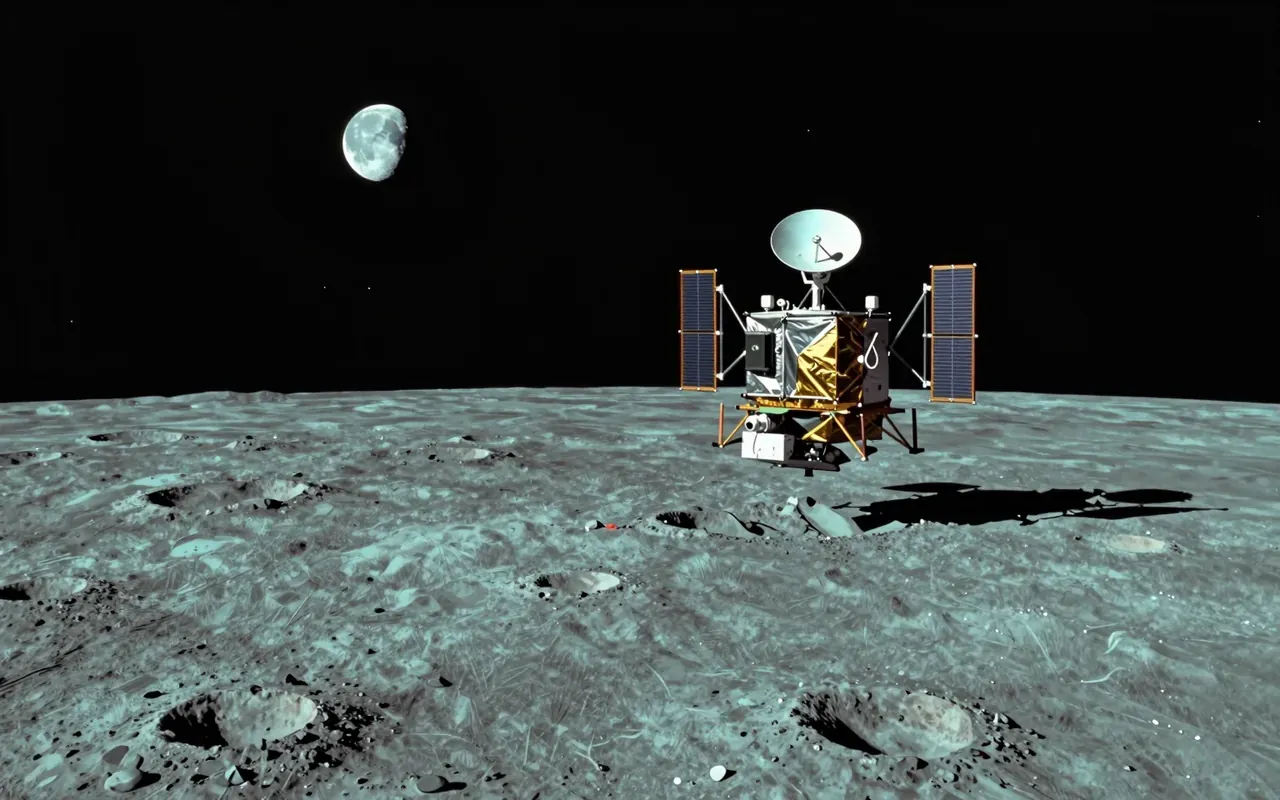
9:53in productionCh. 1 · Japan saw it first/ 9:53 · ceiling 15 min
Astronomy & space · Engineering
Third-party evidence for Apollo Moon landings
Apollo happened — and the world’s space agencies have all seen it for themselves.
Third-party evidence for Apollo Moon landings is observational, multi-national, and instrumentally diverse — but limited to orbital imaging. It confirms presence, location, and surface disturbance. It does not confirm crew activity, sample return, or scientific measurements taken on-site.
JAXA’s SELENE probe delivered the first post-Apollo orbital images confirming human landings — including blast-disturbed soil at Apollo 15.
2:49
India confirmed it twice
India’s Chandrayaan-1 detected disturbed soil; Chandrayaan-2 directly imaged the Apollo 11 descent stage.
4:22
China claims it — but shows nothing
China’s Chang’e 2 has the resolution to spot Apollo hardware — but no public imagery confirms it.
5:40
Korea resolved it
South Korea’s Danuri resolved landers at two Apollo sites in 2023 — the clearest third-party visual confirmation yet.
6:51
The USSR watched it live
The Soviet Union monitored Apollo in real time — not as skeptics, but as adversaries with full technical capability.
Worth your time?
Yes. Study the whole thing.
4.5/ 5
What works
confirms hardware presence
cross-validates landing locations
documents surface disturbance
demonstrates global observational consensus
What does not
proves astronaut presence
confirms surface experiments
validates Apollo science results
replaces NASA archival evidence
Study it if
historians
science educators
space policy analysts
Skip it if
planetary geologists seeking new regolith data
engineers designing next-gen landers
The written brief1 min read
What the work claims
That multiple sovereign space agencies have independently observed physical evidence of Apollo landings — including disturbed regolith, descent stages, and rover tracks — using their own spacecraft and instrumentation.
How it was done
Multiple space agencies used their own lunar orbiters — JAXA’s SELENE (2008), ISRO’s Chandrayaan-1 and Chandrayaan-2 (2008, 2021), CNSA’s Chang’e 2 (2010), and KARI’s Danuri (2023) — to image Apollo landing sites. The Soviet Union monitored Apollo missions via its Space Transmissions Corps.
What holds up
SELENE (2008) photographed light-coloured dust disturbance from Apollo 15’s Falcon engine blast. Chandrayaan-2 (2021) imaged the Apollo 11 Eagle descent stage. Danuri (2023) resolved landers at both Apollo 11 and Apollo 17 sites. All were captured by independent orbiters, with no reliance on NASA data or processing.
What does not
Chang’e 2’s claimed detection of Apollo hardware lacks publicly identified imagery. Chandrayaan-1 could not resolve hardware — only disturbed soil. No source reports spectroscopic, thermal, or in-situ verification. No third party recovered or analysed surface samples.
Why it matters beyond the lab
It transforms Apollo from a historically contested US claim into an empirically anchored, multi-national observational fact — one verified across political, technological, and temporal boundaries.
Is it worth your time
Yes. It delivers direct, independent observational confirmation of Apollo landings using diverse national assets — not NASA instruments, not models, not testimony.