A mountain and a mist
The claim is that a sufficiently large volcanic eruption can cool the whole planet for a year or more, not just the area around it. Mount Tambora’s eruption in April 1815 is the best-documented case: it threw enormous quantities of ash and sulphur high into the atmosphere, and the sulphur reacted with water vapour to form fine sulphate droplets that spread through the stratosphere. Those droplets reflected incoming sunlight back to space while also warming the stratosphere itself, and the effect did not fade quickly. The following year, 1816, became known as the Year Without a Summer, with reduced sunlight and lower temperatures recorded across widely separated parts of the world, from North America to Europe to Asia.
The summer that did not come
The evidence for 1816 comes from ordinary human records rather than instruments built for the purpose. Frosts hit parts of New England in June, and snow fell in places like Albany and Dennysville that month; observers described frost recurring in most months of the growing season, and the price of oats in the region rose sharply as harvests failed. Europe suffered widespread crop failure and food shortages severe enough to trigger unrest. Cold and disrupted weather were also reported in China, where the monsoon pattern was affected, and in northeastern Brazil, which saw a severe drought. A persistent dry haze dimming the sun was noted in North America at the time, consistent with a stratospheric aerosol veil.
Reading the ice and the rings
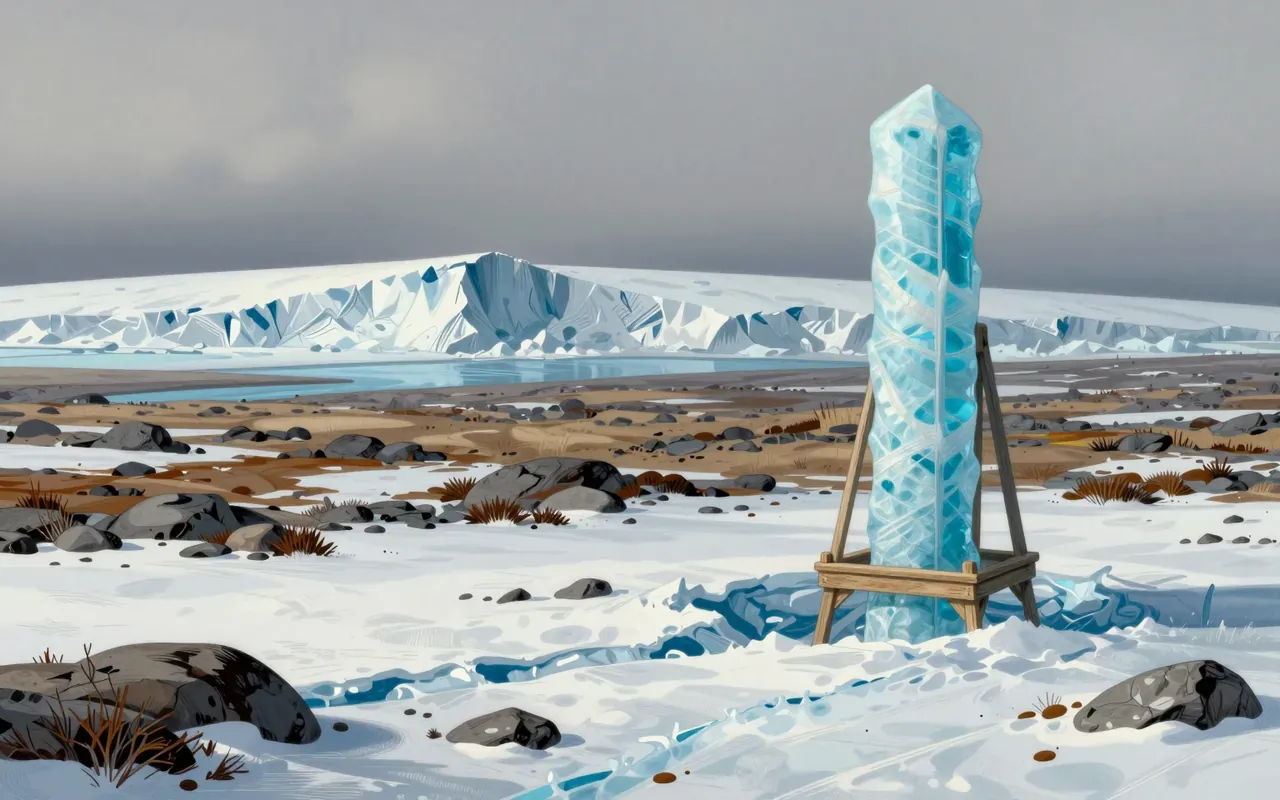
Beyond written accounts, ice cores from Greenland record a spike in sulphate concentration matching the timing of the Tambora eruption, giving physical confirmation of the aerosol veil that written sources describe only indirectly. The same approach, reading sulphate layers in ice cores alongside tree-ring records of reduced growth, has let researchers identify and roughly date volcanic winters going back thousands of years, including large eruptions in antiquity and prehistory. A 2012 analysis of land temperature records found a measurable drop in global land temperature in the period following the Tambora eruption. Together these independent strands, contemporary accounts, ice cores, tree rings and modern temperature analysis, support the same underlying mechanism of stratospheric sulphate cooling.
The mechanism
What does not hold up as neatly is any simple rule that a bigger eruption means more cooling. The amount of cooling an eruption produces depends less on how explosive it is and more on how much sulphur it injects into the stratosphere, and those two quantities do not reliably track each other. Some of the largest known eruptions have left cooling signals that are smaller or more ambiguous than their size would suggest, and reconstructions of very old eruptions, including the enormous Toba eruption tens of thousands of years ago, disagree on whether the expected severe cooling actually shows up in the geological record. Regional responses to the same eruption also vary substantially, with some locations showing clear cooling and others showing little.
Where size stops predicting cooling
The wider importance of this work is that volcanic winters give climate scientists a natural experiment in how the planet responds to a sudden reduction in sunlight, which helps calibrate the same models used to study other kinds of climate forcing. Understanding how sulphate aerosols behave in the stratosphere, how long they persist, and how unevenly their cooling effect spreads across regions has also fed into discussions of deliberate solar geoengineering proposals that would inject aerosols on purpose. Historically, the disruption caused by the Tambora-linked famines and unrest is cited as a reminder that climate shocks lasting only a year or two can still have severe human consequences well beyond the region where the eruption occurred.
Disagreement over the details
This is worth the time for anyone who wants to see how a documented historical disaster becomes durable scientific evidence, since the Year Without a Summer offers an unusually rich paper trail of crop prices, frost dates and travellers’ accounts that can be checked against physical records like ice cores. It rewards patience with the caveat that eruption size alone will not tell you how much cooling to expect, and that older or more contested eruptions still generate real disagreement among researchers. Readers wanting a single tidy figure for how many degrees a big eruption cools the world will be mildly frustrated, but that unevenness is itself part of an honest picture of how volcanic winters actually work.