A cold snap inside a warming world
The claim is that Earth’s climate does not always change gradually, and the Younger Dryas is the best-documented case of it changing very fast. Around 12,900 years ago, as the planet was warming out of the last glacial period, the Northern Hemisphere abruptly reversed into a cold phase that lasted roughly 1,200 years before ending, again abruptly, close to 11,700 years ago. Temperatures fell by several degrees across North America and Europe, and considerably more in Greenland, mostly in winter, while summers changed comparatively little. This matters because it shows the climate system is capable of large, rapid swings within a human lifetime, not only slow drift over millennia, and understanding what triggered one such swing tells us something about how fragile the system can be.
How fast the cooling and warming were
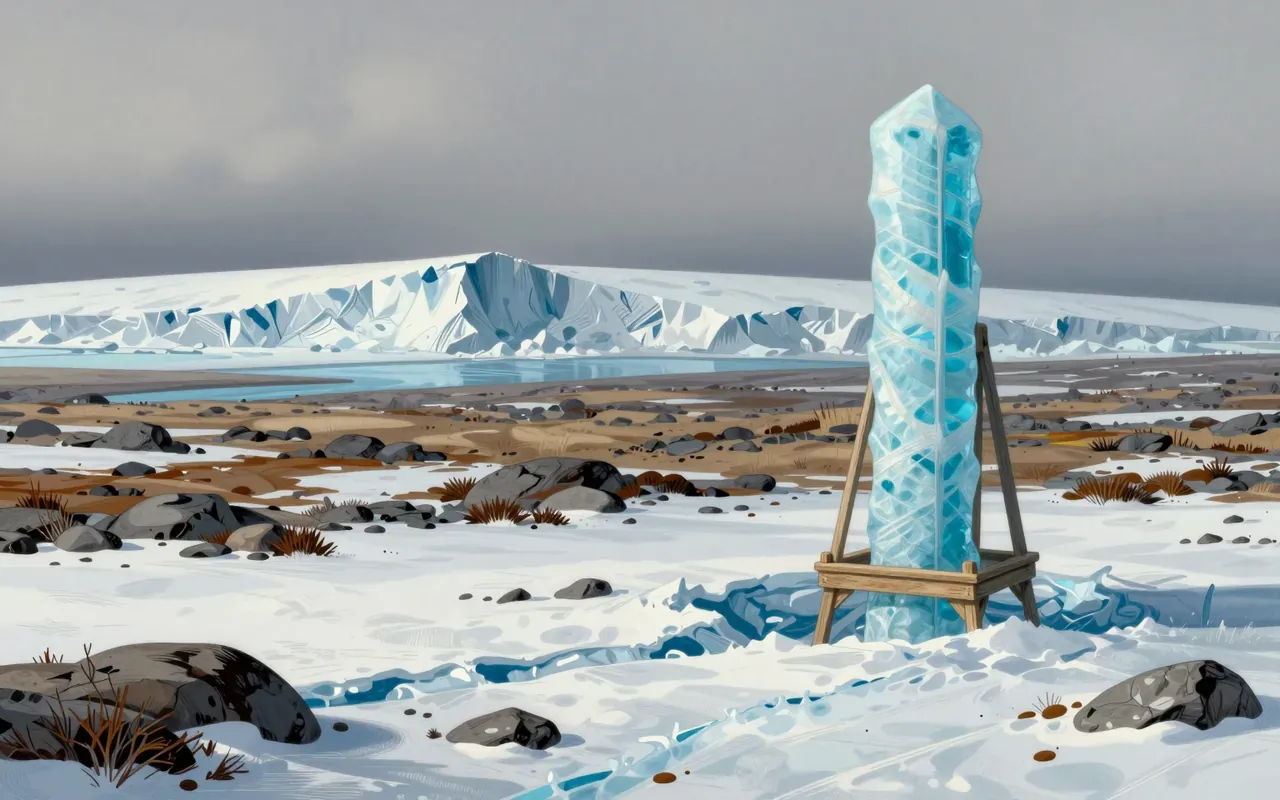
Ice cores from Greenland allow the timing of the Younger Dryas to be measured with unusual precision, because each year of snowfall leaves a distinct layer. These records show that a large share of the cooling in Greenland took place over a matter of decades, and some analyses suggest parts of the shift occurred within just a few years. The recovery at the end of the period was similarly fast, with warming back to near pre-Younger Dryas conditions unfolding over roughly fifty to sixty years in the Northern Hemisphere, though tropical regions recovered more gradually over centuries. This asymmetry between an abrupt Northern Hemisphere shift and a slower tropical response is itself a clue to the mechanism involved.
The ocean-circulation explanation
The scientific consensus attributes the cooling to a substantial weakening of the Atlantic Meridional Overturning Circulation, the system of currents that carries warm water northward in the Atlantic. Weakening this circulation reduces the heat delivered to the North Atlantic region and produces a so-called polar seesaw, in which the Northern Hemisphere cools while parts of the Southern Hemisphere warm, a pattern that shows up in the records. The most commonly cited trigger is a large discharge of fresh glacial meltwater into the North Atlantic, historically attributed to glacial Lake Agassiz, though more recent sediment evidence points toward a routing of that meltwater through the Mackenzie River rather than the Saint Lawrence Seaway previously assumed.
A volcanic contribution, still debated
A further complication is that elevated volcanic activity appears in both ice cores and cave mineral deposits immediately before the Younger Dryas began, raising the possibility that a high-latitude eruption helped push an already weakening ocean circulation past a tipping point by encouraging sea ice growth. This volcanic contribution has not been confirmed to the same degree as the meltwater and circulation mechanism, and researchers continue to debate how much weight it deserves, partly because candidate eruptions such as the Laacher See event do not line up precisely with the onset date. The meltwater-and-circulation account also has to explain why sea level does not show the rise that a very large discharge might be expected to produce.
The comet hypothesis, tested and found wanting
The rival explanation, that a comet or asteroid impact around 12,900 years ago triggered the cooling and contributed to megafauna extinctions, has received sustained independent scrutiny since being proposed in the mid-2000s. Researchers examining the specific evidence offered, including reported nanodiamonds, magnetic spherules, unusual black soil layers, and a platinum spike in a Greenland ice core, have repeatedly found it does not hold up: some materials were later identified as ordinary biological remains, one proposed impact crater was dated to tens of millions of years earlier, and a widely cited platinum anomaly was later shown to have occurred decades after the Younger Dryas began and to match a known period of volcanic activity rather than an impact. Most specialists now reject the impact hypothesis.
Why the argument matters
This is worth the time because it shows two things happening at once: a real, well-supported case of the climate system tipping abruptly, and a public record of how a competing but weaker hypothesis was tested and largely dismantled through independent replication rather than argument alone. The ocean-circulation explanation is not without its own loose ends, particularly around the exact meltwater pathway and the size of any volcanic push, and readers should not mistake consensus for certainty on every detail. But the contrast between how the leading hypothesis has been refined through evidence and how the impact hypothesis was checked and found wanting is a useful worked example of how contested science actually gets resolved, or at least narrowed.