Naming an epoch of human influence
The claim under examination has two parts that are often run together. The first is that human activity has become powerful enough to leave a distinct, global mark on the rock and sediment record, comparable to the boundaries that separate past geological epochs. The term Anthropocene, first used informally by Eugene Stoermer and then popularised from 2000 onward by the atmospheric chemist Paul Crutzen, names this idea. The second, related but separate, claim is that this same period of human dominance has driven a substantial and measurable wave of species decline and extinction, sometimes called the Holocene extinction. The first claim is a formal question about geological classification; the second is an ongoing empirical tally from ecology and conservation biology.
The search for a start date
Settling the geological question required agreeing on when the epoch began, and researchers proposed several candidate dates. Crutzen originally suggested the Industrial Revolution around 1780. Others pointed to a mid-twentieth-century Great Acceleration in population, industrial output and fossil fuel use, marked physically by a spike in radioactive fallout from nuclear weapons testing. A minority view, associated with the paleoclimatologist William Ruddiman, argued for a much earlier start thousands of years ago, tied to the beginnings of agriculture and its effects on atmospheric carbon dioxide and methane. The Anthropocene Working Group, established under the International Commission on Stratigraphy in 2009, spent years weighing these options before a 2019 vote favoured the mid-twentieth-century option.
A lake chosen as the marker
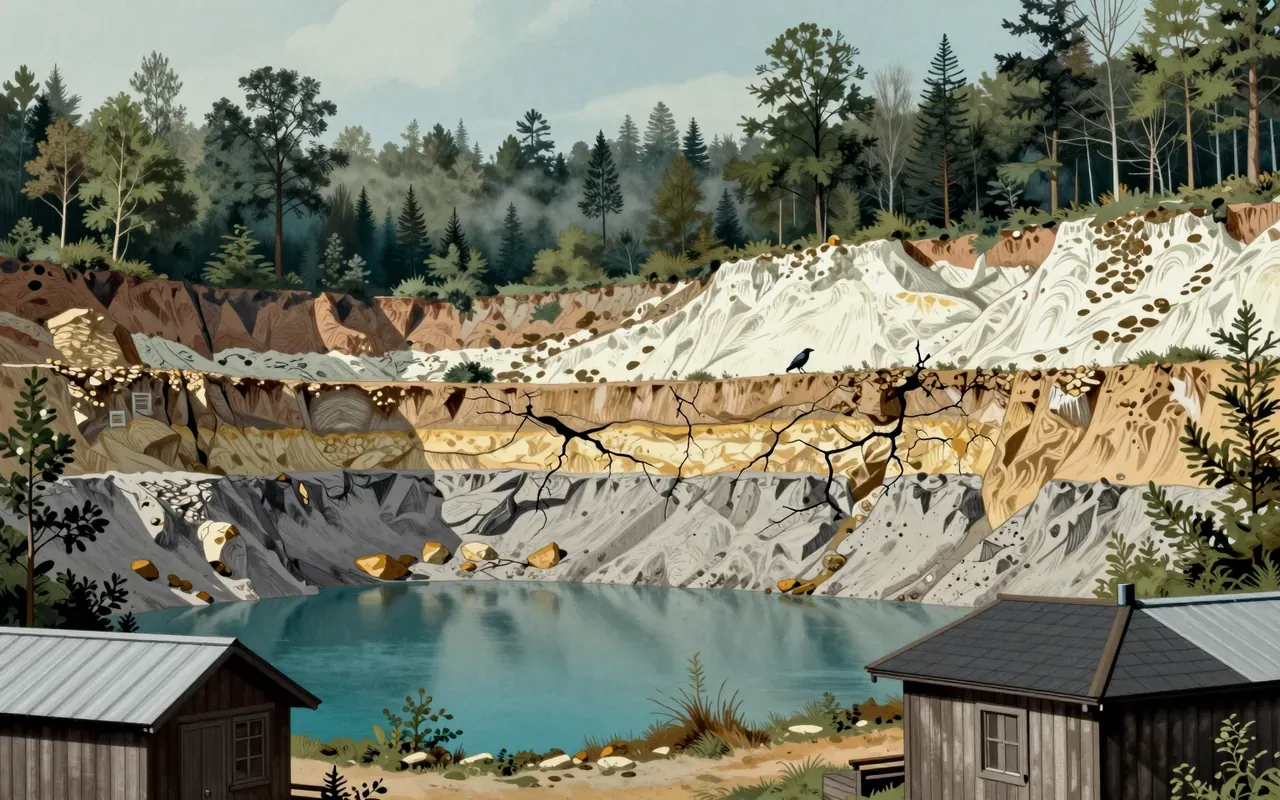
To formalise a geological epoch, stratigraphers require a specific physical site whose sediment layers mark the boundary, known as a Global Boundary Stratotype Section and Point. In 2023 the working group selected sediment from Crawford Lake in Ontario, Canada, as this marker, pointing to a start date around 1950 and preserving signals such as plutonium from nuclear testing and other industrial residues in its layered mud. This was intended as the final technical step before the proposal moved to a formal vote by the commission’s governing bodies, a process that had already taken roughly fifteen years since the working group’s formation.
Rejected in 2024
That vote did not go the way the working group had hoped. In March 2024, the relevant bodies within the International Commission on Stratigraphy and its parent organisation rejected the proposal by a substantial margin. The stated reasoning centred on the fact that human impact on the planet did not begin everywhere at once, making it difficult to justify a single, sharply defined global boundary of the kind used to mark earlier epochs, and on concerns that a 1950 start date was too recent to capture human influence that in some places and in some forms began much earlier. The commission noted explicitly that the term would remain useful outside formal stratigraphy even without official epoch status.
A separate, ongoing count
Separately from this naming dispute, long-term ecological monitoring has documented substantial changes in wildlife populations over the same broad period, using different evidence entirely: repeated population surveys, historical range records and comparisons with fossil-derived background extinction rates. Estimates of how far current extinction rates exceed the natural background vary considerably by method and taxon, and researchers openly debate the precise scale, but multiple independent monitoring programmes converge on the same direction of change, namely widespread decline concentrated among habitat loss, overexploitation, climate change and the spread of invasive species, in roughly that order of documented impact.
A word that outlived its formal rejection
This case is worth understanding because it separates two things people often conflate: the informal, useful idea that humans have become a dominant geological force, and the formal, procedural question of whether that idea meets the specific technical criteria for a named epoch. The rejection in 2024 was not a rejection of human environmental impact as a phenomenon, which continues to be documented through independent ecological monitoring, but a judgement that this particular impact does not fit neatly into the boundary-marking conventions geologists use for the deep past. Readers who want a tidy verdict on either question, when the epoch began or how bad extinction has become, will find instead two genuinely open, actively debated areas of science.