A theorem that could be tested
In 1964, the physicist John Stewart Bell proved that any theory built on local hidden variables, a picture in which particles carry fixed properties determined before they separate and cannot influence each other faster than light, must obey specific mathematical inequalities limiting the correlations two distant measurements can show. Quantum mechanics predicted that entangled particles could violate those inequalities, producing correlations no local hidden-variable theory could reproduce. That result converted a long-running philosophical disagreement about whether quantum mechanics fully describes reality, one that traced back to Einstein’s own discomfort with entanglement, into a question with a specific, checkable experimental prediction attached to it.
A coin flip mid-flight
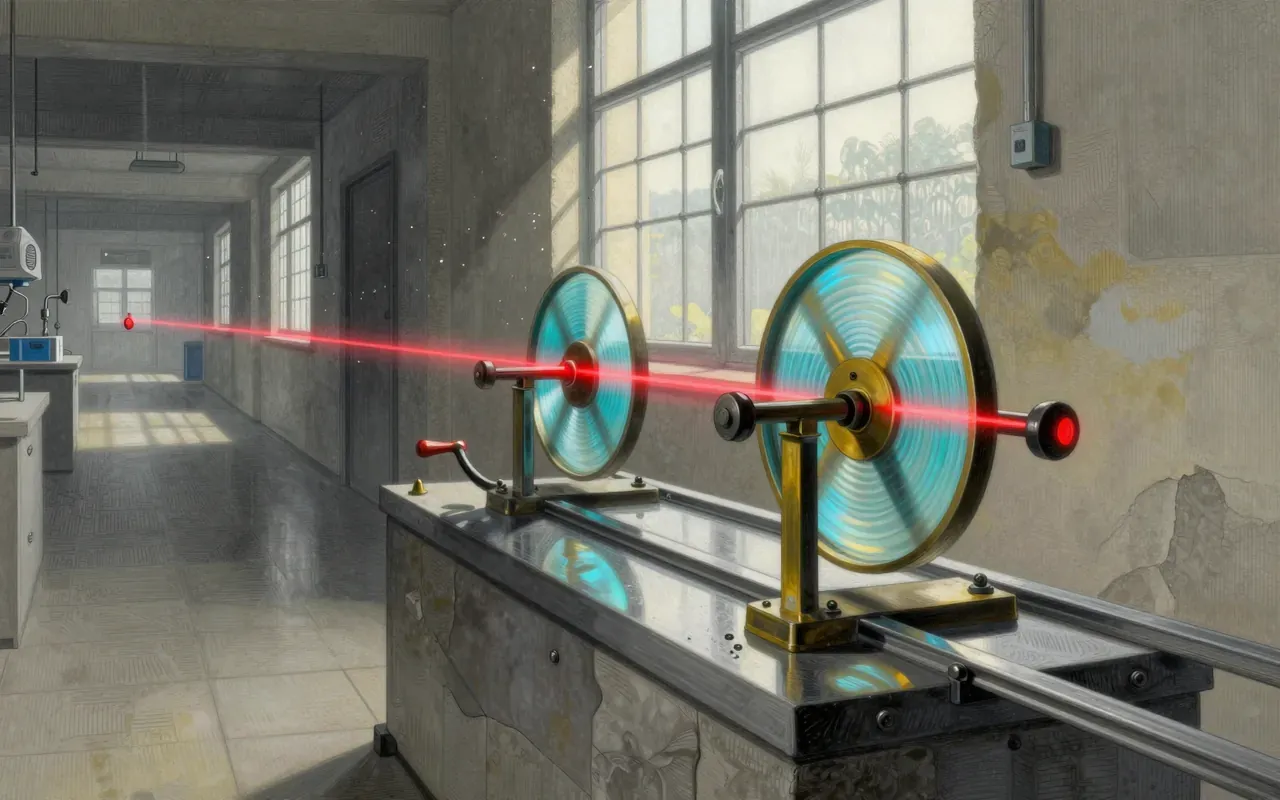
Working at Orsay in France around 1980 to 1982 while completing his doctoral thesis, Alain Aspect ran a series of three experiments using pairs of entangled photons produced by a calcium cascade source, measuring their polarization through detectors set at chosen angles on either side of the source. The most significant of the three changed which of two polarizer settings each detector used while the entangled photons were still travelling between the source and the detectors, a design specifically meant to rule out any ordinary, slower-than-light signal from one detector reaching the other in time to influence the outcome. It was the first Bell test to address that particular gap, an important refinement over earlier experiments that had left the timing of the measurement choice open to question.
Quantum mechanics wins, locality loses
The correlations Aspect measured matched the predictions of quantum mechanics and violated Bell’s inequality, consistent with what every properly run Bell test before or since has found. The basic result, that entangled particles produce correlations no local hidden-variable theory can account for, has never been overturned by a Bell test conducted since. Aspect’s specific innovation, changing the detector settings during the photons’ flight rather than beforehand, remains recognised as an important step toward ruling out one class of mundane explanation for the observed correlations, and it built directly on an earlier 1972 experiment by John Clauser and Stuart Freedman that had first found evidence of the same violation.
Two loopholes still open
Aspect’s results were not fully conclusive on their own, because two distinct loopholes remained. The detection loophole existed because only a fraction of the emitted photons were ever actually detected, leaving room for a hidden-variable theory in which the undetected photons behaved differently from the detected ones; closing this loophole for the strongest version of the test required detection efficiency above roughly 83 percent. The locality loophole persisted in a narrower form even in Aspect’s improved design, since the switching between detector settings was deterministic rather than genuinely random, leaving a contrived possibility that the choice of setting was itself somehow correlated with the particles’ properties in advance.
Closing the gaps
Later experiments closed each gap in turn. A 1998 experiment in Innsbruck led by Gregor Weihs used genuine quantum random number generators to choose detector settings, violating the relevant inequality by more than thirty standard deviations and addressing the locality loophole far more thoroughly than Aspect’s deterministic switching had. Rowe and colleagues closed the detection loophole in 2001 using trapped ions with detection efficiencies well above 90 percent, and in 2013 separate teams led by Giustina and by Christensen closed the same loophole for photons using highly efficient superconducting detectors. By 2015, three independent teams reported experiments that closed the detection, locality and a further memory loophole all at once, producing what physicists now call loophole-free violations of Bell’s inequality.
A shared Nobel, decades later
The episode matters beyond this one test of quantum mechanics because it converted Einstein’s long-standing philosophical unease about entanglement into a settled experimental question, and it helped found the field of quantum information science, which depends on entanglement being a real, usable physical resource rather than a mathematical curiosity. Aspect shared the 2022 Nobel Prize in Physics with John Clauser, whose earlier 1972 experiment preceded his own, and Anton Zeilinger, whose later work extended the same programme further. The roughly forty-year gap between those first tests and the Nobel recognition tracks almost exactly the decades it took to close the loopholes those early experiments had honestly left open.