sciencebriefs
all subjects →
9:52in productionCh. 1 · Comet Hunter/ 9:52 · ceiling 15 min
Astronomy & space

Caroline Herschel

She didn’t wait for permission — she swept the sky, found what others missed, and rewrote the official star catalogue.

Caroline Herschel’s work was observational, archival, and exacting — not theoretical or instrumental. She expanded the known sky, corrected the official star record, and forced recognition of women’s capacity for primary astronomical labour. Her legacy is in the data, not the myth.

Chapters & takeaways4
  1. 1:07
    Comet Hunter

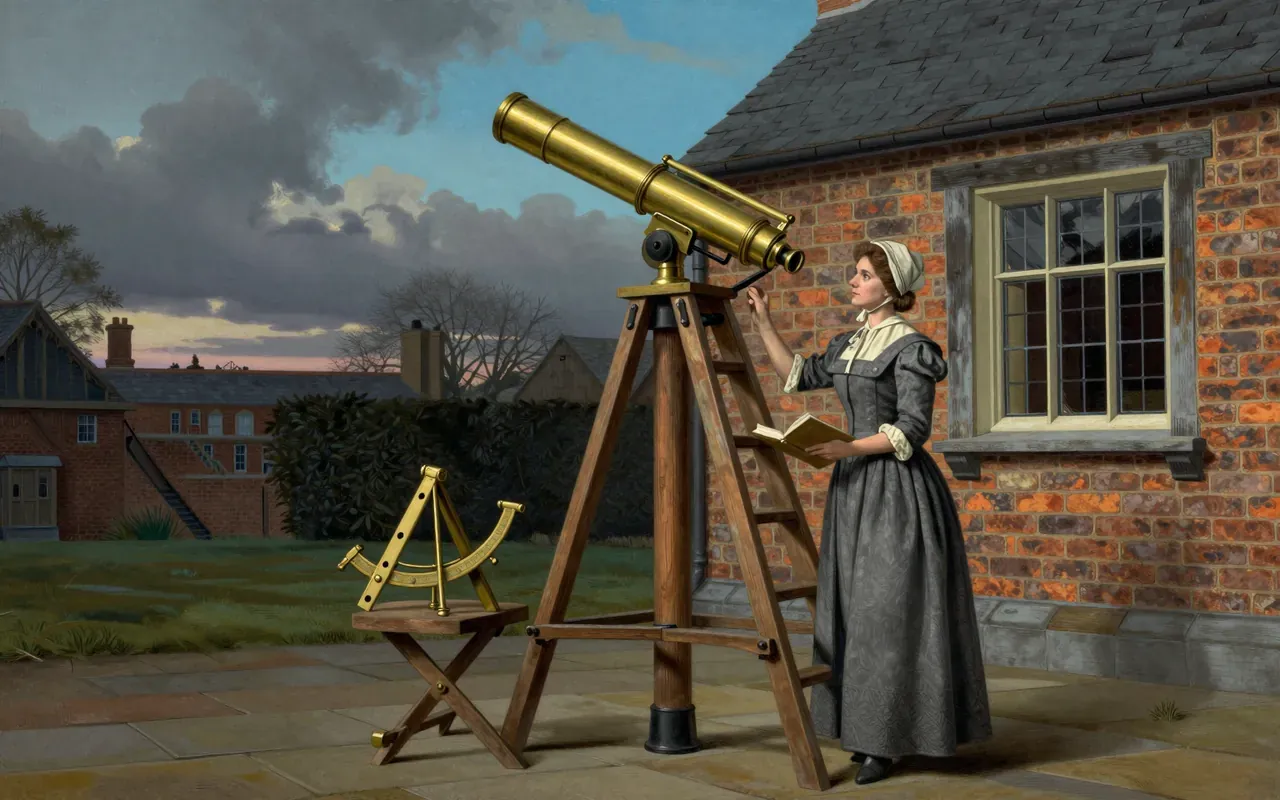
    She discovered eight comets between 1786 and 1797 — five with unquestioned priority, including the first on 1 August 1786 while her brother was away.

  2. 2:56
    Nebula Finder

    On 26 February 1783, she found a nebula missing from the Messier catalogue — and on the same night, independently identified Messier 110, the second companion of the Andromeda Galaxy.

  3. 4:10
    Catalogue Architect

    In 1798, she presented to the Royal Society an index to Flamsteed’s observations, a list of over 560 omitted stars, and errata — all published as a single authoritative catalogue.

  4. 5:32
    Peer-Recognised

    Five of her comet discoveries were published in Philosophical Transactions — the premier journal of the Royal Society.

Worth your time?

Yes. Study the whole thing.

4.5/ 5
What works
  • comet-discovery
  • nebula-identification
  • catalogue-correction
What does not
  • theory
  • instrumentation
  • spectroscopy
  • photometry
Study it if
  • historians-of-science
  • astronomers
  • archivists
Skip it if
  • physicists
  • chemists
  • neuroscientists
The written brief1 min read

What the work claims

Caroline Herschel claimed priority in comet discovery, independent nebular identification, and authoritative correction and expansion of the foundational British star catalogue.

How it was done

Caroline Herschel conducted systematic sky-sweeping using her brother’s telescopes. She recorded observations nightly, cross-referenced them against existing catalogues, and compiled corrections and additions independently.

What holds up

Her discovery of a nebula outside the Messier catalogue on 26 February 1783 holds up. Her independent identification of Messier 110 holds up. Her eight comet discoveries between 1786 and 1797 hold up — five with unquestioned priority, one being Comet Encke in 1795. Her 1798 Catalogue of Stars, published by the Royal Society, holds up: it contains an index to Flamsteed’s observations, over 560 omitted stars, and errata.

What does not

The material does not establish that she designed or built telescopes, developed new theories of celestial mechanics, or made spectroscopic or photometric measurements.

Why it matters beyond the lab

It matters because she demonstrated that meticulous observation and archival rigour — not just theoretical insight — constitute foundational scientific labour. Her work redefined who could produce authoritative astronomical knowledge in the late 18th century.

Is it worth your time

Yes. Her work established rigorous observational practice in a field dominated by men, and produced concrete, peer-verified astronomical records still referenced today.

Same field · Astronomy & space4 of 50
Up next in Science

Cassini–Huygens

· 10:37

Cassini didn’t just visit Saturn — it proved icy moons can be wet, wild, and chemically alive.

10:37