A signal too regular to be noise
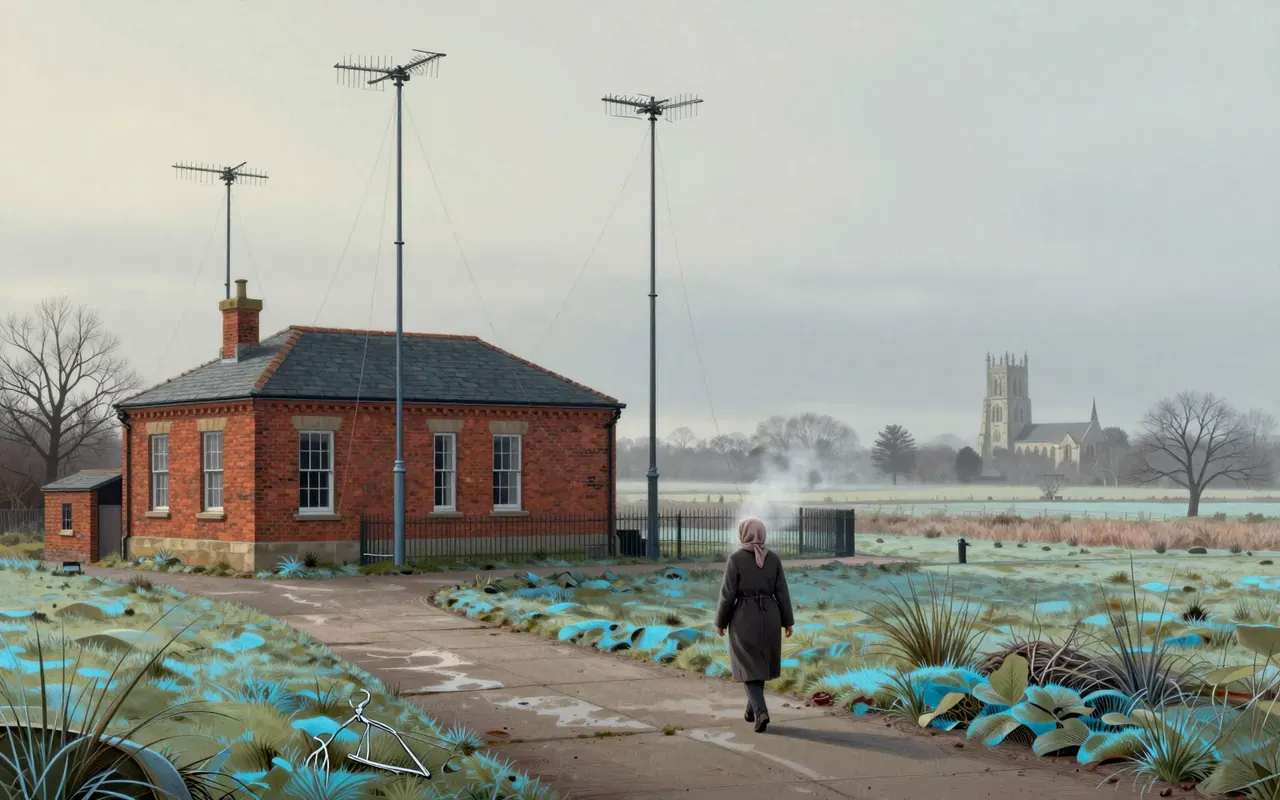
On the night of 28 November 1967, Jocelyn Bell Burnell, then a postgraduate student at Cambridge working under Antony Hewish, picked out an unusually regular signal in the chart-recorder output of the Interplanetary Scintillation Array, a telescope she had helped build near the Mullard Radio Astronomy Observatory to study quasars by the way their radio emission flickers as it passes through the solar wind. The signal repeated with a period close to 1.337 seconds and a pulse lasting about 0.04 seconds, coming from a fixed point in the sky in the constellation Vulpecula. It was eventually catalogued as PSR B1919+21 and understood to be a rapidly spinning neutron star, the first radio pulsar ever identified, a class of object nobody had previously confirmed existed.
Ruling out little green men
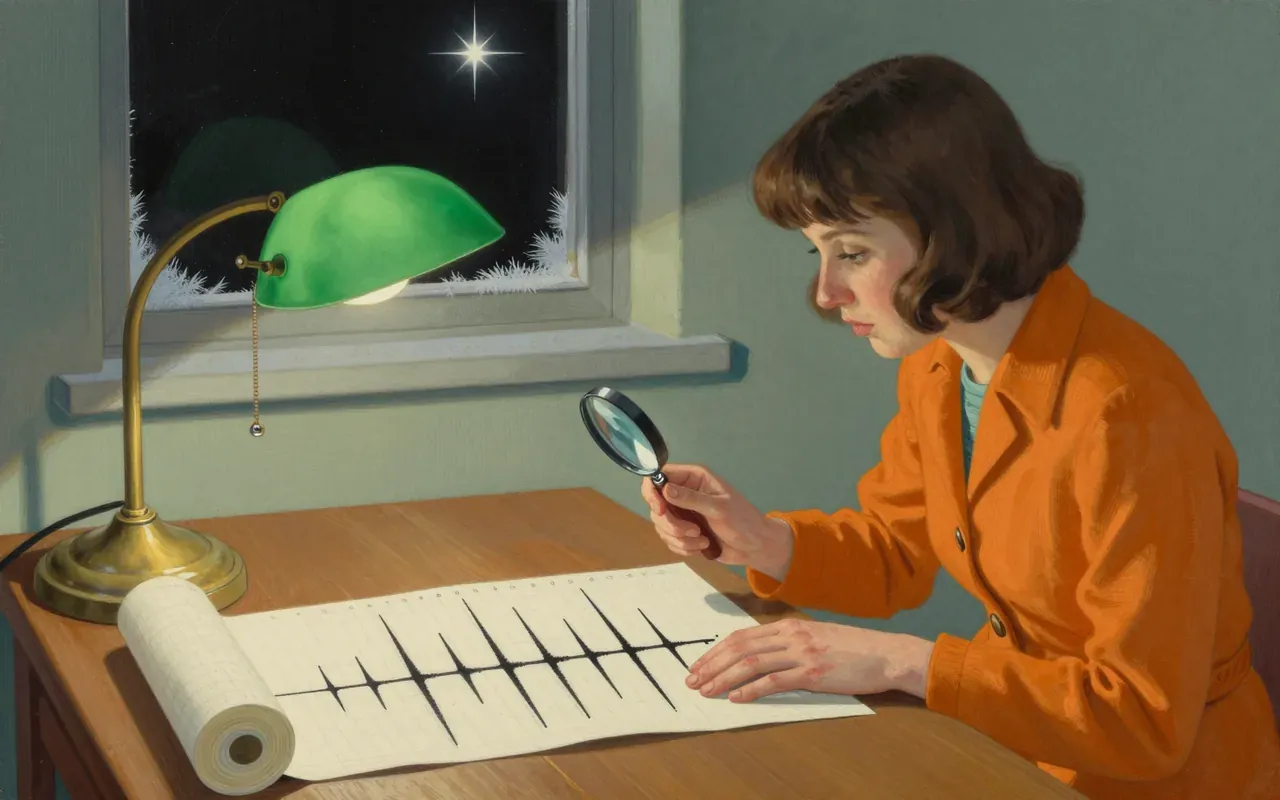
Bell Burnell’s part of the job was largely manual: the array recorded its output on paper charts, and she reviewed roughly ninety-six feet of that paper by eye most nights, watching for the scintillation pattern the telescope had been built to catch. What she noticed instead was a small patch of signal that did not look like scintillation at all, too regular, too brief, recurring at the same point in the sky. Hewish’s first reaction was that it was probably man-made interference, but Bell Burnell kept tracking it and pushed for a faster chart recorder capable of resolving the signal in more detail. That closer look showed a train of pulses arriving with almost clock-like regularity, a pattern distinct from anything the instrument had been designed to detect.
A rotating neutron star
The identification that followed has held. Thomas Gold and Fred Hoyle proposed that the pulses came from a neutron star spinning rapidly enough to sweep a beam of radio emission past Earth once per rotation, in the way a lighthouse beam sweeps past a ship, and that explanation has remained the standard account of how pulsars work. The discovery also established pulsars as a genuine, repeatable class of object rather than a one-off curiosity: once astronomers knew what pattern to look for, more were found, and the study of neutron stars grew directly out of this single detection. The basic facts of the find, the period, the location, the identification as a spinning neutron star, are not in dispute today.
What the early guesses got wrong
Two early readings of the signal did not survive. The first was the idea, only half-serious even at the time, that the pulses might be a deliberate transmission from an extraterrestrial civilisation, and the source was nicknamed Little Green Man 1 before Bell Burnell found a second, similarly regular signal elsewhere in the sky, which made an artificial origin from a single source implausible. The second was Hewish’s initial assumption that the signal was simply interference from human equipment, an explanation Bell Burnell’s persistence and further observation ruled out. Neither idea took long to be abandoned, but both show how much interpretation stood between a strange pattern on a paper chart and the eventual, sturdier explanation of a spinning neutron star.
Credit and its limits
The pulsar discovery opened neutron-star research as an observational field rather than a theoretical one, giving astronomers a real object to study instead of a prediction. But the story is also told, deliberately, for what happened afterwards: the 1974 Nobel Prize in Physics for the discovery went to Hewish and Martin Ryle, and Bell Burnell, despite doing the observing and the initial identification as a graduate student, was left off the citation. Fred Hoyle objected publicly at the time, and Bell Burnell herself later suggested that being a student and a woman together worked against her being considered. The episode has become a recurring reference point in discussions of how scientific credit gets allocated, well beyond the astrophysics it grew out of.
Recognition, decades later
This is worth knowing for two separate reasons that happen to sit in the same story. The astronomy is a clean example of how a genuinely new class of object can turn up inside a survey built to look for something else entirely, and how quickly a strange signal can be talked out of an exotic explanation and into a mundane one. The Nobel dispute that followed is a separate, equally durable lesson about the space between doing the work and getting the credit for it. Bell Burnell’s 2018 Special Breakthrough Prize, decades after the original Nobel, is a coda rather than a correction, which is part of what makes the story worth sitting with.