A pattern where none was expected
The claim, published by Erwin Chargaff around 1950, was that DNA is neither the chemically monotonous molecule most biologists had assumed nor entirely without pattern. Measuring the four bases across DNA taken from a wide range of organisms, he found that the amount of adenine consistently matched the amount of thymine, and the amount of guanine consistently matched the amount of cytosine, in every double-stranded sample he tested. At the same time, the overall ratio of those two pairs to each other varied considerably from one species to the next, in a way that stayed stable within a species but differed sharply between them. That combination mattered: it directly contradicted the prevailing idea that DNA was built from a simple, repeating four-base unit too uniform to carry meaningful information, while establishing a strict internal pairing rule that any correct structural model of DNA would eventually have to explain.
Chromatography and ultraviolet light
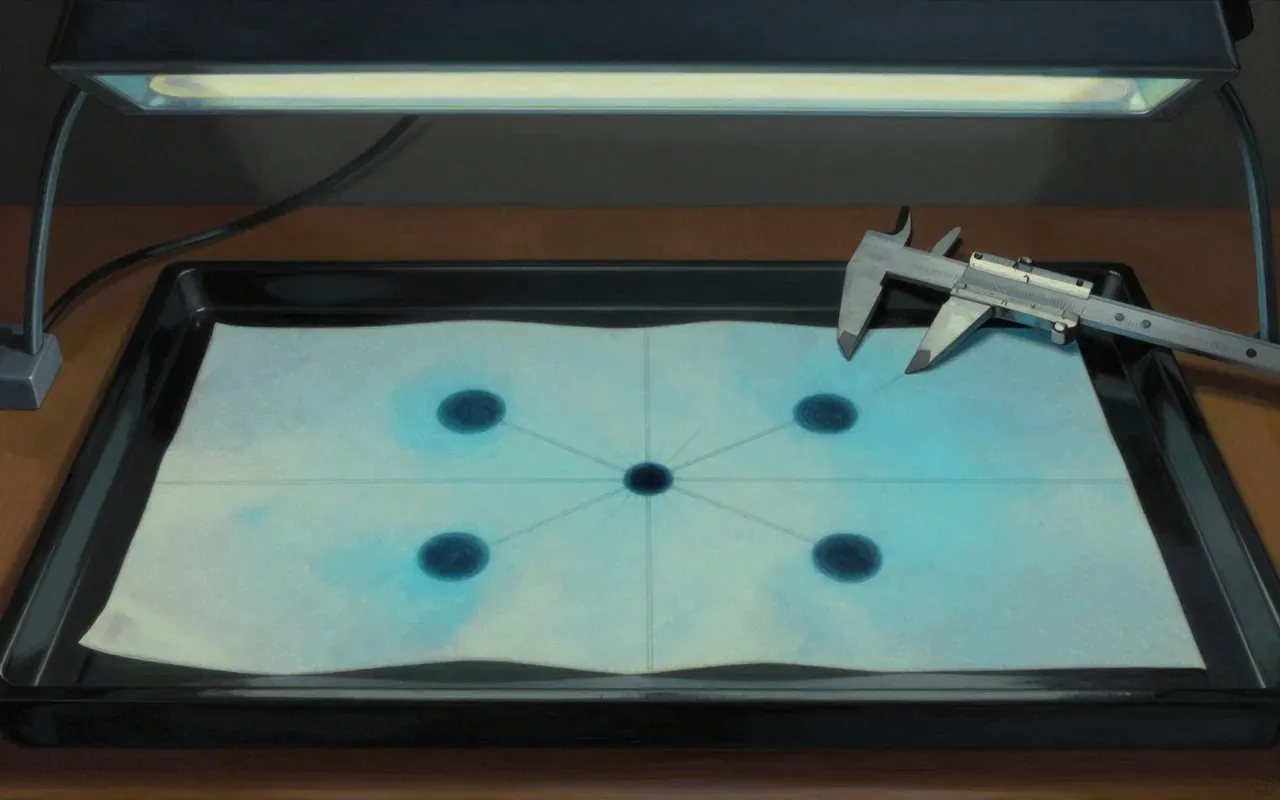
Chargaff’s laboratory relied on two techniques that were still relatively new to biochemistry at the time: paper chromatography to separate the individual bases after breaking DNA down chemically, and ultraviolet spectrophotometry to measure how much of each base was present once separated. Applying this to DNA extracted from organisms as different as maize, octopus, chicken and human tissue, and from bacteria as well, he built a table of base ratios that let him compare species directly. The pairing pattern, adenine against thymine and guanine against cytosine, held steady across every one of them, while the proportion of those two pairs relative to each other shifted from species to species. Later, in 1968, work extending this approach found a second, subtler regularity: within a single DNA strand, and not just between the two paired strands, the same two ratios came out close to equal as well.
A rule with no exceptions where it applies
The core finding, that adenine equals thymine and guanine equals cytosine across a double-stranded DNA molecule, has held without exception in every organism where it has been tested, and it is now understood as a direct chemical consequence of the base-pairing structure Watson and Crick proposed a few years after Chargaff’s results were published. Purines pair with pyrimidines across the two strands, so any measurement across both strands together will always return this equality; the finding was, in effect, the chemical footprint of a double helix before anyone had described the double helix itself. The second, single-strand version of the rule has also proved durable within its proper scope, holding across the eukaryotic, bacterial and archaeal chromosomes and double-stranded viral genomes it has been tested against.
Where the rule stops
The single-strand version does not extend everywhere, and knowing where it stops is part of what makes it a real scientific rule rather than a slogan. It fails for very small organellar genomes, the DNA inside mitochondria and plastids below roughly twenty to thirty thousand base pairs, and it does not apply at all to single-stranded DNA genomes or to any RNA genome, where the underlying chemistry that produces the pattern in double-stranded DNA is simply absent. A related but distinct pattern, described separately by Wacław Szybalski, showed that the coding strand of some bacteriophage genomes carries noticeably more purines than pyrimidines, a bias that sits alongside Chargaff’s rules without following from them, and is a reminder that base composition can carry more than one kind of signal at once.
The clue Watson and Crick needed
The immediate consequence of the first rule was structural: when Chargaff lectured at Cambridge in 1952 and discussed his ratios with James Watson and Francis Crick, the numbers gave them a concrete chemical constraint that any workable model of DNA had to satisfy, and it turned out to fit neatly with a helix in which adenine always sits opposite thymine and guanine always sits opposite cytosine. Chargaff himself received none of the credit that followed; when the 1962 Nobel Prize for the structure of DNA went to Watson, Crick and Maurice Wilkins, Chargaff was left out despite having supplied the numerical evidence that made their pairing scheme plausible in the first place, and he spent much of the rest of his career publicly objecting to that exclusion and, increasingly, to the direction molecular biology and genetic engineering were taking more broadly.
Is it worth your time
This is a compact, well-defined piece of science, and its value lies precisely in how little embellishment it needs: a set of base ratios, oddly stable in one direction and oddly variable in another, that turned out to be exactly the clue a workable model of DNA required. Anyone wanting to see how a fairly narrow piece of chemical measurement can become load-bearing for an entire field will find that clearly laid out here, along with the later refinement showing the same logic applies, with real exceptions, to a single strand. It is a smaller story if what you want is drama, though the aftermath supplies some: a scientist whose numbers underwrote a Nobel Prize he was not given, and who spent the following decades saying so.