A frog’s leg that twitched on cue
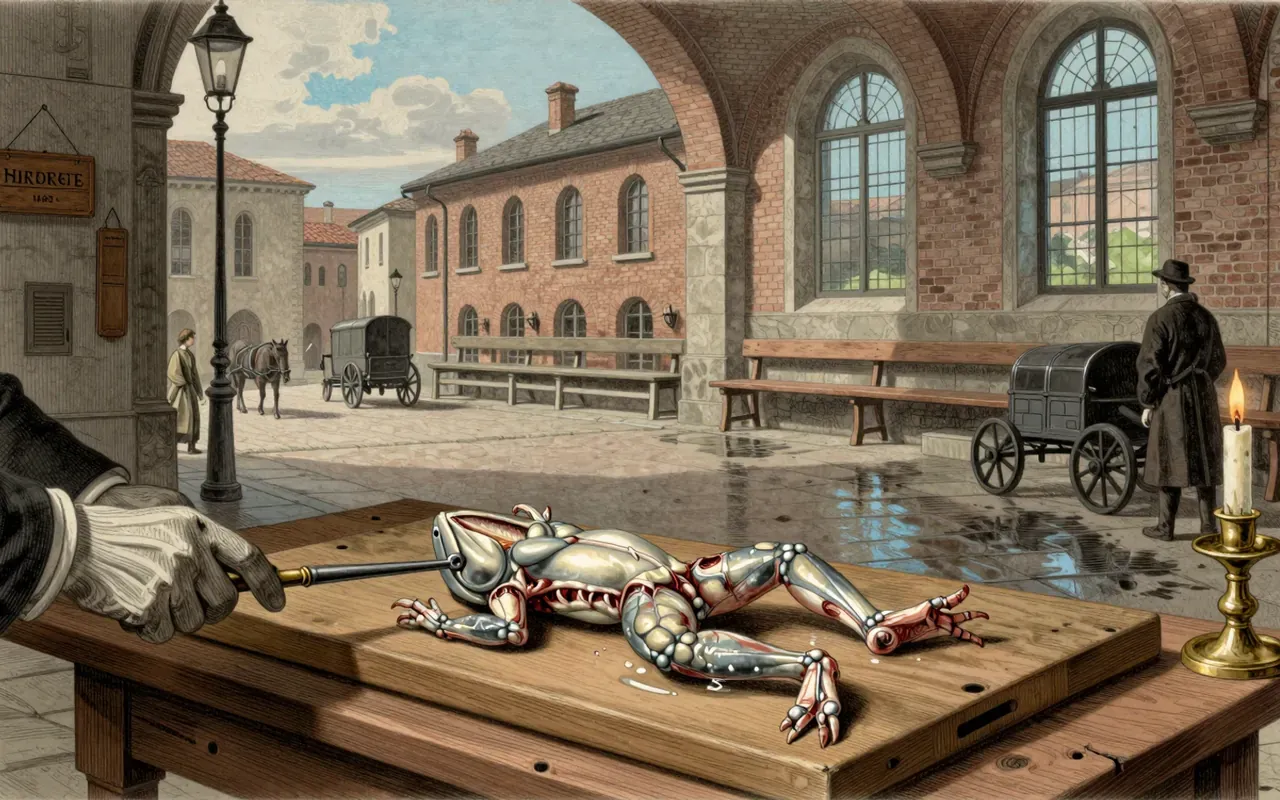
The dispute began with an observation anyone could reproduce: in 1780, Luigi Galvani found that touching two different metals to two separate points on a dissected frog’s leg, while both metals also touched each other, made the muscle contract sharply and repeatedly. Galvani interpreted this as evidence of what he called animal electricity, a form of electrical force generated by the living tissue itself, treating the frog’s leg as the actual source of the current rather than merely a passive participant caught up in producing it, in much the way a nerve or muscle might generate its own signal.
Volta swaps the frog for brine-soaked paper
Alessandro Volta read the same result differently. He argued the frog’s leg was doing two separate jobs at once, acting as both a conductor that let current flow and a sensitive detector that revealed the current was present, but that the tissue itself was not generating anything — the real cause, in his view, was the contact between two dissimilar metals. To test this, he removed the frog entirely, replacing the biological tissue with brine-soaked paper between the same kinds of metal, and found the effect persisted without any living material involved at all.
A stack of metal discs becomes the first battery
That substitution led directly to the voltaic pile, a stack of alternating zinc and copper discs separated by brine-soaked cardboard, which produced a steady electric current rather than the brief twitch a single contact could generate. Volta announced the device in a two-part letter to the Royal Society in London, published in 1800, demonstrating for the first time that a continuous electrical current could be produced entirely by chemical means, with no biological component required to explain any part of the effect, and no frog, nor any living tissue whatsoever, anywhere near the finished apparatus.
What a galvanic cell is actually doing
What the pile actually demonstrated, in the language later chemistry would use, is the basic structure of a galvanic cell: a spontaneous chemical reaction, such as zinc metal reacting with copper ions in solution, can be physically separated into two half-reactions occurring at two different electrodes, an oxidation at the anode releasing electrons and a reduction at the cathode consuming them, connected by a circuit and an electrolyte that lets ions complete the loop. Forcing the electrons to travel through an external wire to get from one electrode to the other is what turns a plain chemical reaction into a usable source of current.
Neither man had quite the whole answer
The full resolution of the Galvani-Volta dispute took rather longer than either man’s own lifetime of arguing over it. Michael Faraday eventually showed that the true source of the electromotive force in a cell like this is the chemical reaction occurring at each electrode-electrolyte interface individually, a description that vindicates Volta’s instinct that metal contact and chemistry, not the animal tissue, produced the effect, while also going well beyond Volta’s own explanation of exactly why two different metals in simple physical contact should generate any current at all, rather than nothing happening.
A short dispute worth the detour
The story rewards attention because it is a genuinely balanced case rather than a simple lesson in who was right. Galvani was wrong that the frog’s leg generated the electricity, but his careful observation of the effect was accurate and reproducible; Volta was right that biological tissue was unnecessary, but his own account of metal contact as the cause was itself incomplete until Faraday supplied the chemical explanation. Following the argument through from a twitching frog’s leg to a proper theory of the electrode-electrolyte interface is a satisfying, self-contained piece of the history of science, and it is short enough to be worth the read in full.