What the work claims
That energy importation and dissipation in chemical systems far from equilibrium can drive internal self-reorganisation leading to new structures—dissipative structures. That this principle extends to systems theory and psychology. That a Liouville space extension of quantum mechanics could resolve foundational problems of irreversibility and measurement.
How it was done
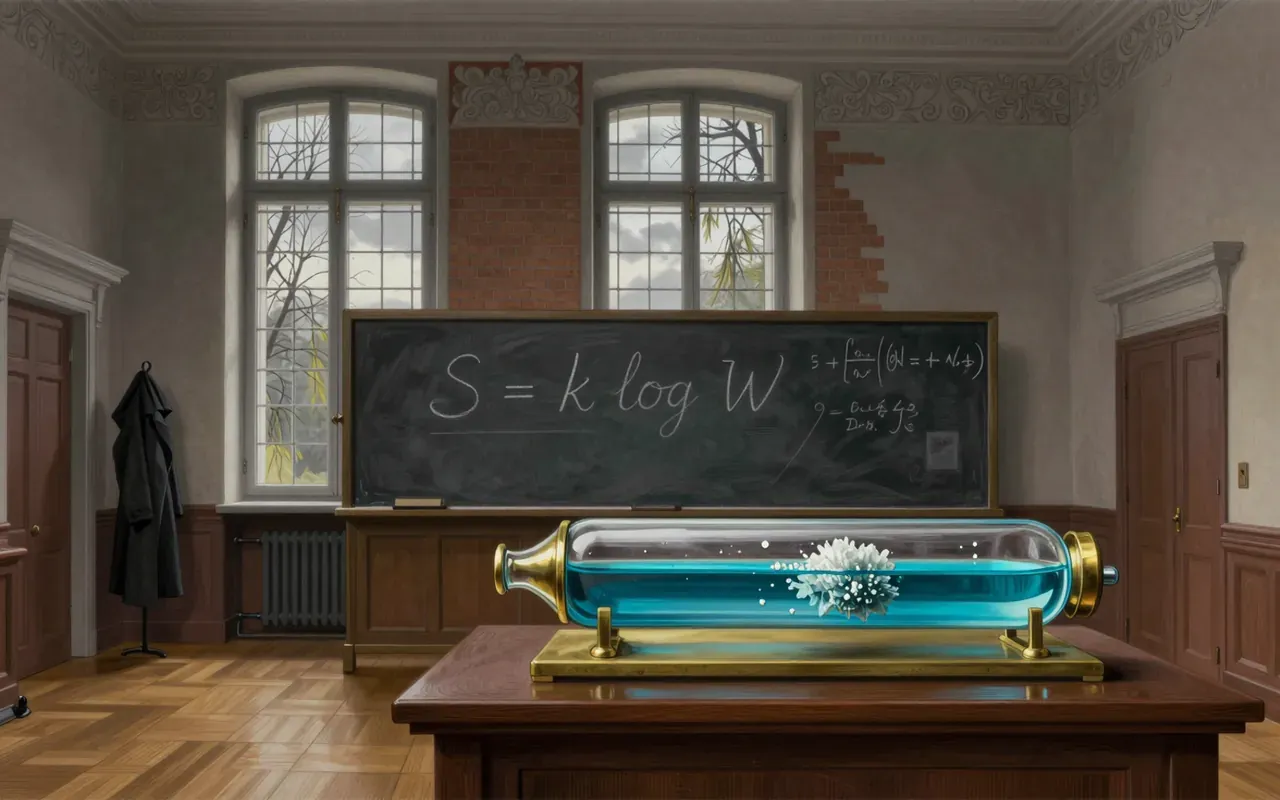
Prigogine defined dissipative structures and their role in thermodynamic systems far from equilibrium. In his 1955 text, he linked them to the Rayleigh-Bénard instability and the Turing mechanism. He and coworkers later proposed a Liouville space extension of quantum mechanics.
What holds up
The definition of dissipative structures in far-from-equilibrium thermodynamic systems holds up. The linkage to Rayleigh-Bénard and Turing instabilities is verified. The formal concept of self-organisation serves as a bridge between general systems theory and thermodynamics—by reconciling terms like entropy, emergence, and irreversibility with scientific rigour.
What does not
The work does not establish that dissipative structures explain psychological phenomena. It does not solve the arrow of time or measurement problem. It does not provide a testable quantum formalism. The relevance to psychology is reported as recognition—not demonstration.
Why it matters beyond the lab
It matters because it gave thermodynamics a language for order arising from flow—not equilibrium—and forced systems thinking to confront entropy as more than disorder. It reframed emergence as physically grounded, not metaphorical—though only for specific non-linear, open, driven systems.
Is it worth your time
Yes—if you need to understand how thermodynamics accommodates self-organisation, or why irreversibility appears in physics without violating microscopic reversibility. Not if you expect experimental protocols, predictive models, or empirical validation beyond chemical reaction-diffusion systems.