sciencebriefs
9:11in productionCh. 1 · No substance required/ 9:11 · ceiling 15 min
Physics · Energy

Lord Kelvin

He didn’t discover cold — he made temperature itself objective.

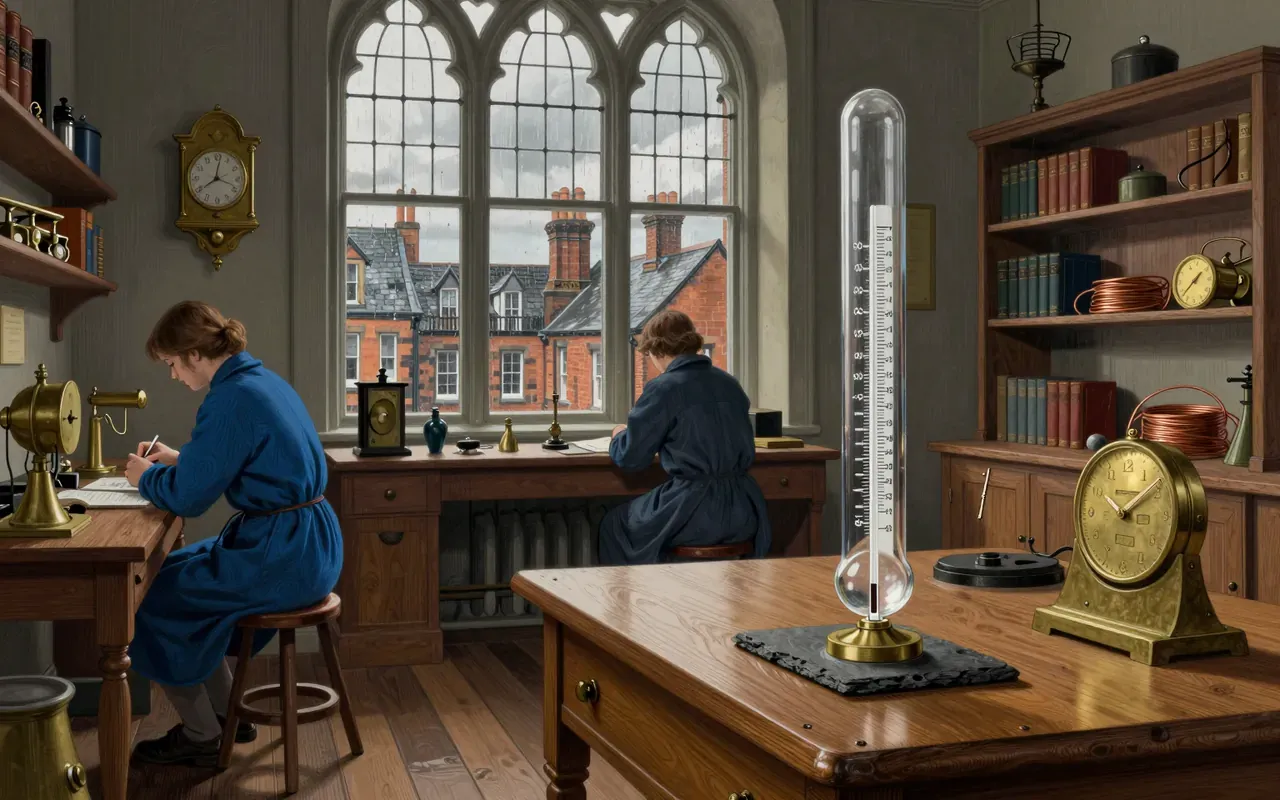
Kelvin established the first thermodynamically rigorous, material-independent temperature scale — defining absolute zero not as speculation, but as the inevitable limit of reversible heat flow. He calibrated it using Regnault’s data. His value remains standard. The SI unit bears his name. His method replaced empirical convenience with physical law.

Chapters & takeaways5
  1. 1:06
    No substance required

    Kelvin’s scale is defined by work, not water or mercury.

  2. 2:19
    The waterfall analogy

    He imagined heat as a waterfall — with absolute zero as the bottom.

  3. 3:21
    Calibrated against experiment

    Regnault’s numbers turned abstraction into calibration.

  4. 4:35
    −273.15 °C — still correct

    His value for absolute zero matches today’s standard to two decimal places.

  5. 5:49
    Named in his honour

    The kelvin unit exists because his logic held up.

Worth your time?

Yes. Study the whole thing.

4.5/ 5
What works
  • Defines temperature objectively.
  • Fixes absolute zero to a value still in use.
  • Became the basis of an SI unit.
  • Remains embedded in all thermodynamic reasoning.
What does not
  • Kelvin did not measure absolute zero directly.
  • Kelvin did not derive absolute zero from atomic theory.
  • The kelvin unit was not adopted during his lifetime.
Study it if
  • Anyone who uses a thermometer, reads a weather report, or works with refrigeration or superconductors.
Skip it if
  • Those expecting a story about instrumentation breakthroughs or lab-based discovery.
The written brief1 min read

What the work claims

That temperature can be defined absolutely — without reference to mercury, gas expansion, or any material — by linking heat flow to reversible mechanical work, and that this definition fixes absolute zero at a unique, measurable value.

How it was done

In 1848, Kelvin proposed a thermodynamic temperature scale based on the equivalence of heat flow and mechanical work — independent of any substance’s properties. He used Regnault’s experimental data to calibrate it. He framed absolute zero using a ‘waterfall’ analogy for heat transfer.

What holds up

His scale is material-independent. Its zero point matches the modern value of −273.15 °C. It remains the foundation of the SI kelvin unit. The unit is named in his honour.

What does not

Kelvin did not measure absolute zero directly. He did not derive it from kinetic theory or atomic models. His scale was not adopted as the international standard until 1954 — long after his death.

Why it matters beyond the lab

Every precision measurement in physics, climate science, materials engineering, and quantum computing relies on a stable, universal anchor for temperature. Kelvin gave it — not as a guess, but as a logical necessity of thermodynamics.

Is it worth your time

Yes. It defines how every modern thermometer, cryogenic system, and thermodynamic calculation anchors temperature — not as convention, but as a consequence of energy conservation.

Same field · Physics4 of 185
11:20
Ibn al-HaythamIbn al-Haytham pioneered experimental optics between 1011–1021. His Book of Optics established vision as intromissive and brain-based, gave the first complete law of reflection, and described the horopter, spherical aberration, colour constancy, and unconscious inference. He used the camera obscura and refractometer. He stated a principle of least time for refraction — anticipating Fermat — but the sources do not say he derived it mathematically or tested it quantitatively. No replication, consensus, or refutation is reported. His method fused geometry, mechanics, and subjective observation — making him the first to treat perception as empirically tractable.
10:27
First observation of gravitational waves2015First direct detection of gravitational waves — GW150914 — on 14 September 2015. Confirmed general relativity’s final undetected prediction. First strong-field test. First binary black hole merger observed. Propagation at light speed confirmed. Graviton mass constrained. No dispersion observed.
11:02
Nuclear fusionNuclear fusion was established as the stellar energy source through a sequence of conceptual, experimental, and theoretical advances between 1915 and 1939. It rests on mass measurements, quantum theory, and reaction pathway enumeration—not on containment, scaling, or net energy yield.
10:02
AvicennaAvicenna laid structural foundations for scientific reasoning—linking observation to logic, disease to unseen agents, self-awareness to immateriality—but produced no empirical verification, no taxonomy of organisms, no experimental protocol, and no mechanism for transmission.
Up next in Science

Wind power

· 8:32

Wind power did not begin with climate policy — it began with a Scottish professor lighting his cottage in 1887.

8:32