How carbon dioxide turns into acid
Ocean acidification describes a change in seawater chemistry driven by the ocean absorbing atmospheric carbon dioxide. When carbon dioxide dissolves into seawater, it reacts with water to form carbonic acid, which in turn dissociates into bicarbonate ions and free hydrogen ions, and a portion of that reaction proceeds further to release still more hydrogen ions alongside carbonate ions. The net effect of more dissolved carbon dioxide is a rising concentration of hydrogen ions in the water, which is what lowers pH, since pH is a direct measure of hydrogen ion concentration, and at the same time reduces the concentration of carbonate ions available in the water, an effect distinct from but related to the pH drop itself, since carbonate is precisely what many marine organisms rely on to build calcium carbonate shells and skeletons.
A measured drop since 1950
This is not a projected or theoretical change but one already measured directly. Average ocean surface pH declined from approximately 8.15 to 8.05 between 1950 and 2020, a shift that sounds small stated as a raw pH difference but that corresponds, because the pH scale is logarithmic, to a 26 percent increase in hydrogen ion concentration over that period. The Intergovernmental Panel on Climate Change’s Sixth Assessment Report, published in 2021, placed this change in a much longer historical context, concluding that present-day surface ocean pH values have no precedent going back at least 26,000 years, a comparison that relies on reconstructing past ocean chemistry from geological and chemical proxy records rather than direct historical measurement.
Older than 26,000 years of comparison
The attribution of this change to human activity holds up as well-established rather than contested: carbon dioxide emissions from human activity are identified as the primary driver, with atmospheric CO2 concentrations having exceeded 422 parts per million by 2024, a substantial rise over pre-industrial levels. The ocean’s role as a carbon sink is central to the mechanism, since roughly 30 percent of the carbon dioxide humans have emitted over the past 270 years has been absorbed into seawater rather than remaining in the atmosphere, a process that has moderated the pace of atmospheric warming somewhat but has done so specifically by shifting the burden into ocean chemistry instead, producing the pH decline now measured directly.
About a third of a much larger total
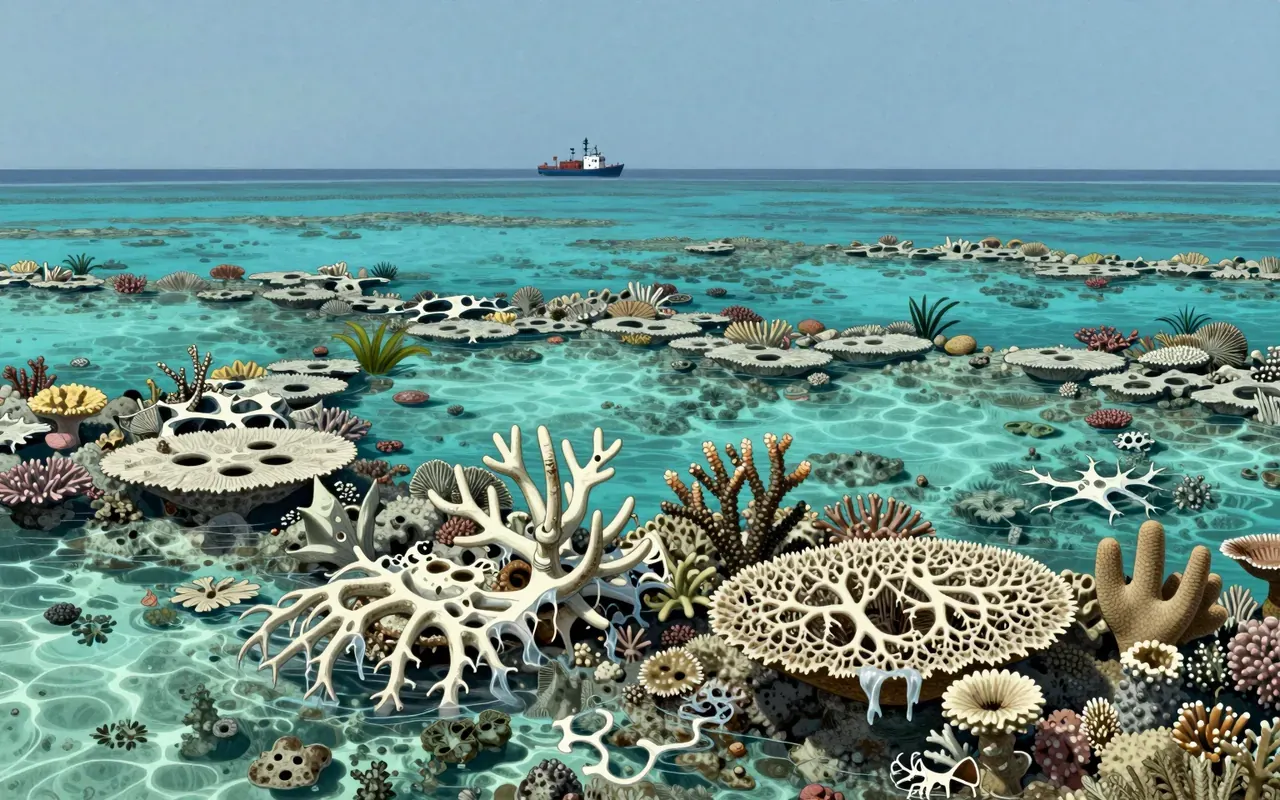
What the chemistry does not by itself resolve is exactly how severely each affected species or ecosystem will respond, since biological sensitivity to reduced carbonate availability varies considerably across organisms. Molluscs, corals, pteropods, and coccolithophores, all of which build calcium carbonate structures, face documented reductions in calcification and, in some cases, active dissolution of existing shells under more acidic conditions, with pteropod shells specifically reported to dissolve in sufficiently acidified water and coral exoskeletons showing reduced density. Some fish larvae have shown disrupted olfactory system development, affecting behaviours tied to navigation, though the precise ecological consequences of these individual effects across whole marine food webs remain an area of ongoing research rather than a fully mapped outcome.
Harder to build a shell
The trajectory implied by current emissions trends carries the change well beyond what has already occurred. Under a high-emissions scenario identified in climate modelling as SSP5-8.5, surface ocean pH is projected to fall to approximately 7.7 by 2100, representing a further two- to four-fold increase in hydrogen ion concentration on top of the levels already reached since 1950. That scale of projected change matters because it would occur within a single century, a timescale far too short for most marine calcifying organisms to adapt evolutionarily, raising the practical stakes of ocean acidification well beyond the chemistry itself and into questions of marine ecosystem resilience, fisheries, and the broader carbon cycle’s future behaviour as a moderating buffer against atmospheric warming.
A further drop already projected
This is a strong use of time for anyone who wants to understand ocean acidification as a measured, mechanistic chemical process rather than as a vague component of climate change discussed only in passing. The specific figures, the 1950 to 2020 pH change, the 26,000-year comparison, the 30 percent absorption share, give the topic a concreteness that general climate coverage often lacks, and the honest treatment of biological effects as still being actively studied, rather than fully catalogued, is a fair representation of where the science currently stands. Readers looking for policy responses or mitigation strategies will need to look elsewhere, but for understanding the underlying chemistry and its documented consequences so far, this delivers clearly.