sciencebriefs
9:33in productionCh. 1 · What is natural selection?/ 9:33 · ceiling 15 min
Evolution

On the Origin of Species

Darwin didn’t prove evolution—he made descent with modification the only viable scientific explanation for life’s diversity.

On the Origin of Species (1859) introduced natural selection as the mechanism for evolutionary descent with modification. It presented evidence for common descent via a branching pattern, drawn from Darwin’s Beagle expedition, research, correspondence, and experimentation. It established descent with modification as the dominant scientific explanation of natural diversification. Its proposition of universal common ancestry is now accepted—but that acceptance postdates the book and is not itself what the book established.

Chapters & takeaways4
  1. 1:12
    What is natural selection?

    Natural selection is defined by analogy to artificial selection—not as a metaphysical force, but as differential survival in a struggle for existence.

  2. 2:48
    What pattern does life follow?

    The book’s evidence supported common descent via branching—not linear progression—and established descent with modification as the dominant explanation for natural diversification.

  3. 4:21
    How was the evidence gathered?

    Evidence came from the Beagle expedition (1830s), then decades of research, correspondence, and experimentation—culminating in a 1859 publication with compelling, integrated argument.

  4. 5:53
    What did the book *not* establish?

    Universal common ancestry is now accepted—but that acceptance is separate from what the 1859 book itself established.

Worth your time?

Yes. Study the whole thing.

5/ 5
What works
  • established descent with modification as the dominant scientific explanation of natural diversification
  • introduced natural selection as a defined, testable mechanism
  • presented evidence for common descent via a branching pattern
  • integrated field observation, breeding analogy, and comparative anatomy into a single explanatory framework
What does not
  • prove universal common ancestry
  • describe molecular genetics
  • refute Lamarckism conclusively
  • include statistical population modelling
Study it if
  • biologists
  • historians of science
  • anyone who needs to understand why biology is historical
Skip it if
  • those seeking proof of human origins
  • readers expecting experimental protocols
  • anyone looking for modern genetic evidence
The written brief1 min read

What the work claims

Populations evolve over generations through natural selection. The diversity of life arises by common descent through a branching pattern of evolution. Natural selection operates like artificial selection, shaped by the struggle for existence.

How it was done

Darwin built his argument using evidence from the Beagle expedition in the 1830s, plus subsequent research, correspondence, and experimentation. He introduced natural selection as a mechanism defined by analogy to artificial selection in breeding. He published this in 1859.

What holds up

The book established evolutionary descent with modification as the dominant scientific explanation of natural diversification. It presented evidence for common descent via a branching pattern. It introduced natural selection as the primary mechanism—supported by observable struggle for existence and analogy to selective breeding.

What does not

The book did not prove universal common ancestry at publication. That proposition is now accepted, but the document states that acceptance came later—not as an immediate consequence of the 1859 text.

Why it matters beyond the lab

It displaced static, typological views of species with a dynamic, historical framework for all biology. Its logic underpins conservation, epidemiology, agriculture, and medicine—but only where descent with modification applies. It does not explain origins of life, molecular mechanisms, or non-biological systems.

Is it worth your time

Yes. It remains the foundational text for evolutionary biology—not because it is complete, but because it established descent with modification as the dominant scientific explanation of natural diversification, and its core mechanism remains central to modern biology.
Same field · Evolution4 of 69
10:48
Charles Darwin1809–1882Darwin's discovery is the theory of evolution by natural selection — jointly introduced with Wallace — grounded in descent with modification from a common ancestor, supported by compelling evidence in On the Origin of Species (1859), and now recognised as the unifying theory of the life sciences.
13:00
Recent African origin of modern humansTwo competing accounts of human origins faced off through the late twentieth century: the recent African origin model, holding that modern humans evolved in Africa and then spread outward displacing earlier populations, and the multiregional model proposed by Milford Wolpoff and colleagues, holding that human populations across the world evolved together over roughly two million years through continuous gene flow. Mitochondrial DNA studies beginning in the 1980s traced all non-African maternal lineages back to a single, comparatively recent African branch, evidence that fits the recent African origin model far better than the multiregional one, and further genetic and fossil work through the 2000s and 2010s reinforced that non-Africans descend mainly from a dispersal out of Africa roughly seventy to fifty thousand years ago. The multiregional model in its strong form has become a minority position, but the story is not a clean replacement narrative either, since genetic evidence has since shown that the dispersing populations interbred with Neanderthals and Denisovans along the way, leaving measurable traces in people alive today.
9:13
Burgess ShaleThe Burgess Shale is a fossil deposit in British Columbia, dated to c.505 million years ago, preserving soft-bodied organisms as carbon films. Walcott found it in 1909, quarried it from 1910, and amassed over 65,000 specimens — but his taxonomic interpretations of most fossils are now rejected. Later work by the Geological Survey of Canada confirmed its uniqueness: it remains the largest and best-preserved early Cambrian soft-part assemblage. It does not prove evolutionary mechanisms — it provides the only high-resolution anatomical data from that interval.
13:00
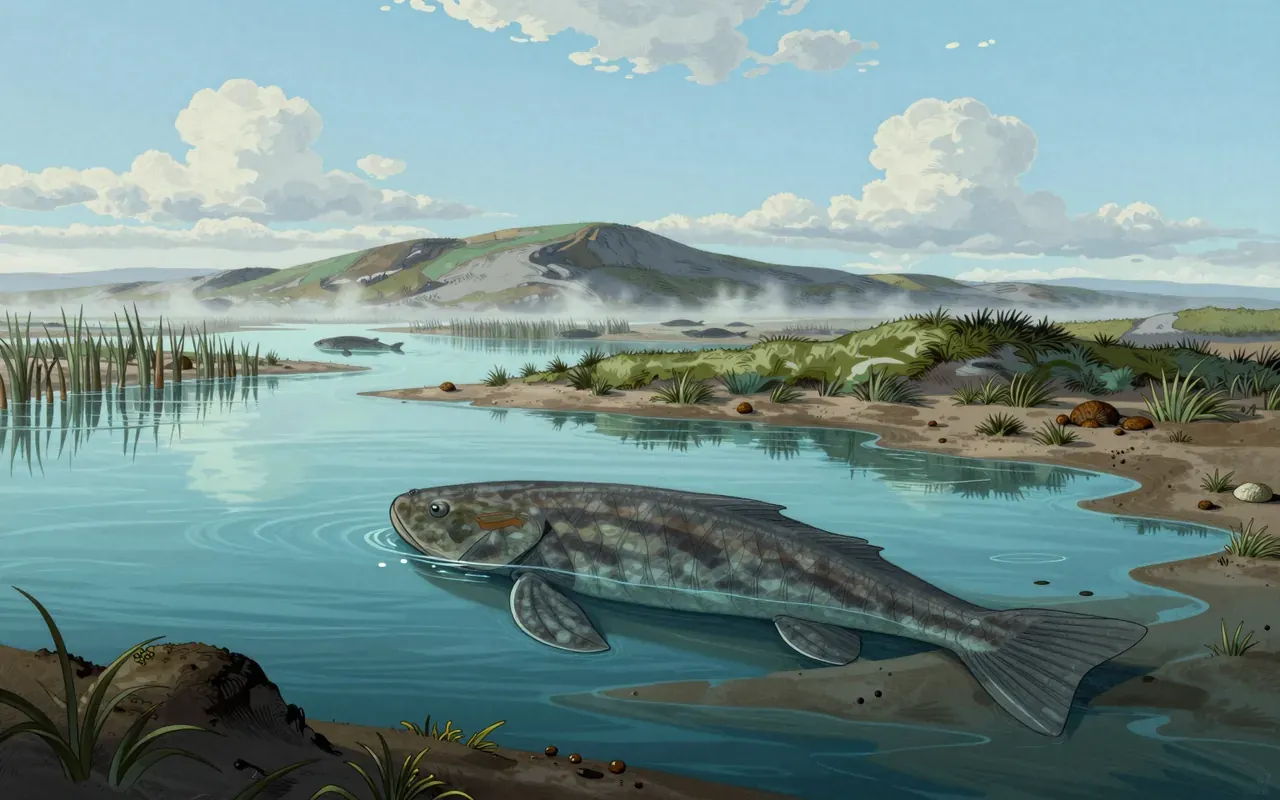
TiktaalikNeil Shubin, Edward Daeschler and Farish Jenkins reasoned that if a transitional form between fish and four-limbed land animals existed, its fossils would most likely turn up in rocks of the right age from a shallow-water environment, and they targeted Late Devonian rock exposed on Ellesmere Island in Arctic Canada. Their search, ongoing since 2000, paid off in 2004 with the discovery of Tiktaalik, an animal with fish traits such as scales and fins alongside tetrapod-like traits including a mobile neck, robust limb bones and lungs, dated to about 375 million years old. The find fit neatly between earlier fish and the earliest known tetrapods in both anatomy and age, though the researchers themselves were careful never to call it a direct ancestor, only a close approximation of what such a transitional animal would have looked like. That tidy narrative was complicated in 2010 when trackways found in Poland, dated some twelve to eighteen million years earlier than Tiktaalik, appeared to show fully limbed locomotion, raising open questions about whether unknown, earlier tetrapod-like animals existed alongside or before it.
Up next in Science

Schrödinger's cat

Erwin Schrödinger · 9:11

Schrödinger didn’t invent quantum weirdness — he exposed its refusal to describe reality without cheating.

9:11