9:13in productionCh. 1 · Where it is/ 9:13 · ceiling 15 min
Evolution · Earth & climate
Burgess Shale
The Burgess Shale doesn’t prove an ‘explosion’ — it’s the only place where we can see what exploded.
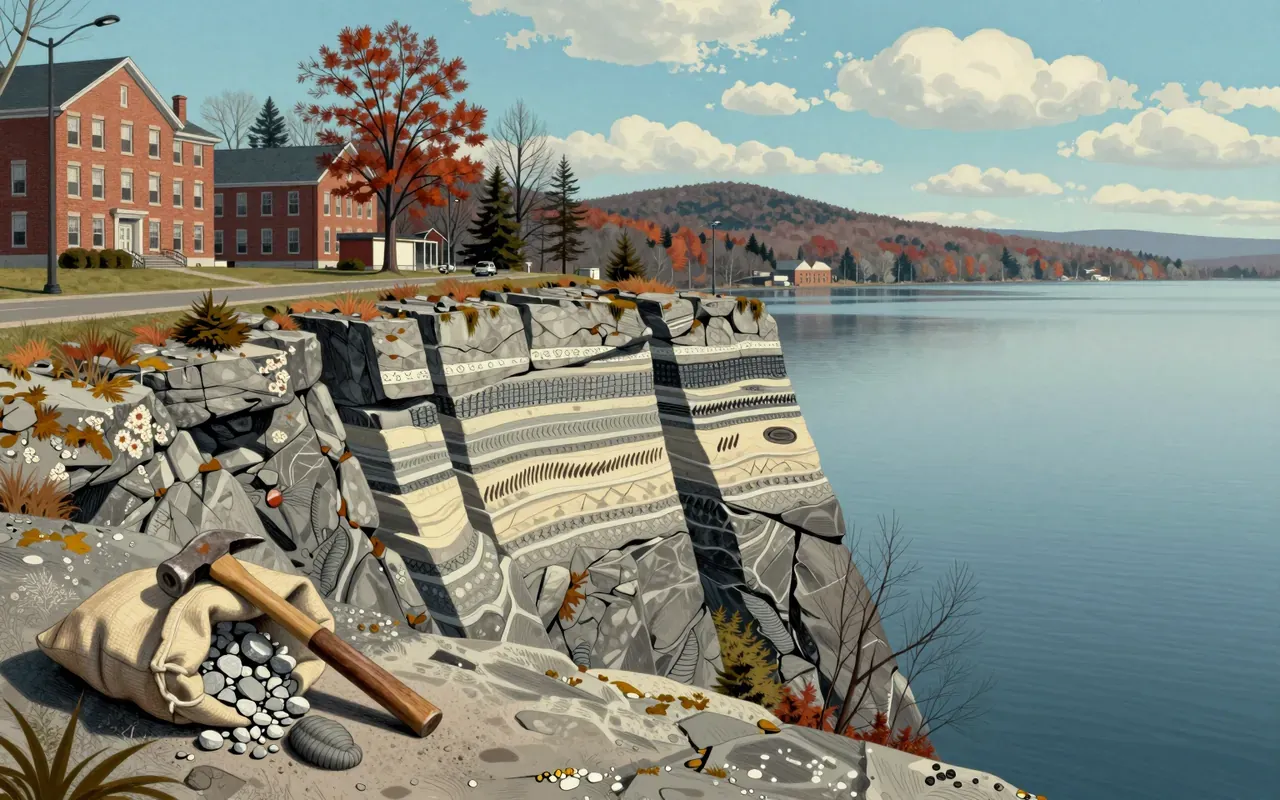
The Burgess Shale is a fossil deposit in British Columbia, dated to c.505 million years ago, preserving soft-bodied organisms as carbon films. Walcott found it in 1909, quarried it from 1910, and amassed over 65,000 specimens — but his taxonomic interpretations of most fossils are now rejected. Later work by the Geological Survey of Canada confirmed its uniqueness: it remains the largest and best-preserved early Cambrian soft-part assemblage. It does not prove evolutionary mechanisms — it provides the only high-resolution anatomical data from that interval.
Discovered by Walcott in 1909, quarried from Fossil Ridge in 1910 — a physical site in British Columbia, not a theoretical construct.
2:03
What it preserves
Soft parts preserved as carbon films — rare for 505-million-year-old rocks, and unmatched in scale.
3:30
What Walcott got right — and wrong
Walcott collected over 65,000 specimens, but his classifications of most are now rejected.
5:27
Who dug next
Excavations resumed by the Geological Survey of Canada — not a private revival, but an institutional re-engagement.
Worth your time?
Yes. Study the whole thing.
4.5/ 5
What works
anchors morphological disparity studies
constrains Cambrian fossil record completeness
enables direct comparison of early body plans
What does not
proves rapid diversification
confirms Walcott's taxonomy
represents global Cambrian fauna
Study it if
evolutionary biologists
palaeontologists
Cambrian geologists
Skip it if
molecular biologists
climate modellers
geneticists
The written brief1 min read
What the work claims
The Burgess Shale documents an early explosion of anatomical diversity in animal life. Walcott claimed many fossils were ancestral to modern groups; later work rejected those assignments but confirmed the site’s age and preservation quality.
How it was done
Charles Walcott discovered the Burgess Shale on 30 August 1909 in the Canadian Rockies of British Columbia. He established a quarry on Fossil Ridge in 1910 and collected over 65,000 specimens by 1924. Later, the Geological Survey of Canada resumed excavations at the Walcott Quarry under Harry Blackmore Whittington.
What holds up
The deposit is real, located in British Columbia, and dates to c.505 million years ago. Its fossils preserve soft parts as thin carbonaceous films — a rarity among early Cambrian deposits. It is one of the earliest fossil beds with such preservation.
What does not
Walcott’s classifications of most fossils are now rejected. His interpretations did not recognise many forms as distinct phyla or stem-group lineages; the material does not support any claim that his taxonomy was methodologically sound or predictive.
Why it matters beyond the lab
It anchors deep-time comparisons of morphological disparity. Its fossils constrain models of evolutionary tempo and mode in the Cambrian — not because it proves rapid diversification, but because it provides the only large-scale, high-fidelity soft-tissue snapshot from that interval.
Is it worth your time
Yes — it remains the most extensive early Cambrian soft-part fossil assemblage known, directly informing how we reconstruct animal body plans at the dawn of complex multicellular life.
Since 1967 the second has been defined by a fixed count of caesium-133 oscillations, a standard that still runs GPS and global timekeeping even though optical clocks have already surpassed it in precision.