A particle allowed by theory, missing in practice
The particle at the centre of this story was theoretically conceivable long before anyone found it. Quarks combine most commonly into either three-quark baryons, such as protons and neutrons, or quark-antiquark pairs called mesons, but the underlying theory does not forbid other combinations, and a five-quark particle, four quarks bound with one antiquark, was recognised as a theoretical possibility from close to the earliest days of quark models in the 1960s, with the name pentaquark itself coined later, in 1987. For decades, however, no experiment produced convincing evidence that such a particle actually existed in nature.
A 2003 claim that spread quickly
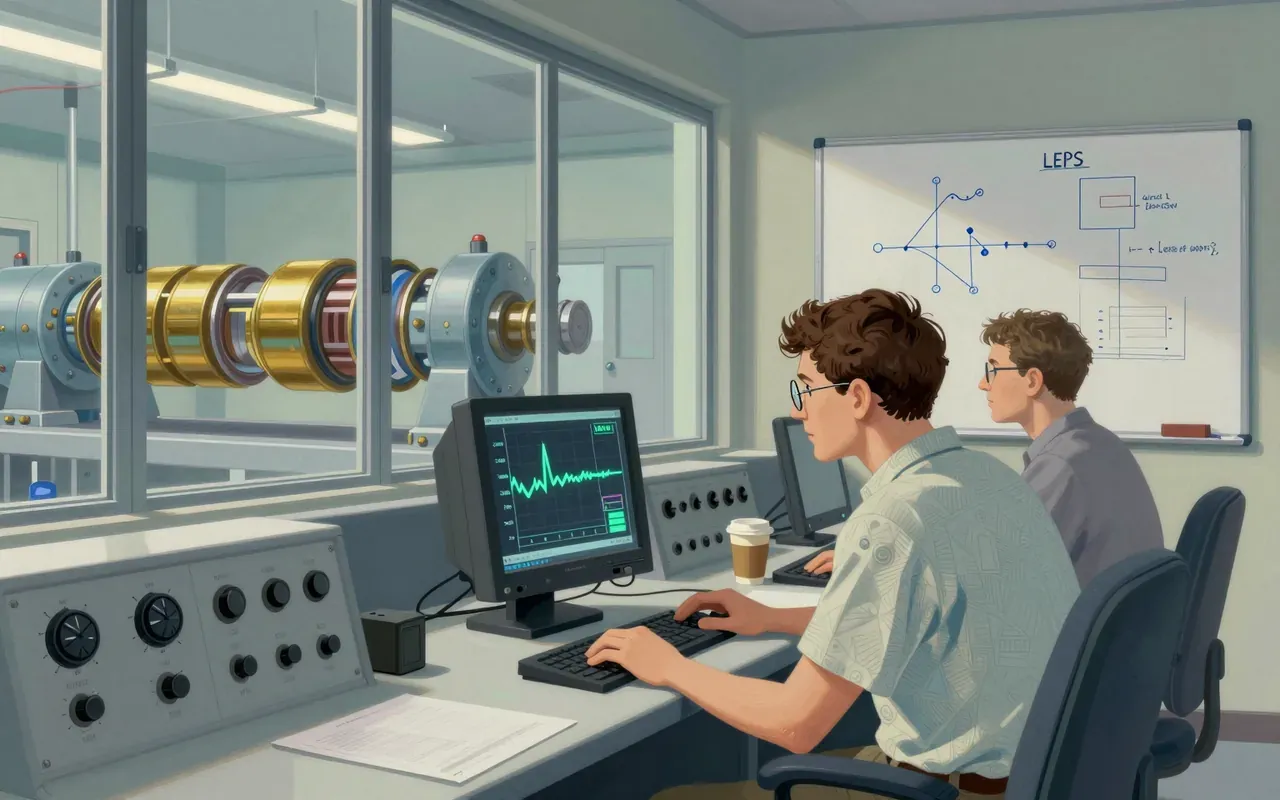
That changed, apparently, in 2003, when the LEPS experiment in Japan reported a narrow resonance at a mass near 1540 mega-electronvolts, with a statistical significance of 4.6 sigma, and labelled the new state the theta-plus. The claim generated substantial excitement across the field, and over the following months nine further independent experiments around the world reported detecting similar narrow signals, with measured masses clustering between roughly 1522 and 1555 mega-electronvolts, each individually exceeding the four-sigma statistical threshold often treated as suggestive evidence on its own, giving the strong appearance of a genuine and independently confirmed new particle spreading rapidly through the particle physics community. Two further pentaquark-like states, reported at other masses in the following years, would later be judged statistical effects rather than genuine resonances.
Collapsing under replication
The excitement did not survive closer scrutiny. Ten separate experiments, several specifically designed to replicate the conditions of the original positive claims, found no evidence of the proposed particle at all. By 2006 the Particle Data Group, the body that maintains the standard reference compilation of particle physics results, had already downgraded its confidence in the claimed pentaquark, and by 2008 the assessment had turned decisively negative, concluding that the overwhelming weight of evidence indicated the originally claimed particles simply did not exist, with the initial signals attributed to flawed methodology and statistical artefacts rather than a genuine discovery.
An accidental find in 2015
Confirmation of an actual pentaquark came from an entirely different direction seven years later. In 2015, the LHCb collaboration at CERN, an experiment whose primary purpose is studying differences between matter and antimatter rather than searching for exotic particles, was analysing the decay of a particle called the bottom lambda baryon into a J/psi meson, a kaon and a proton. Within that decay data, the researchers found that the process sometimes proceeded through intermediate states that could not be explained as conventional particles, but that matched the expected signature of genuine pentaquarks, an unplanned and, by the collaboration’s own description, essentially accidental discovery.
Well past the discovery threshold
The statistical strength of this result set it clearly apart from the earlier, retracted claims. LHCb identified two distinct pentaquark states, with individual statistical significances of 9 and 12 sigma respectively and a combined significance of 15 sigma, far exceeding the five-sigma threshold particle physics conventionally requires before a result is described as a confirmed discovery rather than a suggestive hint. Both particles decayed in a pattern indicating a composition of two up quarks, one down quark, a charm quark and an anti-charm quark, ruling out simpler conventional explanations for the observed signal.
Still an open question inside the particle
LHCb has since confirmed additional pentaquark states through further analysis, including one reported in 2019 and another, containing a strange quark for the first time, reported in 2022. What remains genuinely unresolved is the internal structure of these particles: researchers are still working out whether a pentaquark is a compact object with all five quarks tightly bound together, or a looser, molecule-like pairing of an ordinary three-quark baryon and a two-quark meson held together by a residual force resembling the one that binds atomic nuclei. This is worth understanding both as a clean case study in how false positives get corrected through independent replication, and as a live example of a confirmed discovery whose deeper physics is still being worked out.