Three kinds of shaking
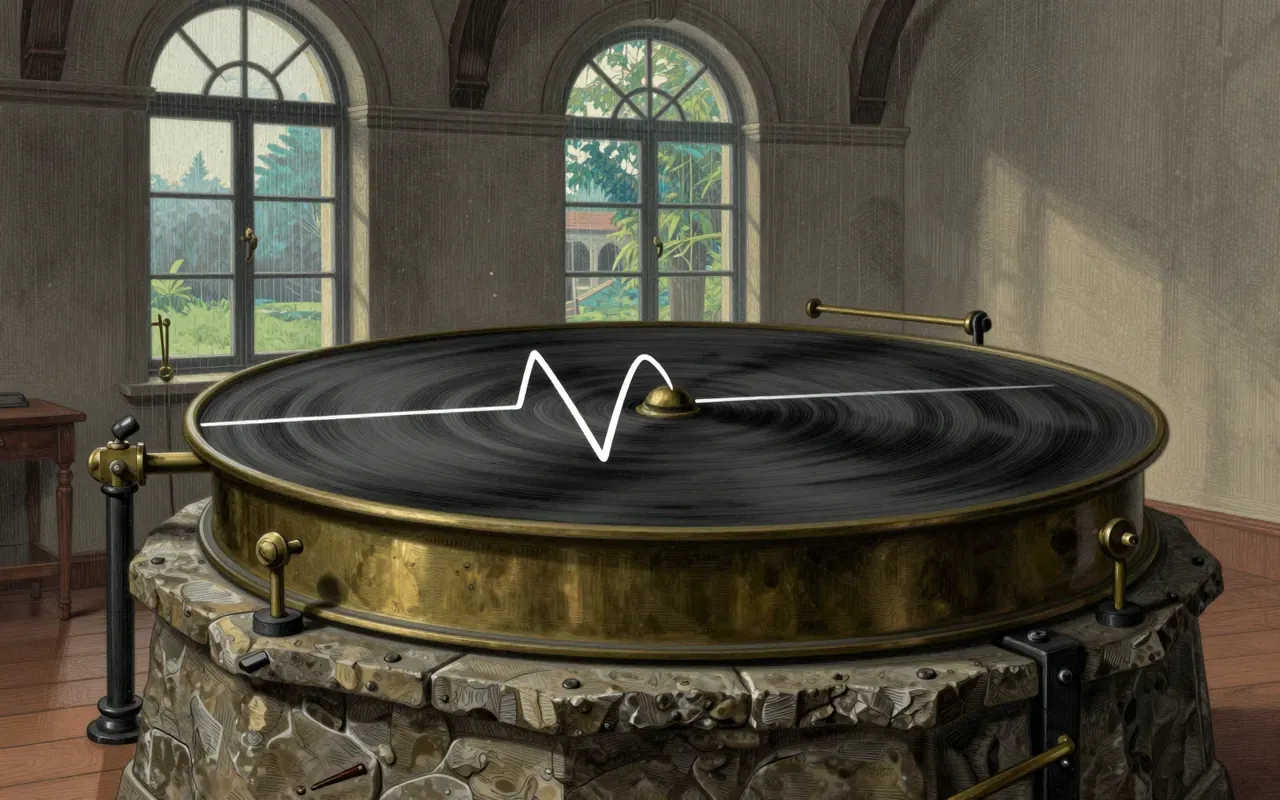
The claim is that Earth has a distinct, dense inner region, and that this can be shown without sampling it directly, using nothing but the timing of ground vibrations recorded far from where an earthquake occurs. Seismic waves divide into three broad types: fast compressional P waves that travel through any material including liquids, slower shear S waves that displace ground sideways and cannot pass through a liquid at all, and still-slower surface waves that travel along the crust and account for most of an earthquake’s damage. Because these types travel at different, predictable speeds through different materials, the pattern of when each one arrives at a distant recording station carries information about what the wave passed through on its way there.
A field seismologist in Assam
Richard Dixon Oldham built this argument from earthquake data rather than laboratory experiment. Working for the Geological Survey of India, he studied the 1897 Assam earthquake directly in the field, documenting a fault with uplift reported up to 35 feet and ground accelerations exceeding that of gravity. From seismograms of the event, recorded mainly at stations in Italy, he identified and named the three wave phases — the compressional, distortional and surface waves — and showed that the first two travelled through Earth’s body while the third stayed near the surface. This distinction between body waves and surface waves, applied across records from multiple earthquakes at varying distances, was the foundation for everything that followed.
Where the shear waves stopped
What holds up, and is credited as the first clear evidence of Earth’s core, is Oldham’s reading of S-wave arrival times across a range of distances from different earthquakes. Past an angular distance of around 120 degrees from an epicentre, S waves failed to arrive when and where a uniform Earth would predict, while P waves showed a comparable disruption. Since S waves cannot travel through a liquid, the pattern was consistent with a dense, liquid core sitting at Earth’s centre, one that Oldham estimated at around four-tenths of Earth’s overall diameter. The core had been proposed before on theoretical grounds, but Oldham’s contribution was the first quantifiable, data-driven case for it.
What the timing data could and couldn’t say
What this method cannot do, on its own, is say what the core is made of, only how it behaves toward waves passing through it — its bulk density and its resistance, or lack of it, to shear. The inference rests entirely on timing differences measured at seismograph stations, using the general relationship that wave speed depends on the density and elastic properties of the material it crosses, together with the further principle that first-arriving waves at great distances travel faster paths through progressively denser material at depth. That is a powerful but indirect kind of evidence: it constrains size and physical state tightly while saying comparatively little about chemical composition, which later work had to establish through other means.
Reading a planet without opening it
The value beyond planetary science is in the method itself, which now underpins ordinary earthquake location as much as deep-Earth study. The gap between P-wave and S-wave arrival at a single station gives a rough distance to a nearby earthquake, while three or more widely spaced stations recording P-wave arrivals can fix a distant earthquake’s location outright; dense modern sensor networks push that precision down to the kilometre scale. The same body of wave physics — Rayleigh waves, Love waves, and Earth’s normal-mode oscillations first observed after the 1960 Chilean earthquake — has since been extended into a general toolkit for probing large-scale internal structure wherever a sufficiently large disturbance can be recorded.
A quietly foundational hour
This is worth the time because it is a clean example of strong inference from indirect evidence, laid out with an identifiable person, a specific earthquake, and a specific numerical anomaly rather than a vague appeal to ‘seismic evidence’ in the abstract. Readers who like watching a scientific claim get built step by step, from fieldwork through data anomaly to a bounded conclusion, will find the Oldham material satisfying precisely because it does not overreach — it argues for a core’s size and liquid state and stops there. Anyone hoping for a fuller, present-day account of what the core actually contains will need to look past this specific piece, but as an account of how the argument was first made, it holds together well.