A well with no shadow
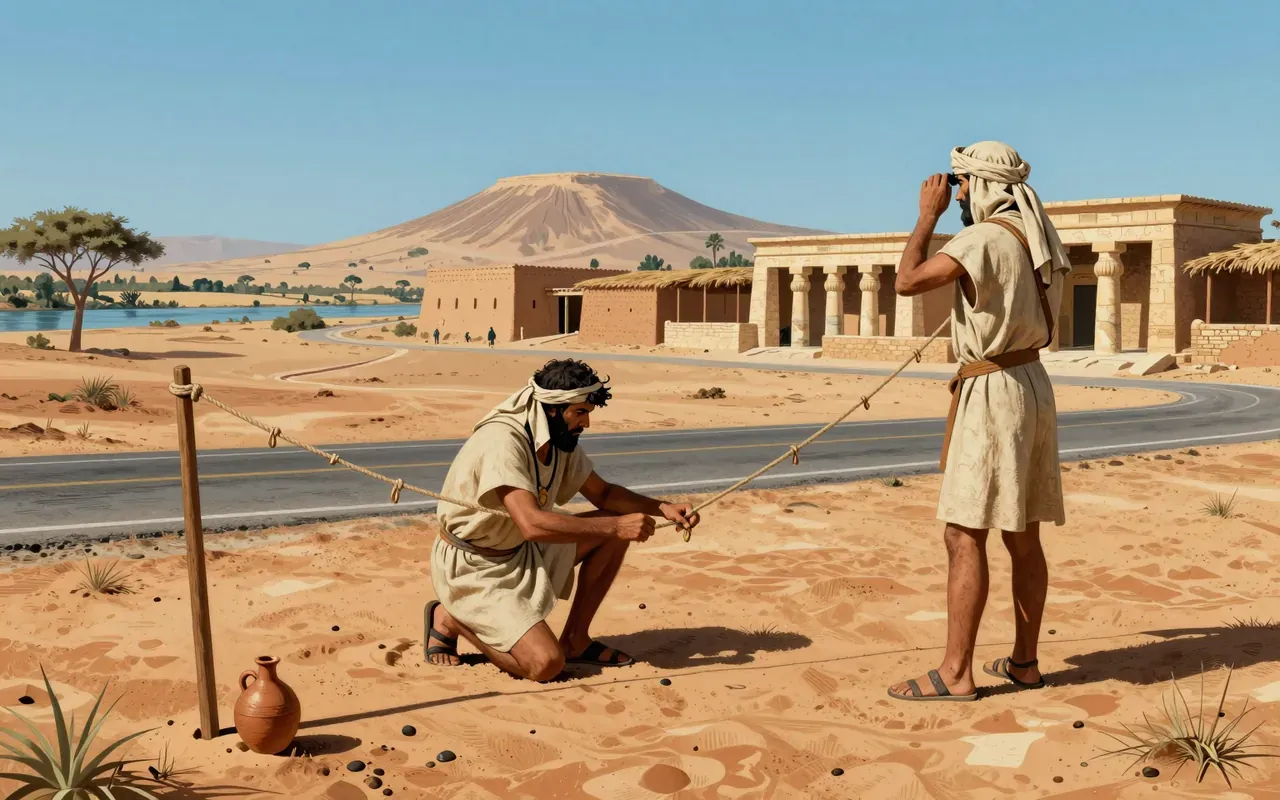
Around 240 BC, Eratosthenes, then chief librarian at the Library of Alexandria, set out to measure the circumference of the Earth using an observation reported from the city of Syene, modern Aswan. There, he had learned, a vertical rod known as a gnomon cast no shadow at all at local noon on the day of the summer solstice, because the sun at that moment sat directly overhead. That single fact gave him a fixed reference point: at that specific place and time, the angle of the sun above the horizon was, for practical purposes, exactly ninety degrees, with nothing to measure because there was no shadow left to measure.
A gnomon in Alexandria
At the same moment, in Alexandria, a comparable gnomon cast a shadow that could be measured, and from the ratio of the rod’s height to that shadow’s length, an angle could be worked out for how far the sun stood from directly overhead there. Ancient sources, preserved through the later writer Cleomedes, record that angle as about seven degrees, close to one-fiftieth of a full circle. Since Alexandria and Syene were treated as lying on the same north-south meridian, the difference in the sun’s angle between the two cities corresponded directly to the difference in their latitude, and Eratosthenes used the distance between them, reported as roughly five thousand stadia and said to have been checked by professional surveyors, as the basis for the next step.
One-fiftieth of a circle
If five thousand stadia represented one-fiftieth of the full meridian, then multiplying that distance by fifty would give the circumference of the Earth, and ancient sources record the resulting figure as somewhere in the range of 250,000 to 252,000 stadia. This basic geometric reasoning, that the difference in the sun’s overhead angle between two points a known distance apart along the same meridian reveals the curvature of the Earth between them, is entirely sound and remained a recognisable technique in geodesy for centuries afterward. Whatever the accuracy of Eratosthenes’ specific inputs, the logic connecting shadow angle, distance, and circumference has never been in question.
What a stadion actually was
Turning his answer into a distance in modern units runs into a genuine, unresolved historical problem: nobody today knows with certainty how long a stadion, Eratosthenes’ unit of length, actually was. Estimates found across historical sources range roughly between about 155 and 210 metres depending on which ancient stadion standard is assumed, and different choices produce noticeably different modern circumference figures from the same original stadia count. Compounding the uncertainty, Syene sat about one degree north of the Tropic of Cancer rather than exactly on it, and about three degrees east of Alexandria rather than on the same meridian, two departures from his working assumptions that historians note happened to run in roughly opposite directions, partially cancelling each other out rather than compounding.
Two errors that cancelled out
What makes the result durable is not any specific number but the demonstration that the size of the entire planet could, in principle, be inferred without leaving it, using nothing more exotic than two shadows, an assumed distance between two cities, and basic geometric reasoning about circles and angles. Modern scholars applying Eratosthenes’ method with different assumptions about the stadion have reached figures ranging from about 40,074 kilometres to roughly 40,338 kilometres, some remarkably close to the currently accepted circumference of a little over 40,000 kilometres, others less so, which is itself the honest state of the evidence rather than a gap to be explained away.
How close did he actually get
This is worth attention less for a single tidy verdict than for what the uncertainty itself reveals. The celebrated version of the story, a nearly exact match to the modern figure, depends on picking a particular stadion length among several plausible candidates, and historians still debate even whether the commonly cited 252,000-stadia figure reflects Eratosthenes’ original measurement or a later rounding for mathematical convenience. Understanding the method well enough to see why its accuracy cannot be pinned down precisely is, in the end, a more interesting result than simply repeating the version where he got it almost exactly right.