Eight dragons, eight balls
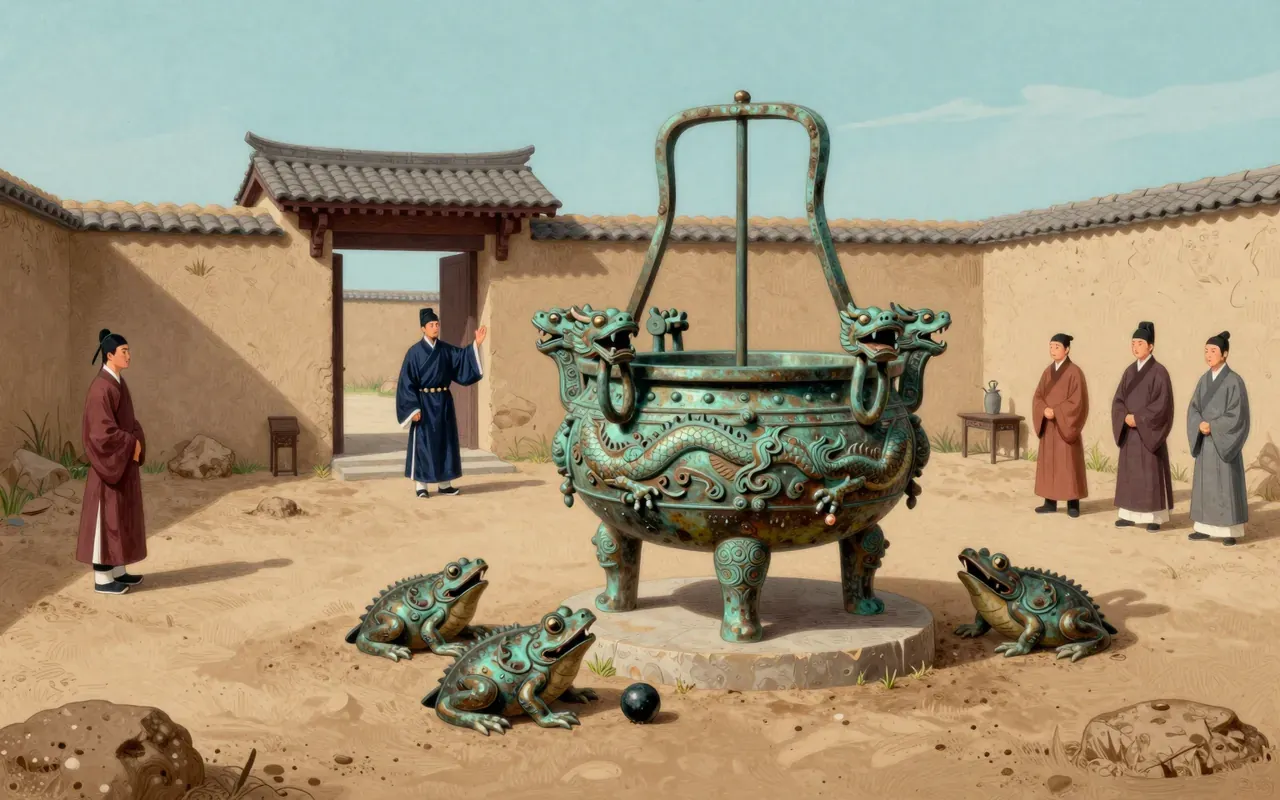
In AD 132, during China’s Han dynasty, the mathematician and astronomer Zhang Heng built what is generally regarded as the first seismoscope, a large bronze vessel roughly two metres across known as the Houfeng Didong Yi, fitted with eight dragon heads spaced around its rim, each holding a bronze ball in its mouth, and a central column able to move along eight internal tracks, evidently some kind of pendulum mechanism that responded to ground motion. The device was built specifically to register earthquakes at a distance from the capital, at a time when the only other way to learn of one was to wait for a traveller to bring word of it.
A ball drops, a rider confirms
When an earthquake occurred, the shaking triggered the mechanism so that one dragon’s mouth opened and dropped its ball into a bronze toad positioned below it, producing a sound and, through which of the eight dragons released its ball, indicating the rough direction the tremor had come from. Its most striking documented success came in AD 143, when the device registered a tremor that residents in the capital had not felt at all. Days later, a messenger arrived from the east confirming that a major earthquake had indeed struck the Gansu region, in the direction the device had indicated, an early instance of an instrument detecting a real event before any human observer had noticed anything at all.
A long gap before the next real instrument
No comparably functional seismic instrument reappeared in the historical record for well over a thousand years. Sustained modern interest only picked up again following the 1755 Lisbon earthquake and, more directly, a series of tremors near Comrie in Scotland in 1839, which led a UK committee to be formed specifically to develop better earthquake detection methods. James David Forbes presented one resulting instrument in 1842, using an inverted pendulum with a pencil recording onto paper above it, though the design proved largely ineffective in practice. Robert Mallet, beginning his work in 1857 and using controlled explosive charges to study how seismic waves travel through the ground, is credited in some accounts with laying the real foundation of instrumental seismology as a field.
A horizontal pendulum in Japan
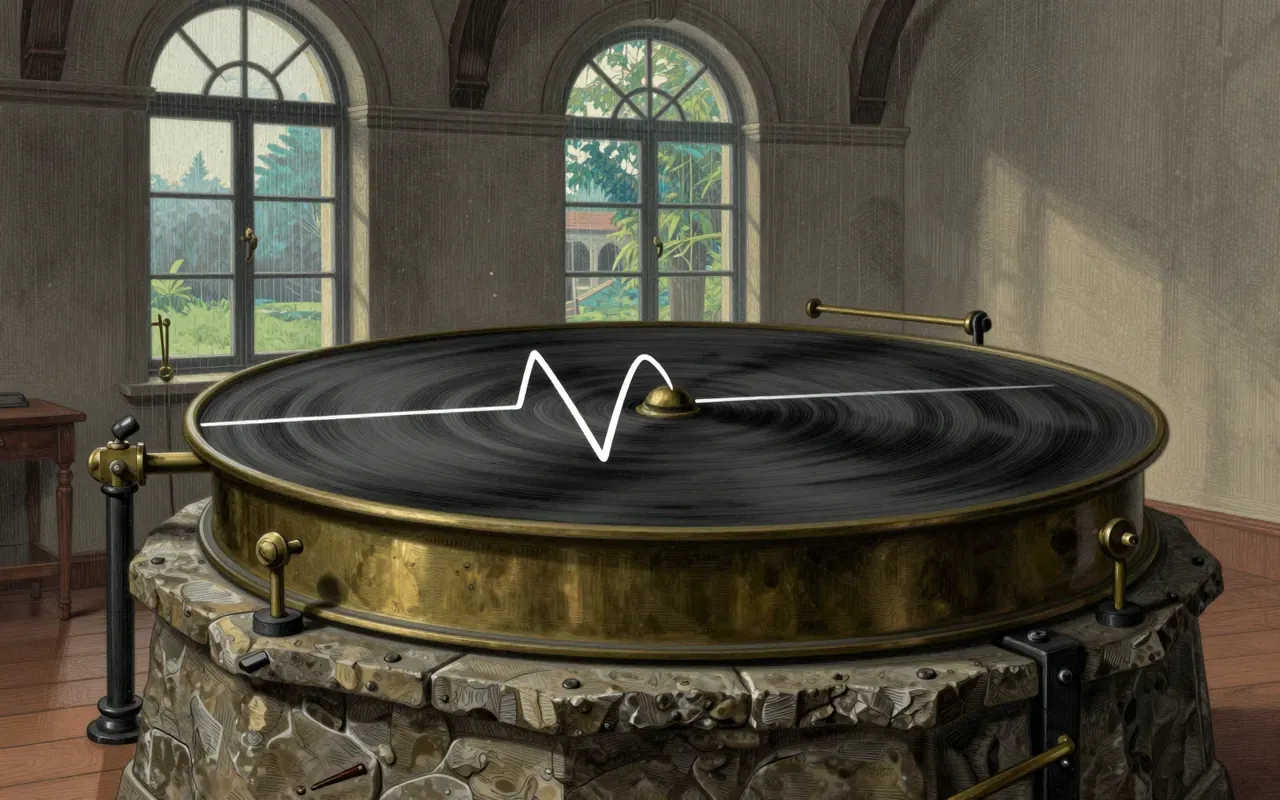
The breakthrough that actually produced usable, reliable readings came in Japan in 1880, when John Milne, working with James Alfred Ewing and Thomas Gray, built the first horizontal pendulum seismometer, a design substantially more sensitive and practical than Forbes’ earlier attempt. Ewing’s version of the instrument produced the first true seismogram on 3 November 1880, and a separate design by Filippo Cecchi produced the first genuinely usable seismogram in 1887. The term seismometer itself had already been coined decades earlier, in 1841, by David Milne-Home, well before an instrument existed capable of living up to it in practice.
Reading the planet’s insides
Once reliable instruments existed, seismic waves became a way to study the planet’s interior rather than only its surface tremors, since the way vibrations from an earthquake bend and travel through different layers reveals what those layers are made of. In 1889, Ernst von Rebeur-Paschwitz recorded the first teleseismic signal, an earthquake in Japan detected all the way in Potsdam, Germany, demonstrating that seismic waves could be tracked across enormous distances. Harold Jeffreys used this kind of data in 1926 to establish that Earth’s core is liquid, a conclusion Inge Lehmann refined further in 1937 by identifying a distinct solid inner core within that liquid layer, entirely from analysis of how seismic waves bent and reflected as they crossed the planet.
From earthquakes to nuclear tests
Modern seismometer networks, typically recording ground motion along three separate axes and sensitive across an enormous range of frequencies, now serve well beyond their original purpose of detecting earthquakes. Because seismic waves travel considerably faster than the tsunami waves an undersea earthquake can trigger, the same networks provide tsunami warnings, and the sensitivity that catches a distant earthquake also picks up underground nuclear test explosions, work now formalised through the International Monitoring System. This is worth an hour for the nearly two-thousand-year gap between Zhang Heng’s bronze dragons correctly identifying a real, unfelt earthquake and the modern instruments doing the same job with far more precision.