A statistical shortcut for wheel setting
Colossus was built to speed up one specific task: working out the starting positions of the wheels on the German Lorenz cipher machine for a given intercepted message, a job cryptanalysts at Bletchley Park called wheel setting, done by statistically comparing patterns in the ciphertext rather than by any direct decryption. The task had already been attempted with a slower relay-based device that could not keep pace with the volume of high-level German traffic being intercepted. The claim behind Tommy Flowers’s design, unusual for the time, was that an electronic machine built from thousands of thermionic valves could do this job fast and reliably enough to matter, at a moment when most engineers working on wartime code-breaking equipment assumed valve counts in the low hundreds were close to the practical limit for a machine that had to keep working.
Flowers’s unconventional bet
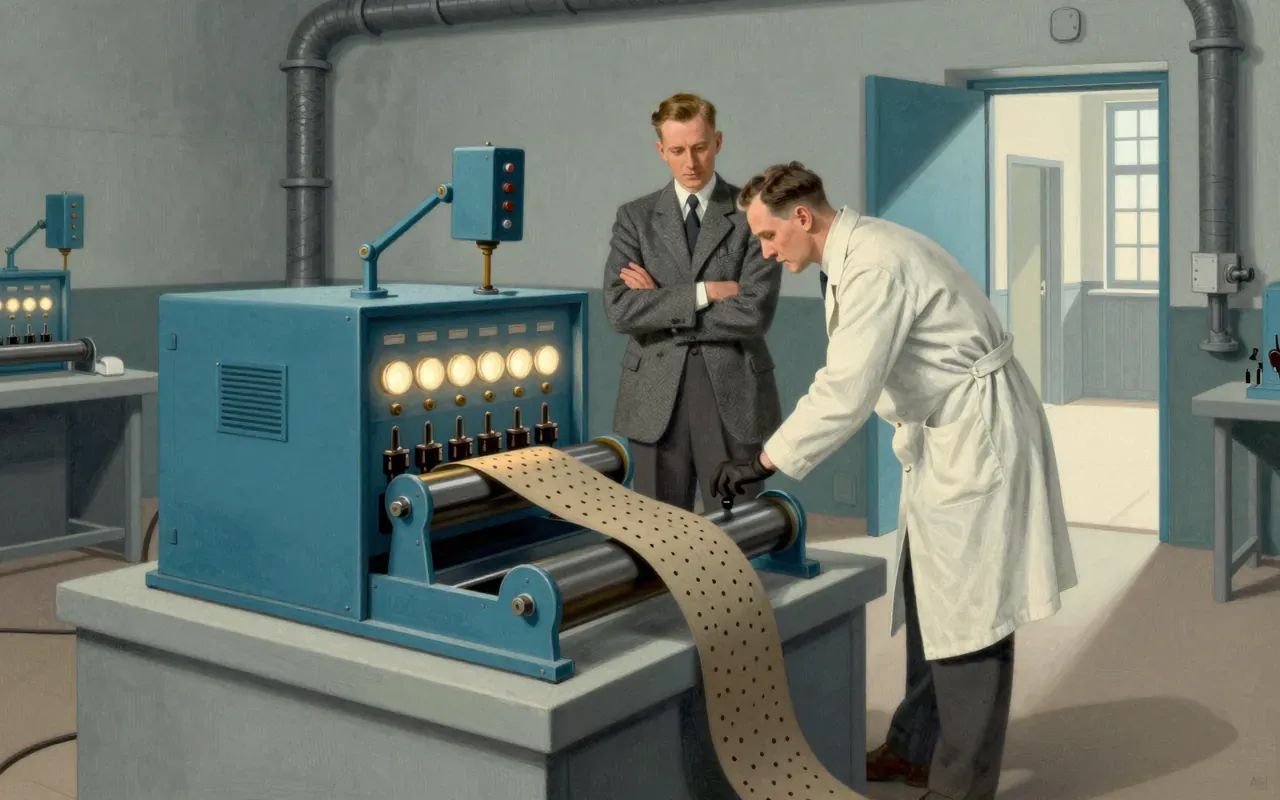
Flowers built his case on experience rather than theory: before the war he had already used several thousand valves at once in reliable telephone trunk circuits at the Post Office Research Station in Dollis Hill, which put him in a position few other British engineers were in to argue that a machine using far more valves than anyone had previously tried could still be dependable. Designed between February and December 1943 and completed that December, the first Colossus used roughly fifteen to sixteen hundred valves and had no working memory at all, reading its data instead from loops of punched paper tape at high speed and testing possible wheel settings by statistical comparison as the tape ran. It became operational at Bletchley Park in early 1944, and an improved version with 2,400 valves followed that June, in time to support the intelligence effort around the Normandy landings.
What the wartime record confirms
Its wartime record settles the practical question completely: ten machines were running by the end of the war, breaking Lorenz traffic and supplying substantial high-level intelligence through the war’s final two years, and the underlying engineering bet, that thousands of valves could be run together continuously and reliably, held up without qualification. Once its existence became public knowledge decades later, historians of computing were able to assess it against other early machines, and it is now generally regarded as the first programmable, electronic, digital computer, distinguishing it from earlier electromechanical designs and from the larger valve-based machines that followed it elsewhere after the war, whose scale it had anticipated years in advance.
Not quite general-purpose
What does not hold up is the idea that a single Colossus was a fully general-purpose computer in the modern sense. On its own it was not capable of simulating any computation a Turing machine could perform; that property was only shown, decades afterward, to hold for a cluster of the ten wartime machines working together rather than for any one of them alone. Its place at the root of computing history is also more complicated than the “first computer” label suggests, because the machine and its design were kept secret for roughly thirty years after the war, so the engineers who built the computers that followed in the late 1940s and 1950s were working from separate, independently developed ideas rather than from anything Colossus had demonstrated.
Thirty years of silence
The scale of the secrecy is itself part of the story. All but two of the twelve machines built were dismantled soon after the war, the remaining pair were later destroyed as well, and Flowers was ordered to destroy the technical drawings and plans, which he did. The full picture did not become public until a 1974 book broke the wider silence around Bletchley Park, an academic paper followed in 1977, and the detailed technical documentation was not released in full until the year 2000. A working replica, built between 1993 and 2008 and now on public display, has since let the machine’s real capability be tested directly, including a 2007 exercise in which the rebuilt Colossus was heavily outpaced by an amateur’s ordinary modern laptop, a comparison that still leaves its actual wartime processing speed as a genuine achievement for 1944.
Is it worth your time
This is worth understanding because it is a case where secrecy, rather than any technical failure, is the reason a genuinely pioneering machine is not better known as the origin point of electronic computing, and untangling that separates the real engineering achievement from the historical accident of who got credit and when. Readers interested in how wartime pressure can force an unconventional engineering bet, thousands of valves where convention said hundreds, will find a clear and well-documented case here. It is a smaller reward for anyone hoping Colossus turns out to be the hidden ancestor of the computer on their desk, since the thirty years of silence meant that later designers, working in the open, built the lineage that actually led there.