What the work claims
Hooke claimed empirical regularities across scales — from spring tension to planetary motion — and used instrumentation to extend human perception into the microscopic and celestial realms. His work treated observation, illustration, and mechanical analogy as interlocking tools of natural philosophy.
How it was done
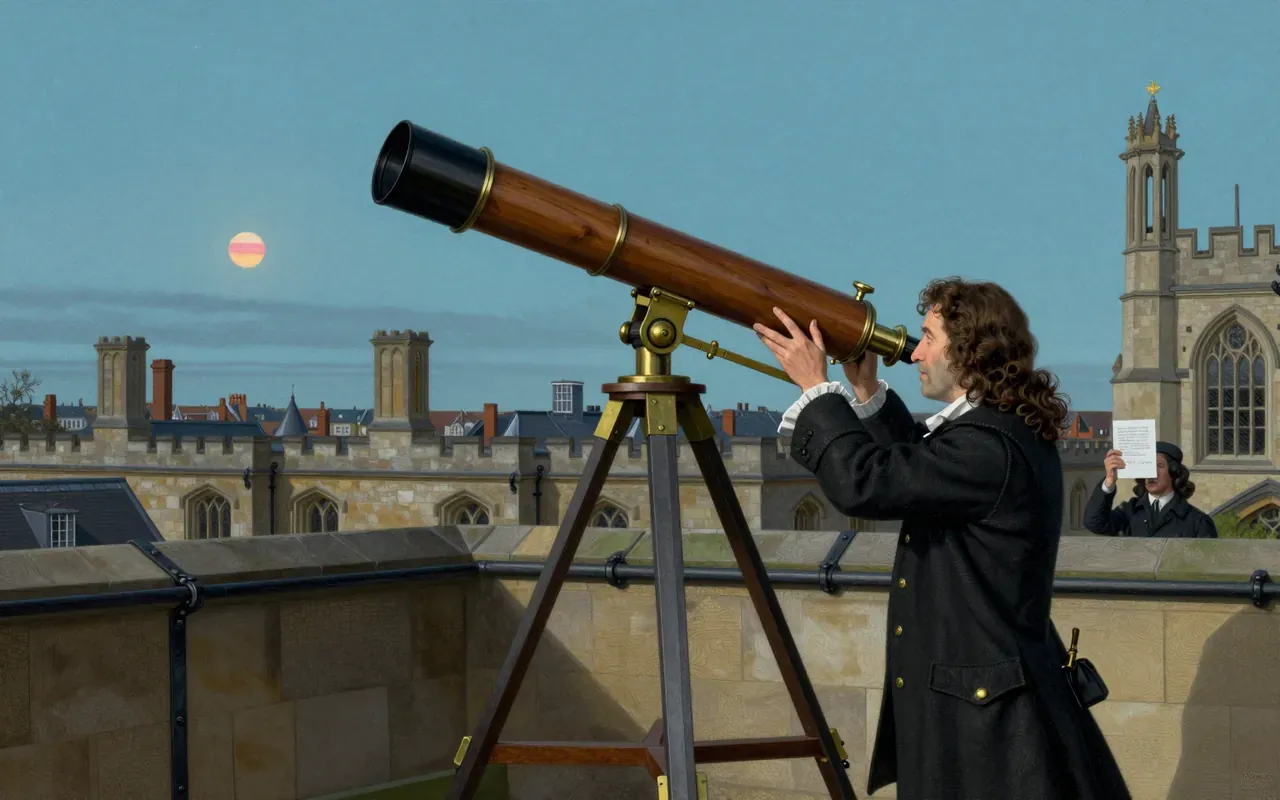
Hooke used instruments he designed or operated: a compound microscope in 1665 for biological observation; a 12 ft refracting telescope in May 1664 to track Jupiter’s Great Red Spot; and telescopic and illustrative methods to map the Pleiades and lunar craters. He recorded findings visually and textually in Micrographia (1665).
What holds up
Six verified results hold: coining ‘cell’ in Micrographia (1665); identifying rotations of Mars and Jupiter in 1664; observing Jupiter’s Great Red Spot with a 12 ft telescope in May 1664; discovering Gamma Arietis (a visual binary) in 1664; illustrating the Pleiades and lunar craters in Micrographia; and discovering the law of elasticity in 1660.
What does not
The material does not support claims that Hooke formalised gravitational theory, measured lunar gravity quantitatively, proved the Moon has an atmosphere, or established cellular function. It says nothing about his law of elasticity being experimentally validated beyond its statement, nor about his inverse-square hypothesis being tested.
Why it matters beyond the lab
Hooke demonstrated that disciplined instrumentation could yield reproducible, shareable facts — not just speculation. His Micrographia made microscopy a public, visual science. His celestial drawings anchored astronomical observation in evidence, not authority.
Is it worth your time
Yes. Hooke’s verified work establishes him as a rare multi-domain experimentalist whose direct observations and instrument design shaped microscopy, planetary astronomy, and mechanics — all within a single decade.