An infectious agent with no genes
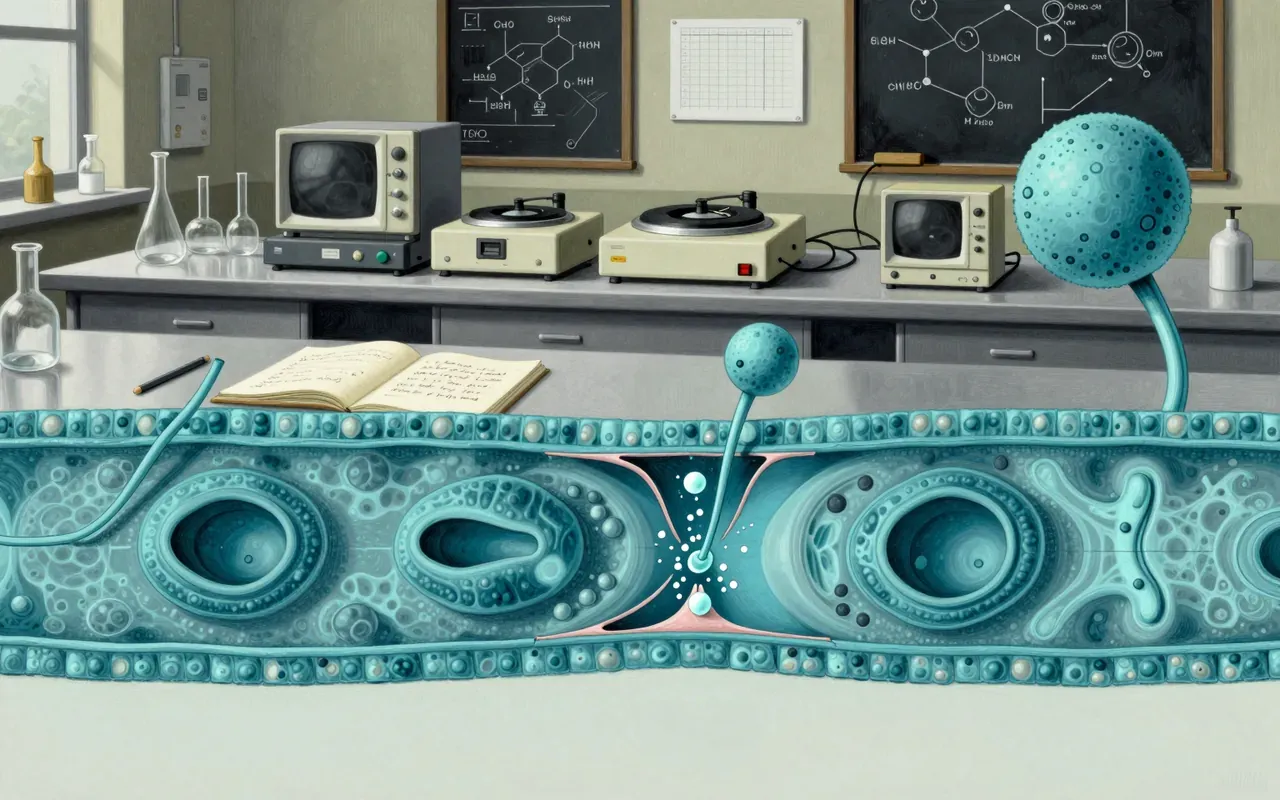
Stanley Prusiner’s claim, developed from the early 1970s and named in 1982, was that the infectious agents behind diseases such as scrapie, bovine spongiform encephalopathy and Creutzfeldt-Jakob disease were not viruses or any other nucleic-acid-based pathogen but self-replicating misfolded proteins, which he termed prions — combining protein and infection. This directly contradicted the assumption, treated as close to axiomatic in biology at the time, that transmitting an infection or a heritable trait required DNA or RNA to carry the necessary information. Prusiner’s claim was that a protein alone, by converting normal copies of the same protein into its own abnormal shape, could act as an infectious and self-propagating agent without any genetic material being involved in the process at all.
Theory before the protein was purified
The idea had theoretical groundwork before Prusiner: in the 1960s, Tikvah Alper and John Stanley Griffith had already proposed that the scrapie agent might be a protein rather than a virus, partly because it survived doses of ionising radiation that would destroy nucleic acids, and partly because a protein-only mechanism could plausibly convert normal molecules into abnormal ones without needing to replicate genetic instructions. Prusiner’s own contribution was experimental: purifying the infectious agent from diseased tissue and demonstrating it behaved as a protein, work he announced in 1982 and that colleagues completed isolating in the two years following. The proposed mechanism itself involves the abnormal form, called PrPSc, contacting the normal form, PrPC, and inducing a conformational change — increasing beta-sheet structure at the expense of alpha-helix structure — that converts the normal protein into more of the abnormal, infectious form.
Resistance built into the evidence
The protein-only mechanism is now the accepted explanation for a defined family of diseases, and it has held up against the objection that seemed strongest at the time: that a protein alone could not plausibly account for the biological specificity and apparent strain variation seen in these diseases. It also held up against physical scrutiny — prions resist heat, ionising radiation, standard protease treatment and formaldehyde, which is exactly the resistance profile the protein-only hypothesis, unlike a nucleic-acid-based agent, would predict. Genetic evidence has reinforced the picture rather than complicating it: a polymorphism at codon 129 of the PRNP gene affects susceptibility, with one genotype roughly five times more likely to develop sporadic Creutzfeldt-Jakob disease than another, showing that host genetics shapes vulnerability even though the infectious agent itself carries no genetic material of its own.
A gap the simplest model couldn’t close
The mechanism is not fully settled at the level of detail: the material notes that a purely protein-only conversion, modelled as a simple one-to-one interaction, would require an implausibly effective catalytic process — a discrepancy calculated at roughly a factor of ten to the fifteenth — which pointed to something missing from the simplest version of the hypothesis. Later work identified cofactor molecules, including phospholipids and polyanions, as apparently necessary for high infectivity in laboratory conditions, meaning the protein-only story as originally stated required amendment rather than standing exactly as first proposed. It should also be kept separate from more recent findings the material mentions — prion-like mechanisms suspected in Alzheimer’s, Parkinson’s and ALS — which extend the general idea of self-propagating misfolded proteins but are not themselves established prion diseases in the sense Prusiner originally defined.
Beyond one family of diseases
Accepting that an infectious agent can be a protein with no genetic material changed what counts as a possible mechanism of disease transmission, which is why prion-like self-propagation is now considered, cautiously, as a possible contributing mechanism in neurodegenerative diseases far more common than any classical prion illness. Practically, it also changed how healthcare and food-safety systems treat contamination risk, since prions survive standard sterilisation methods that reliably destroy viruses and bacteria, and the material notes that specific protocols using sodium hydroxide or sodium hypochlorite are recommended precisely because ordinary sterilisation is not enough. The bovine spongiform encephalopathy outbreak and its human variant of Creutzfeldt-Jakob disease made this a matter of public health policy rather than a purely academic dispute, since it directly shaped food safety regulation around animal feed and tissue handling.
A heresy that needed a decade
This is worth the time as a case study in a genuinely heretical scientific claim turning out to be correct: Prusiner’s own description of the idea as heretical when he introduced it is not exaggeration, since it contradicted a near-universal assumption about how biological information is transmitted, and the material is candid that the hypothesis needed both later refinement — the cofactor evidence — and years of resistance before the 1997 Nobel Prize confirmed its acceptance. It is less rewarding if what’s wanted is a settled, tidy mechanism, since even the accepted version still carries open questions about cofactors and about how far prion-like behaviour extends into other neurodegenerative diseases. Read it for the shape of the scientific argument as much as for the diseases themselves.