73 seconds after launch
On the morning of 28 January 1986, Space Shuttle Challenger launched into unusually cold conditions, with the right solid rocket booster measured at 8 degrees Fahrenheit, far colder than any prior shuttle launch. Seventy-three seconds into flight, at an altitude of roughly 46,000 feet, the vehicle broke apart, killing all seven crew members aboard. The cause traced to an O-ring seal in the right booster’s aft field joint, a rubber component whose job was to prevent hot pressurised gas from escaping past a joint in the booster casing. In the cold, the O-ring had stiffened and lost the flexibility it needed to seal properly, allowing gas to leak through, burn into the external fuel tank’s attachment strut, and ultimately trigger the structural failure of the entire vehicle as it passed through roughly Mach 1.92.
A warning given the night before
The failure was not a surprise to everyone involved beforehand. The evening before launch, engineers at Morton Thiokol, the contractor responsible for the solid rocket boosters, held a teleconference in which Roger Boisjoly and Allan McDonald argued against launching at all unless temperatures rose above 53 degrees Fahrenheit, the coldest temperature at which the O-ring seals had previously performed successfully in an actual flight. NASA manager Lawrence Mulloy pushed back on that recommendation, and under the resulting pressure, Morton Thiokol’s own management reversed its engineers’ position and authorised the launch to proceed, a decision made the night before conditions turned out to be colder still than the very threshold the engineers had already flagged as risky.
A recommendation reversed under pressure
The technical explanation for the disaster held up completely under investigation: the O-ring did fail as a direct result of cold-weather stiffening, exactly as the Thiokol engineers had warned it might. President Reagan appointed the Rogers Commission, chaired by William Rogers, to investigate, and its June 1986 report confirmed the O-ring failure as the immediate cause while extending its analysis considerably further, describing the disaster as an accident rooted in history rather than a single unforeseeable mistake, since NASA and Thiokol had known about weaknesses in the O-ring joint design as far back as 1977 and had never adequately resolved them, allowing the same known risk to persist across dozens of successful launches until conditions turned unusually severe.
Feynman and the ice water
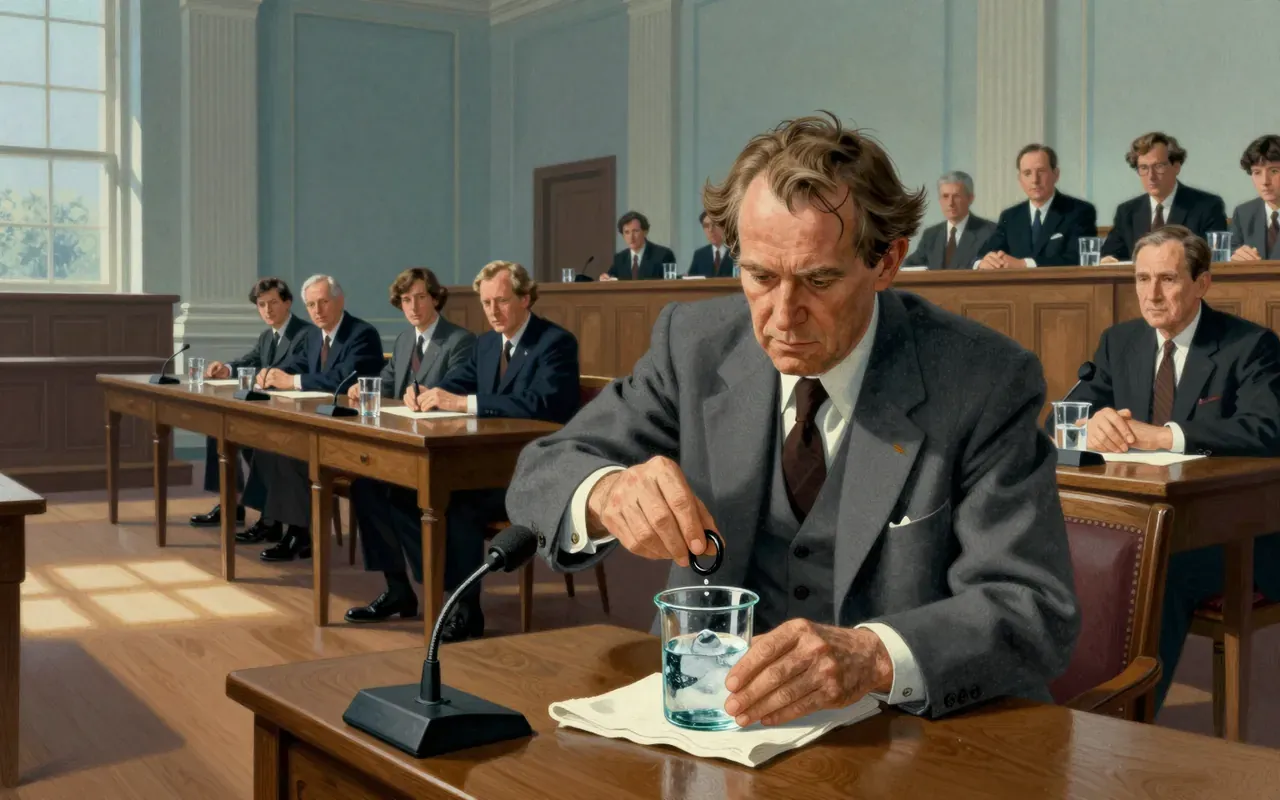
What the commission’s investigation revealed most starkly was a communication failure between the engineers who understood the risk and the managers who made the launch decision. Physicist Richard Feynman, serving on the commission, produced its most widely remembered moment, a televised demonstration in which he dropped a sample of O-ring material into ice water and showed it had lost its resilience, making a technical failure mode visible to a nonspecialist audience in a way documents alone could not. Feynman also uncovered a striking discrepancy in how risk had been represented within NASA: management’s public estimate put the odds of catastrophic failure at one in 100,000, implying a shuttle could launch daily for 274 years and expect only one accident, while engineers closer to the hardware gave private estimates ranging from one in 50 to one in 200, a gap Feynman took as evidence that honest risk assessment had broken down well before the launch decision.
A gap between engineers and management
The consequences extended well beyond the immediate technical fix. The shuttle program was grounded for 32 months while the solid rocket boosters were redesigned with new capture features intended to prevent the kind of joint rotation that had allowed gas to escape in the first place, and NASA established a new Office of Safety, Reliability, and Quality Assurance in response to the commission’s findings about internal communication failures. Commercial satellite launches were shifted away from the shuttle toward expendable rockets, reducing the pressure to maintain an ambitious flight schedule that some accounts of the disaster’s context connected to the willingness to accept marginal risk. Feynman’s own minority report, appended separately to the commission’s findings, closed with the observation that reality must take precedence over public relations, since nature itself cannot be persuaded by favourable messaging.
History rather than an isolated mistake
This is essential reading, not primarily for the technical detail of how an O-ring fails in cold weather, though that detail matters, but for what it demonstrates about how organisations can possess accurate warnings and still act against them under schedule and institutional pressure. The specific numbers, the 53-degree threshold, the 8-degree launch temperature, the wide gap between management’s and engineers’ risk estimates, turn an abstract lesson about organisational failure into something concrete and checkable. Anyone working in engineering, safety, or any field where technical warnings compete with schedule or political pressure will find this a genuinely useful case study, not merely a historical tragedy to mourn.