Random mutation or induced response
In 1943, Salvador Luria and Max Delbrück set out to resolve a specific, contested question about bacteria: when a bacterial population becomes resistant to a virus, does that resistance come from a mutation that occurred randomly at some point before the bacteria ever met the virus, or does contact with the virus itself somehow induce the resistance directly in cells it touches? The two possibilities corresponded to genuinely different pictures of how evolution works, one in which selection acts on variation that already existed beforehand, and one in which the environment produces the adaptation it then rewards, and nothing about bacteria at the time made it obvious which picture applied to them.
Bacteria, a virus, and separate tubes
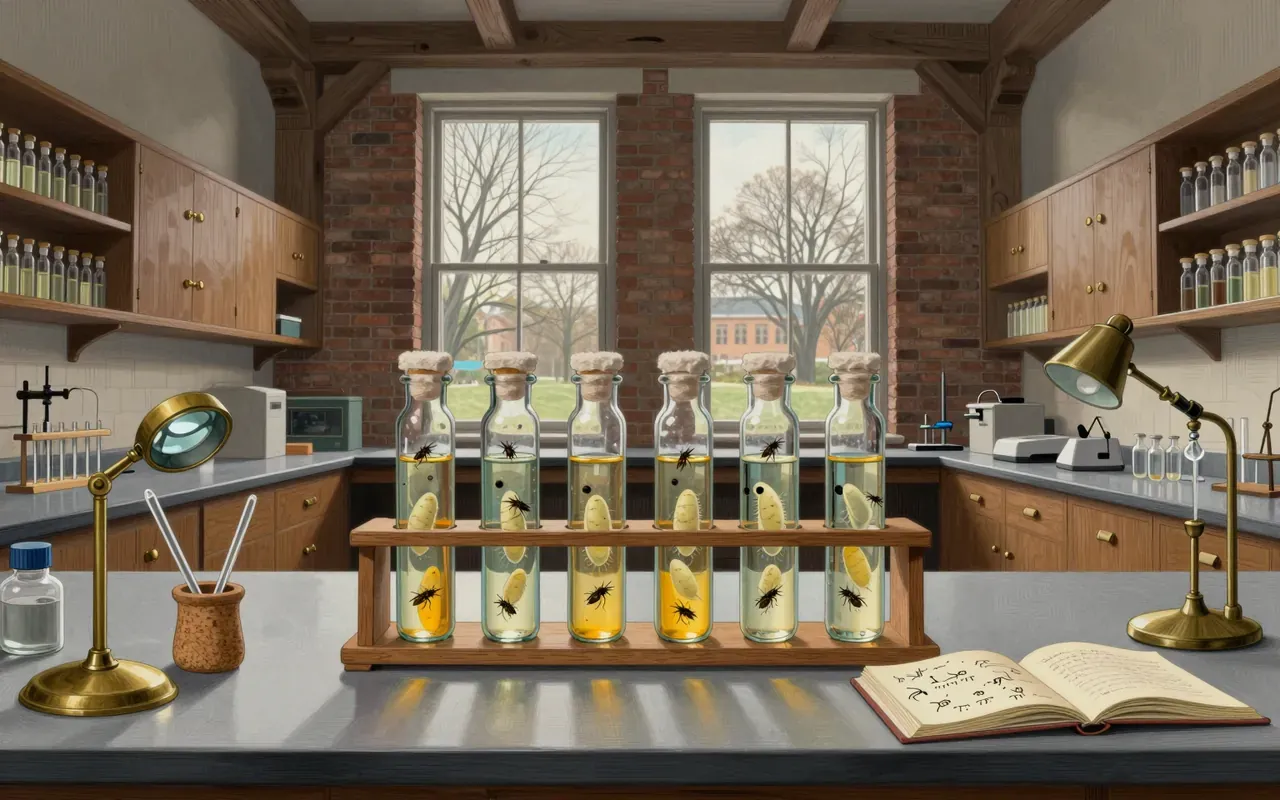
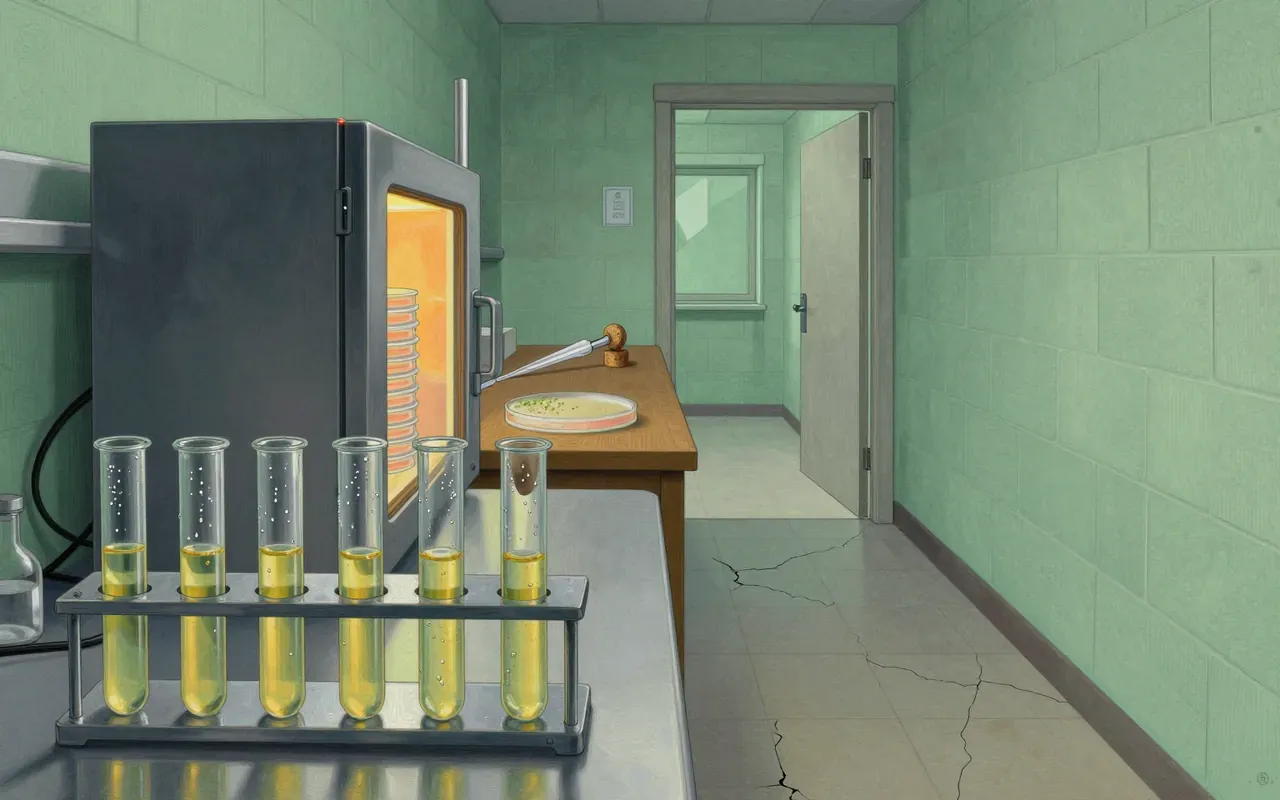
Their method relied on counting rather than any new instrument. They grew a number of separate, independent cultures of Escherichia coli, starting each from a small number of cells and letting it grow for a period, then plated equal volumes from each culture onto agar containing the bacteriophage T1, a virus that kills susceptible bacteria on contact. If exposure to the virus were what caused resistance, every plate should show a similar, fairly modest number of resistant colonies, since each culture had received the same exposure to the same virus at the same time. If instead resistance arose from mutations occurring randomly during each culture’s earlier, ordinary growth, then the timing of those chance mutations would matter enormously to the final count.
A spread too wide for chance alone
The results matched the second picture. The number of resistant colonies varied wildly from plate to plate, with some showing large jackpots of survivors and others almost none, a pattern of variance far exceeding what a uniform, virus-induced response would produce, which should have followed a distribution with variance close to its mean. That kind of unevenness makes sense only if an early mutation in one culture’s history had time to multiply into a large resistant population before plating, while a culture where the same mutation happened to arise late, or not at all, would show few or no resistant colonies. Delbrück worked out a probability distribution, since named for both researchers, that matched this pattern of wide fluctuation mathematically, turning a striking but qualitative impression into a precise, checkable statistical claim.
Delbrück does the math
What the experiment settled was specifically the mechanism question: mutations conferring resistance to the virus arise randomly during ordinary bacterial growth, independent of the virus, and exposure to the virus afterward only reveals which cells already happened to carry that mutation rather than causing it. It did not, on its own, explain what a mutation actually is at the molecular level, a question that later genetics would take up separately, and its direct evidence concerned this one case, bacteriophage resistance in a particular bacterium, rather than a sweeping claim covering every trait in every organism. The strength of the result lies in how cleanly it distinguished two specific, competing predictions, not in how far its scope extended beyond that comparison.
Bacteria obey Darwin too
The finding mattered well past this one virus and this one bacterium because it settled a genuinely open question about whether the basic logic of Darwinian evolution, selection acting on variation that already existed before the environment intervened, held for single-celled organisms as much as for plants and animals. Bacteria reproduce far faster than the organisms Darwin had studied and live in intimate, continuous contact with whatever might be killing them, and it had not been obvious in advance that the same evolutionary rules would apply. The fluctuation test showed that they did, extending natural selection’s reach down to the simplest organisms being studied and helping lay the statistical groundwork for the emerging field of bacterial genetics.
A Nobel, decades later, for something broader
Luria and Delbrück, together with Alfred Hershey, went on to share the 1969 Nobel Prize in Physiology or Medicine, though the prize citation recognised their broader body of work on the replication and genetic structure of viruses rather than the fluctuation test specifically, a reminder that a result can shape how an entire field thinks well before, or even separately from, the achievement that eventually wins it formal recognition. This is worth an hour for how a small, countable difference, resistant colonies bunched heavily on a few plates and nearly absent on others, was enough on its own to settle a real dispute about how evolution operates at the smallest biological scale available at the time.