sciencebriefs
all subjects →
10:50in productionCh. 1 · One Physics for All/ 10:50 · ceiling 15 min
Physics · Astronomy & space

Isaac Newton

Newton didn’t discover gravity — he discovered that the same mathematics explains an apple and a moon.

Newton’s Principia established universal gravitation and laws of motion as predictive tools — not metaphysical truths. It succeeded where predecessors failed: by linking calculation to observation across scales. Its power lies in what it delivered — derivations, explanations, instruments — not what it claimed to be ultimate.

Chapters & takeaways4
  1. 1:16
    One Physics for All

    Newton unified heaven and Earth under one set of mathematical laws.

  2. 2:59
    Predictions That Stuck

    His predictions — from tides to Earth’s shape — were tested and confirmed by others.

  3. 4:33
    Solved, Then Stalled

    He solved the two-body problem — then exposed the limits of his own method with the three-body problem.

  4. 6:20
    Tools Before Truth

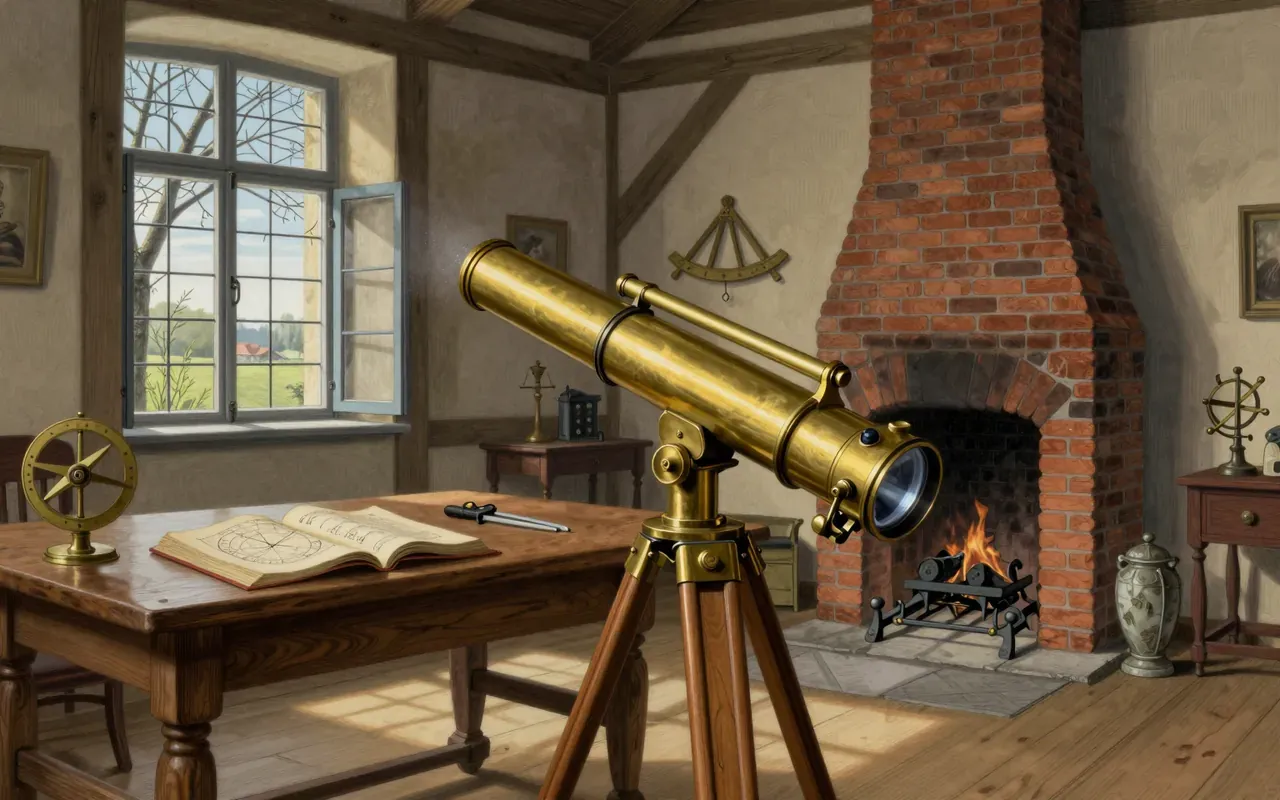
    He built instruments, ran experiments, and grounded theory in observation — from prisms to telescopes to Earth’s age.

Worth your time?

Yes. Study the whole thing.

4.5/ 5
What works
  • Principia
  • prism-experiments
  • reflecting-telescope
  • Earth-age-calculation
What does not
  • relativity
  • quantum-mechanics
  • proof
  • consensus
Study it if
  • engineers
  • astronomers
  • historians-of-science
Skip it if
  • quantum-theorists
  • biologists
The written brief1 min read

What the work claims

That terrestrial and celestial motion obey identical mathematical principles. That gravity governs tides, comets, precession, and planetary orbits. That white light is composed of colours with distinct refrangibility.

How it was done

Newton derived universal gravitation and laws of motion in the Principia. He solved the two-body problem. He used prisms to observe differential refraction of colours in 1666. He built the first functional reflecting telescope. He calculated Earth’s age experimentally.

What holds up

Newton’s derivation of Kepler’s laws from gravity holds. His inference of Earth’s oblateness holds — confirmed by Maupertuis, Clairaut, and La Condamine. His conclusion that colour is intrinsic to light holds — based on prism dispersion in 1666.

What does not

The Principia does not prove gravity is a force acting at a distance; it models its effects. It does not explain why mass generates gravitational attraction. It does not resolve the three-body problem — only introduces it.

Why it matters beyond the lab

It replaced qualitative cosmology with quantitative prediction. It enabled precise navigation, satellite trajectories, and geodetic surveying. It made physics a discipline of testable, universal law.

Is it worth your time

Yes. Newton’s work established the first unified, mathematical framework for physical explanation — one that still underpins engineering, orbital mechanics, and geodesy today.
Same field · Physics4 of 114
Up next in Science

Ivan Pavlov

· 10:06

Pavlov won the Nobel Prize for stomach surgery — not salivation. The dog’s drool was a footnote, not the finding.

10:06